
❐ BD Digest Desk
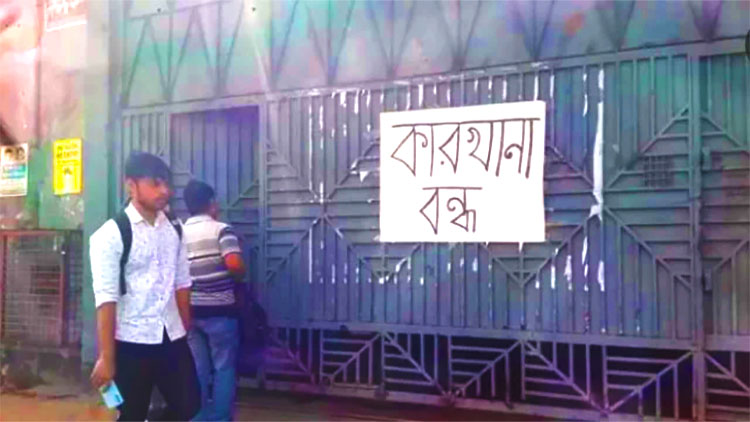
Unique Designers and Unique Washing Limited in Gazipur’s Board Bazar area has been declared permanently closed due to various reasons including financial crisis. As a result, about 2,200 employees of the company, including 1,700 workers, have become unemployed.
The industrial police said the factory has been closed since June 16.
Meanwhile, in a tripartite meeting held with the owners, it was decided to pay all legal dues, including arrears of wages and job-related benefits, to the workers by July 27th.
According to industry-related organizations, such incidents are not isolated. A total of 457 factories in 7 industrial areas have been permanently closed from August 2024 to June this year.
Analysis of data from industrial intelligence and related agencies shows that out of 457 factories, 205 have closed due to lack of sufficient purchase orders and 190 have closed due to the financial crisis of the owner.
This means that the main reason for the closure of 86.43 percent of factories is the lack of sufficient work and the financial crisis of the owner.
In addition, 11 factories have closed due to worker dissatisfaction, while 51 factories have been permanently closed due to political reasons, banking complications, gas and electricity shortages, shortage of raw materials, and factory relocations, among other reasons.
Industrial police sources say that in most cases, factories are being closed with notices as per the labor law. However, the crisis is arising due to delays in paying workers’ dues.
The source said that although the process of closing down with notice is legal, in many cases salaries, service benefits and other dues are not paid on time. This creates resentment among the workers and necessitates administrative intervention to control the situation.
In addition, in many cases, if the factory closure is not notified in advance, sudden worker dissatisfaction arises, which complicates the situation.
Additional IGP of Industrial Police Gazi Jasim Uddin said, “Most factories are closing down their operations with notices as per the labor law. However, the main problem is the delay in paying workers’ dues. Even though many factories close down with notices, workers’ salaries and other dues are often not paid properly. If commitments are not met within the stipulated time, worker dissatisfaction arises.”
He added, “We try to resolve the issue through discussions between the owners and workers. Although this is not our main responsibility, it is necessary to do this to keep the situation under control. Without prior information, the situation sometimes becomes more complicated.”
The total number of factories in the country’s industrial areas is 10,238. Of these, 124 out of 1,705 factories in Ashulia have been closed. 155 out of 2,764 factories in Gazipur have been closed.
In Chittagong, 119 out of 1,778 factories have been closed. In Narayanganj, 38 out of 1,960 factories have been closed. In Mymensingh, eight out of 293 factories have been closed. In Khulna, six out of 673 factories have been closed.
Seven out of 317 factories in Comilla have been permanently closed. However, no information was available about any factories being permanently closed in the Sylhet region.
According to the information received, out of a total of 457 closed factories, 108 are members of the Bangladesh Garment Manufacturers and Exporters Association (BGMEA). Another organization in this sector, BKMEA, has 35 member factories.
Bangladesh Textile Mills Association (BTMA), an organization of manufacturers of raw materials, yarns and fabrics for ready-made garments, has eight members. There are 19 closed factories under the Bangladesh Export Processing Zones Authority (BEPZA). The number of factories outside any organization is 287. 151 or more than one-third of the permanently closed factories are related to the ready-made garment and textile sector.
Multiple sources in the garment industry say that a long-term shortage of purchase orders and pressure on production costs have reduced the viability of many factories. Uncertainty in order flow in the global market, rising raw material prices and rising domestic production costs have also put pressure on the industry.
The government has already announced incentives to revive closed factories.
According to BGMEA sources, 322 factories have already expressed interest in getting this incentive. Of these, 199 are completely closed, while the remaining 123 are partially closed. The eligibility of these factories to get the incentive is being scrutinized.
BGMEA President Mahmud Hasan Khan said, “The issue of factory closures is not one-sided. Although there are minor discrepancies in the reasons for the closures, the information is correct in most cases. It is not that all factories are closing at once. Some factories are in crisis, some are struggling to survive. It is possible to keep some factories operational through assistance as needed. That initiative is also ongoing.”
Stating that there is a process to determine the actual status of closed factories through third-party audits, he added, “Our activities are ongoing to determine which factories can be kept open and which are in crisis.”
Industry insiders say that many factories are unable to operate due to multiple pressures. Global economic pressures, credit crunch in the banking sector, energy shortages, and rising production costs have created major pressure on the industry.
This has been compounded by managerial weaknesses. As a result, on the one hand, orders are declining, and on the other hand, production costs are increasing, making it difficult to survive.
Bangladesh Chamber of Industries (BCI) President Anwar-ul Alam Chowdhury Parvez said, “This crisis did not happen due to a single reason. It is the result of long-term and multifaceted problems. Initially, there was a shortage of orders, which later turned into a working capital crisis. Many factories could not open LCs, resulting in disruption of raw material import and production.”
Stating that the energy crisis, rising gas and electricity prices, and banking pressure have reduced the competitiveness of the industry, he added, “The global crisis, the impact of the COVID pandemic, the Russia-Ukraine war, and inflation have also affected the industry. Along with this, there is the most recent Middle East crisis. Altogether, there are many reasons behind the closure of factories.”
Industry analysts and experts say that the high level of shutdowns and stagnation seen in the country’s manufacturing sector in recent years is due not only to financial weakness, but also to shrinking market demand, policy uncertainty, and structural weaknesses.
The government is also taking steps to bring back production to factories that are truly in danger. But the most important policy decision now should be to select industries that have the true capacity to survive, rather than providing massive support.
Policy Exchange Bangladesh Chairman and Chief Executive Officer (CEO) Dr. M Masrur Riaz said, “We see the issue of helping distressed factories as a positive one. Because many businesses in the country have been in distress in the last three-four years due to various reasons including the macroeconomic situation, post-Covid situation, and political changes.”
Stating what to do in this situation, he said, “Many institutions can be revived if they receive policy support. However, it would not be right to consider them indiscriminately. Those that have been closed for many years have little chance of being reopened with little support. Because in many cases, their machinery and infrastructure cannot be reopened without complete reconstruction. There are also factories that have been closed recently, and they have a chance of recovery.”
He said, “Targeting is very important in this case. We need to decide who will be the real beneficiaries. We also need to consider the factories that were closed due to political reasons, whether they will be able to return to business at all in the current situation.”
He added that a third-party audit is needed for those selected for assistance, adding, “We need to verify their actual situation and why they closed. Then, assistance should be provided only after creating and validating a recovery roadmap.”

https://stapravda.ru/20221228/reyting_samyh_populyarnyh_hostingov_v_rossii_196445.html, рейтинг хостингов России подтверждает, что выбор надежного провайдера важен для бизнеса.