
-Pritilata Devi, teacher and researcher.
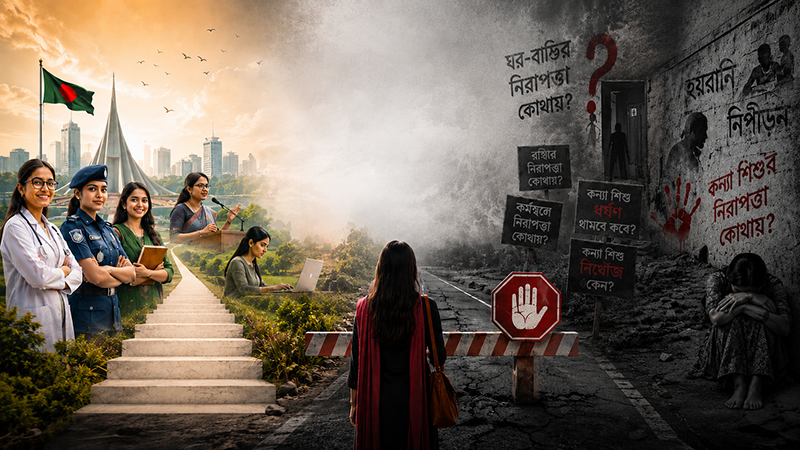
Bangladesh, which was constantly moving forward on the path of women’s empowerment, women’s freedom and women’s participation, suddenly seems to have stopped that progress and we are having to think about women’s safety again. Women’s safety is now in question everywhere, both at home and abroad.
Image before August 2024
Before August 2024, Bangladesh was not only a model of progress for women in South Asia, but also a leader in international indicators. Bangladesh was ranked first among seven South Asian countries in the Global Gender Gap Report 2023. This means that Bangladesh was leading the region in closing the gender gap in important areas such as education, political participation, and empowerment.
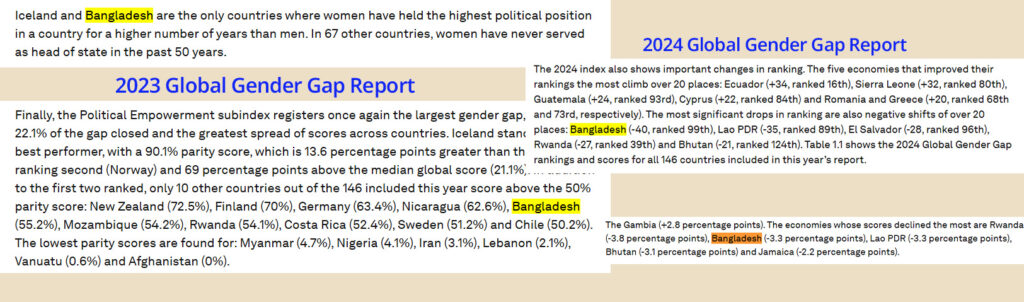
But after August 2024, that picture began to change.
Start of change: August-September 2024
In just one month, from August to September 2024, documented violence against women and girls increased by 27 percent. Rape cases increased from 8 to 13, and gang rapes increased from 7 to 11.
This is not just a change in a few numbers, because at the same time, incidents of public harassment of women and so-called ‘moral policing’ are also coming to light.
2025 forecast: Trends are clearer
Police data shows that rape cases have increased by 27 percent in one year—from 5,566 to 7,068. The total number of cases of violence against women and children has also increased by 25 percent.
But the most dramatic changes are seen in children.
According to the Law and Arbitration Center (LAK), rape and gang rape incidents increased by nearly 76 percent in the first six months of 2025 compared to the same period the previous year—from 250 to 441. This means that it is not just a women’s safety crisis; children are also increasingly at risk throughout this period.
The same is true for rape of female children. In the first seven months, the number of cases increased by almost 75 percent—from 175 to 306. And in just seven months, the number of rapes of female children exceeded the number in the entire year of 2025.
Why this is not an isolated incident
This is where the biggest question arises. Because the increase in the number of any one crime may be an isolated incident. But if rape, child abuse, and open harassment of women – various indicators – show an increase at the same time, then it is difficult to dismiss it as just an isolated crime.
The trend did not stop in 2026 either.
And this trend did not stop in 2026. According to HRSS, various forms of violence against women and girls increased by 56 percent in the first six months of 2026 compared to the same period the previous year.
Added to this is another concern—what women should wear, where they should go, whether they should play sports, whether they should participate in any events—all of which are also being met with public protests and pressure. In other words, the crisis is not limited to the question of ‘how safe are women?’
Key question: Is freedom being curtailed?
The question is – are women able to live in public as freely as before?
So the question becomes clearer when we look at August 2024 not just as a date of political change, but as a before-and-after marker. Why have so many new questions arisen about the safety of women and children and women’s freedom in public spaces in Bangladesh, which was leading South Asia in the women’s progress index before August 2024?
Statistics may not provide the full answer, but it’s hard to deny that they are signaling a change.
One of the yardsticks for measuring a nation’s progress is how safely and freely its women and children can move around in public spaces. Finding answers to the questions that recent statistics raise is now the demand of the hour.
In addition to the security crisis, there is another crisis: women are losing their earning capacity.
In addition to the issue of women’s social security and independence, another issue is equally important—women’s economic empowerment. Because employment and income opportunities provide the greatest foundation for women to share household responsibilities and participate in building society. Recent data shows that this is precisely where women are continuously falling behind—at almost all levels of the labor market.
Women’s position in garments and factories is shrinking
The ready-made garment sector has long been the largest employment sector for women in Bangladesh, but women’s participation in this sector is steadily declining.
- According to recent data, a total of 402 garment factories belonging to BGMEA and BKMEA have permanently closed in the three years from July 2024 to June 2026.
- At least 20,000 workers have been laid off or retrenched in the country in the first six months of 2026, most of them in the garment sector. 19,188 workers have been laid off in the 80 BGMEA member factories alone, of which 27 factories have closed completely.
- According to information from the Industrial Police, 7,784 workers have been laid off in 79 factories in eight industrial zones in the first five months alone.
While the reasons for the layoffs and factory closures in the garment sector include falling purchase orders, strict bank policies, and financial crises, the reality is that this sector historically has the largest number of female workers. As a result, when a crisis occurs in the sector, it has the greatest impact on women’s employment.
Women’s representation in the latest BCS is worryingly low
Not only in the private sector, but also in the highest level of government jobs, the BCS, women’s participation is continuously decreasing.
According to the PSC’s annual report, the percentage of women receiving final recommendations is shown in a sequential manner:
- 34th BCS (2015): 35.63 percent women
- 41st BCS: 26.71 percent women
- 43rd BCS: 19.46 percent women (the lowest rate compared to previous BCSs)
- 44th BCS: 20.17 percent women
- 47th BCS (most recent BCS held after August 5): 22 percent women—only 294 of the 1,334 recommended candidates are women
In other words, while in 2015, about 36 out of every 100 recommended candidates were women, in recent BCSs, it has come down to around 20. PSC Chairman Professor Dr. Mobasher Monem himself admitted that the success of female candidates in recent BCS exams is declining at an ‘alarming’ rate. PSC member Professor Dr. Ferdous Arfina Osman also said that women’s participation in government administration is on a downward trend – currently, the rate of women in government administration is only 29 percent.
In the context of the July 2024 movement, the Supreme Court’s ruling completely abolished several quotas, including the women’s quota; where previously the total quota in government jobs was 56 percent, it was reduced to just 7 percent. Some analysts and PSC officials believe that the impact of the complete abolition of the women’s quota could also be a reason for this downward trend, although they believe that a series of data analysis of several more BCSs is needed to reach a final conclusion on this issue.
The question is so much deeper.
When you put these two images side by side – the shrinking employment of women in garments and factories, and the steadily declining representation of women in the highest government job exams – it becomes difficult to avoid one question.
If women’s earning capacity continues to shrink, both in the private industrial sector on the one hand and at the highest levels of government employment on the other, it is time to consider the question: is it simply a result of economic recession or competition, or is it subtly removing women from active participation in shaping society?
Because taking away earning opportunities is not just about losing a job. It undermines the very foundation of women’s financial independence, decision-making power, and presence in the public sphere. So it’s time to consider the crisis of security and the crisis of economic participation as a holistic trend, not in isolation.

https://stapravda.ru/20221228/reyting_samyh_populyarnyh_hostingov_v_rossii_196445.html, рейтинг хостингов России подтверждает, что выбор надежного провайдера важен для бизнеса.