

In the face of the student-public movement, the Sheikh Hasina government fell on August 5th. The interim government formed thereafter has announced that the International Crimes Tribunal will prosecute the crimes against humanity committed during this movement. However, several questions have arisen regarding the judges and prosecutors appointed by the government to the International Crimes Tribunal.
The International Crimes Tribunal was established in 2010 to prosecute crimes against humanity committed during the 1971 liberation war. Many have been tried and punished by this Tribunal for their crimes against humanity during the war. Trials of several others accused of such crimes were ongoing. After the interim government took responsibility, all judges and prosecutors of the Tribunal resigned. Consequently, new judges and prosecutors were appointed.
Who Are the Judges of the Tribunal?
Days after taking office, the interim government reconstituted the International Crimes Tribunal (ICT), appointing three new judges to oversee its proceedings. Golam Murtaza Mazumdar, a retired district court judge, was named chairman. Mazumdar, who is also among 23 individuals recently appointed as High Court judges by the interim government, is joined on the Tribunal by Moititul Huq Md. Enamul Chowdhury, another retired district and sessions judge, and Shafiul Alam Mahmud, a lawyer who was also recently appointed as a High Court judge.
Concerns have arisen regarding these appointments, particularly the judges’ qualifications. None of the appointees have experience in international law, a critical component of cases involving crimes against humanity. Critics argue that such expertise is essential for handling the Tribunal’s complex legal framework.
Two of the judges are retired district court judges who have not presided over criminal trials in years. Mazumdar, who retired in 2019, has not served as a judge for five years. Despite this, he has been elevated to the status of an appellate division judge as the Tribunal’s chairman. Similarly, Mahmud’s lack of judicial experience is raising eyebrows. Though a practicing lawyer, Mahmud has never served as a judge and is politically affiliated with the opposition Bangladesh Nationalist Party (BNP). In 2019, he was elected to the Supreme Court Bar Association as a BNP representative and remains an active member of the Bangladesh Nationalist Lawyers’ Forum.
The appointment of a politically aligned individual to such a sensitive position has sparked further concerns about impartiality, even if Mahmud is capable of independent judicial decision-making. The absence of prior judicial experience, however, compounds skepticism about his qualifications for this role.
Given the abundance of more experienced High Court judges in Bangladesh, critics question the rationale behind appointing relatively junior figures to oversee a trial of such national and international significance.
Who Are the Prosecutors of the Tribunal?
The government announced the appointment of five Supreme Court lawyers as prosecutors for the International Crimes Tribunal (ICT) on Sept. 5. Mohammad Tazul Islam was named Chief Prosecutor, with Md. Mizanul Islam, Gazi Monowar Hussain Tamim, BM Sultan Mahmud, and Abdullah Al Noman also joining the prosecution team. On Oct. 7, Md. Saimum Reza Talukder was added as a prosecutor, although Mizanul Islam did not assume his role due to health issues.
On Oct. 24, five more prosecutors were appointed to the ICT: SM Moinul Karim, Md. Nure Ershad Siddiqui, Shaikh Mahdi, Tarek Abdullah, and Tanvir Hasan Zoha.
Concerns Over Appointments
Chief Prosecutor Mohammad Tazul Islam is a controversial figure, known for his close association with Jamaat-e-Islami. He previously represented several Jamaat leaders accused in ICT cases. Similarly, Mizanul Islam and Gazi Monowar Hussain Tamim also served as defense attorneys for individuals charged with crimes against humanity.
A former Appellate Division judge, speaking on condition of anonymity, criticized the decision to appoint individuals who had previously defended accused war criminals. The judge argued that such appointments could raise ethical concerns and potential conflicts of interest, calling for a reassessment by the government and higher courts.
Political Affiliations Among Prosecutors
Out of the 11 prosecutors appointed to the ICT, seven are reportedly affiliated with political parties. In contrast, no political ties were found for Abdullah Al Noman, Md. Saimum Reza Talukder, Tarek Abdullah, and Tanvir Hasan Zoha.
The political backgrounds of some appointees have fueled further scrutiny, as the sensitive nature of the tribunal’s cases requires impartiality and nonpartisan appointments.
Profiles of ICT Prosecutors: Controversies and Political Affiliations
Tazul Islam
Tazul Islam, a graduate of the Law Department at Rajshahi University (1991-92 academic year), was reportedly an active member of Islami Chhatra Shibir during his student years, according to anonymous classmates and former leaders of other student organizations. Chhatra Shibir activities at the university between 1992 and 1996 were linked to violence, including the deaths of seven individuals from groups such as the Chhatra Dal, Chhatra League, Chhatra Union, Chhatra Maitri, and the Nationalist Social and Cultural Organization (JASAS).
In his legal career, Islam worked closely with Barrister Abdur Razzak, a Supreme Court lawyer and former assistant secretary general of Jamaat-e-Islami. The High Court canceled Jamaat-e-Islami’s registration in 2013, rendering the party ineligible for elections.
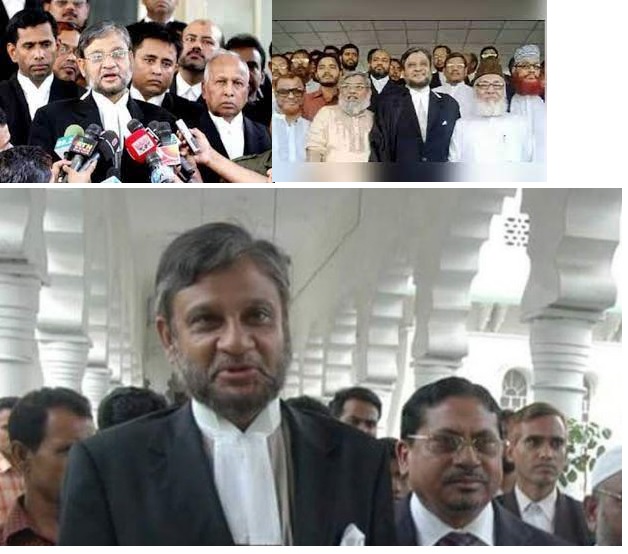
In 2019, reformists within Jamaat-e-Islami formed Jonokankhar Bangladesh, later establishing the Amar Bangladesh (AB) Party in 2020, with Islam serving as joint convenor. Following his appointment as Chief Prosecutor of the International Crimes Tribunal, Islam resigned from his position in the AB Party.
Mizanul Islam
Mizanul Islam, a lawyer associated with Jamaat-e-Islami, has represented several high-profile Jamaat leaders, including former Amir Motiur Rahman Nizami, in cases before the International Crimes Tribunal. Islam, currently residing in Rajshahi, has publicly criticized the tribunal’s judgments.
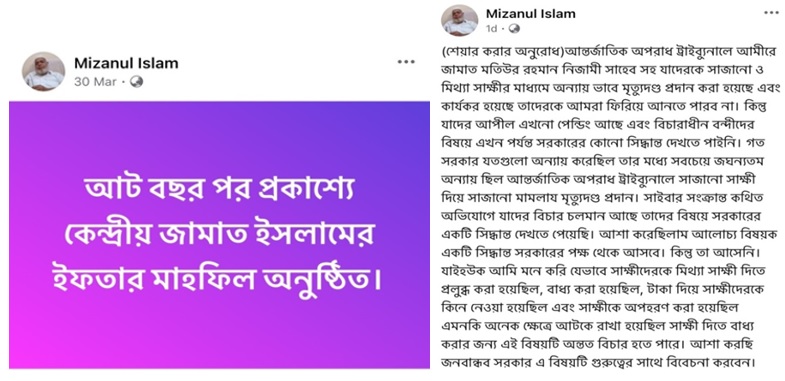
In recent Facebook posts, he alleged that fabricated evidence and false witnesses were used to convict Jamaat leaders, including Nizami, and shared updates about Jamaat’s Iftar events. Despite his initial appointment to the prosecution team, Islam announced that he would not assume the role due to health reasons.
Gazi Monowar Hussain Tamim
Gazi Monowar Hussain Tamim is a lawyer with affiliations to Jamaat-e-Islami. He has served as a defense attorney for several accused individuals, including Jamaat leaders, in cases before the International Crimes Tribunal (ICT). His father, Maulana Gazi Abubakar Siddique, was a member of Jamaat’s Majlis-e-Shura in Bagerhat and ran for the national parliamentary elections three times from the Bagerhat-3 constituency on a Jamaat ticket.
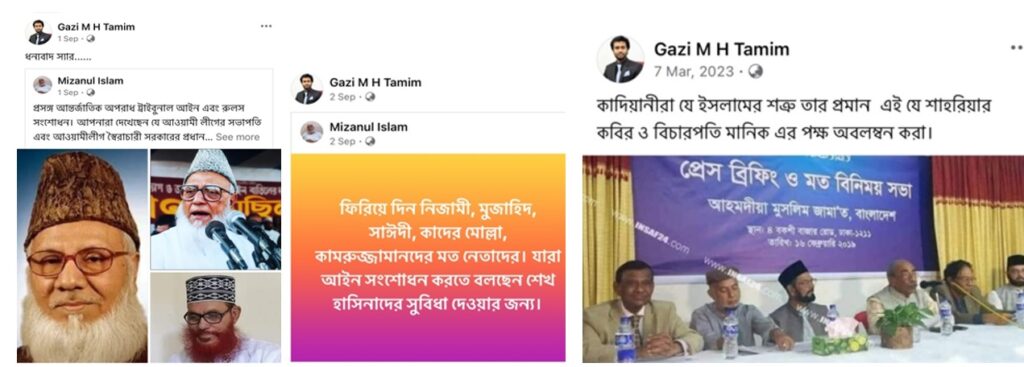
Tamim has shared numerous Facebook posts from Mizanul Islam, referencing Jamaat leaders such as Golam Azam, Motiur Rahman Nizami, Delwar Hossain Sayeedi, Ali Ahsan Mujahid, and Quader Mollah. He also shared a post with the caption, “Qadianis are enemies of Islam.”
B.M. Sultan Mahmud
B.M. Sultan Mahmud is a Supreme Court lawyer affiliated with the Bangladesh Nationalist Party (BNP). He is based in Narail and serves as an advisor to the Narail District BNP. Despite his appointment to the ICT prosecution team, he has retained his BNP position. His Facebook profile reflects his professional and political affiliations.

SM Moinul Karim
SM Moinul Karim, a former activist of Islami Chhatra Shibir, participated in the “General Students’ Rights Council” movement against quotas in 2008 under the caretaker government. The movement was supported by Shibir. Several members of Karim’s family are reportedly involved in Jamaat politics.
Md. Nure Ershad Siddiqui
Md. Nure Ershad Siddiqui, a Supreme Court lawyer, is actively involved in party politics. He serves as a member of the Higher Council of the Gono Odhikar Parishad, led by Nurul Haque Nur, and is the General Secretary of the Lawyers’ Rights Council.
Shaikh Mahdi
Shaikh Mahdi, a graduate of Dhaka University’s Law Department from the 2009-2010 academic session, has been reported by several classmates to have been involved in Islami Chhatra Shibir politics during his time at the university. Additionally, Mahdi is known to have familial and personal connections with several leaders of Jamaat-e-Islami.
A senior Supreme Court lawyer, speaking on condition of anonymity, described the cases handled by the International Crimes Tribunal (ICT) as politically sensitive. The lawyer expressed concerns that the political affiliations of prosecutors, including Mahdi, could undermine the perceived impartiality of the tribunal. They suggested that appointing non-partisan and credible individuals would have helped avoid these controversies and maintain the tribunal’s integrity.
During the Awami League government’s tenure, British journalist David Bergman wrote several critical pieces about the International Crimes Tribunal. As a result, he was even accused of contempt of court. After the interim government appointed Tazul Islam as the Chief Prosecutor, Bergman criticized the decision in multiple posts on X (formerly Twitter).
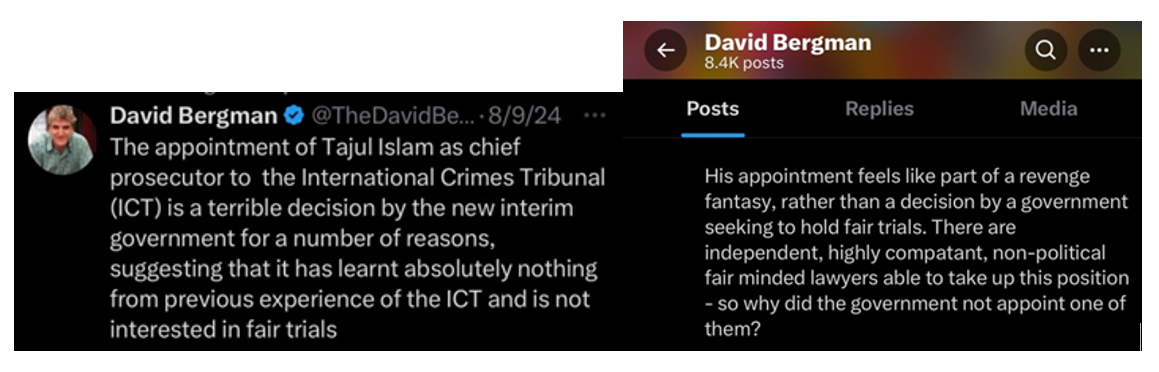
In one of his posts, Bergman wrote that appointing Tazul Islam as the Chief Prosecutor by the new interim government is a bad decision for several reasons. He indicated that this shows the tribunal has not learned from past experiences and has no interest in justice. In the same post, he referred to the appointment as reflecting a “revenge fantasy.”

https://stapravda.ru/20221228/reyting_samyh_populyarnyh_hostingov_v_rossii_196445.html, рейтинг хостингов России подтверждает, что выбор надежного провайдера важен для бизнеса.