
❐ BD Digest Desk
In the post-August 2024 political reality, anti-India sentiment in Bangladesh has reached its peak. The parties in power have capitalized on anti-India sentiment to create division among the common people. This has also affected diplomatic relations.
However, despite all these complications, it has not had a major impact on mutual trade.
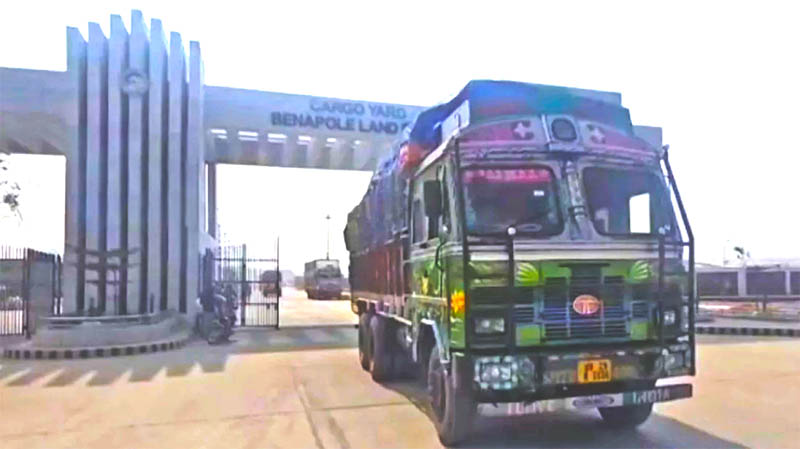
Various conditions have been added by both sides on the import and export of goods, which has hit mainly the land ports located at the border. Amidst all these administrative hurdles, the volume of goods purchased from India has increased significantly, although the sale of Bangladeshi goods in the Indian market has stagnated and is going around in the same circle.
Statistics and trade gap
According to the National Board of Revenue, goods worth $10.96 billion entered the country from India in the 2025-26 fiscal year, up from $9.62 billion in the previous fiscal year. This means that an additional $1.34 billion has been added to the import bill from India in just 12 months.
In contrast, Bangladeshi exports to India in the same fiscal year amounted to $1.75 billion, slightly less than the $1.76 billion in the previous year.
This situation has left the two neighbors with a huge trade imbalance—Bangladesh imports at least six times more goods from India than it exports.
Domestic demand for raw materials and geographical advantages
A significant portion of the raw materials used in Bangladesh’s factories and production come from India. Domestic companies benefit from geographical proximity when importing yarn, cotton, processed fabrics, industrial materials, and agricultural commodities; transportation time is shorter and costs are also more affordable than other sources.
Entrepreneurs in the ready-made garment sector often have to rely on Indian products, especially due to the specific needs of international buyers.
As a result, whatever the political bilateral relations, it is not possible to suddenly stop this supply of essential raw materials. This economic interdependence has been created due to the long border and infrastructural connections with India; therefore, India is Bangladesh’s second largest trading partner after China and the largest market in the whole of South Asia.
Changing the textile sector and import routes
A major proof of this demand is found in the picture of yarn imports from India. According to Shawkat Aziz Russell, president of the Bangladesh Textile Mills Association, about Tk 30,000 crore was spent on buying yarn from India in the 2025-26 fiscal year, which is more than double the Tk 14,000 crore spent last year.
As the constraints on land routes increased, traders chose sea routes as an alternative, and this jump in imports occurred from there.
According to him, some products that used to come through informal land ports in the past are now coming through legal sea routes, giving a clearer picture of the real demand. However, he is in favor of stopping the import of yarn across the border so that domestic textile mills can survive in an unfavorable cost market.
Policymakers now face a two-pronged challenge—on the one hand, maintaining a cheap supply of yarn for garment exporters, and on the other, protecting local mills from extreme competition.
Reasons for India’s export stagnation
The big question now is why Bangladesh is lagging behind in India’s vast market despite continuous increase in imports.
Economists and experts observe that Bangladesh only wants to export ready-made garment-based products, where India already faces extreme competition from domestic and global manufacturers.
M. Masrur Riaz, Chairman of Policy Exchange Bangladesh, identified 3 main reasons for the lag in the Indian market:
- India has its own strong domestic manufacturing system,
- That country’s strict quality control tests and strict standards and
- Absence of integrated regional supply chains
He believes that if the Comprehensive Economic Partnership Agreement (CEPA) is signed, the trade environment can be made easier and more reliable by removing these tariff and non-tariff barriers.
Conflicting decisions and recent events
After the political upheaval of 2024, there were visible changes in the trade policies of the two countries. A brief overview of the course of events:
Duration |
Steps taken and decisions |
| March 2025 | A recommendation was made to ban the entry of Indian yarn by land to protect local industries. |
| April 9, 2025 | India has withdrawn transit facilities for sending Bangladeshi goods to third countries. |
| April 15, 2025 | The NBR banned the entry of Indian yarn through land ports (sea routes remained open). |
| May 17, 2025 | India has imposed restrictions on the import of Bangladeshi garments, jute and agricultural products by land route. |
| June 27, 2025 | India’s land-based restrictions were also extended to some additional Bangladeshi jute and textile materials. |
Despite all these obstacles, trade has not lost momentum. The reality of the economic needs of the two countries has triumphed over political and administrative tensions.
Urgent call for diplomatic solution and normalization
Business leaders have called for the restoration of normal movement through land ports.
BKMEA President Mohammad Hatem believes that dialogue at a higher political level is needed to avoid economic losses.
MA Razzak, head of research institute ‘RAPID’, and Md. Fazlul Haque, administrator of FBCCI, believe that border trade is not just about the exchange of goods, but is part of overall bilateral diplomacy; therefore, it is important to remove the complications through discussions with the goodwill of the top leadership.
Future prospects and bilateral discussions
A glimmer of hope was seen in a meeting with the Indian Chamber of Commerce and Industry (CII) on August 18. The Commerce Ministry said that work is underway to fully normalize trade within the next few months.
Commerce Minister Khandaker Abdul Muktadir has urged the two countries to take advantage of their geographical advantages and remove barriers.
The CII delegation proposed the formation of two joint working groups to invest in Bangladesh’s technology and infrastructure sectors; they also gave positive signals for joint work in emerging sectors such as data centers, green hydrogen, semiconductors and battery storage.
Long-term economic goals
The key challenge for Bangladesh is not to limit trade to just ‘one-way shopping’. Removing temporary border crossing barriers is not the end of the story; it is essential to improve the quality of domestic products, diversify them, and establish joint supply chains to adapt to India’s stringent quality control system.
At the same time, a fine balance must be maintained between the availability of raw materials and the protection of domestic industries. Only if we can increase our own production capacity by purchasing raw materials from India, transfer mutual technology, and increase joint investment, will it be possible to reduce this long-standing trade deficit to the desired level.

https://stapravda.ru/20221228/reyting_samyh_populyarnyh_hostingov_v_rossii_196445.html, рейтинг хостингов России подтверждает, что выбор надежного провайдера важен для бизнеса.