
❐ BD Digest Desk
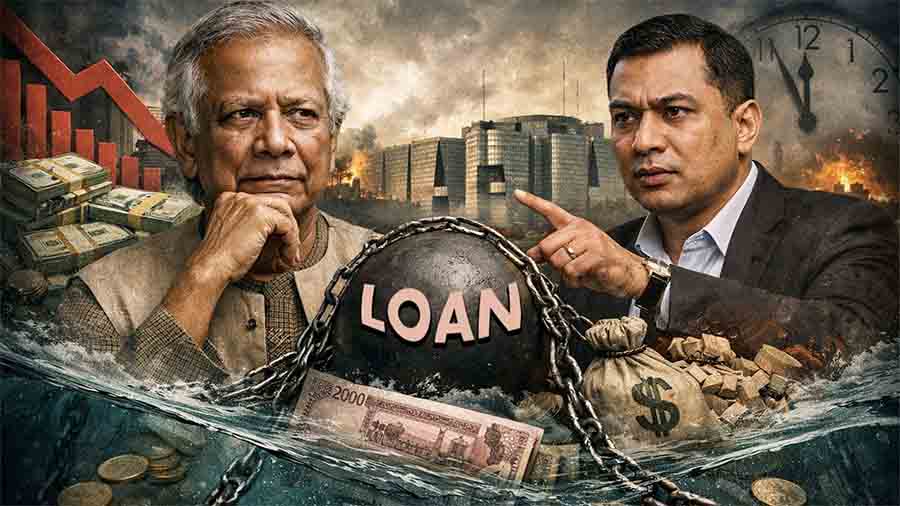
Bangladesh currently has the second-highest non-performing loan (NPL) rate in the world, after war-torn Ukraine. Nearly one-third of the country’s total banking sector loans are now classified as non-performing.
Bangladesh has the highest default rate among SAARC countries, raising concerns about weak debt management, political influence, and failure to collect loans.
According to the latest banking data, war-torn Ukraine tops the global list with a default rate of 37.35 percent. This reflects the massive damage caused to the country’s economy by the ongoing war. Bangladesh is in second place with a default rate of 32.26 percent. Bangladesh is followed by Chad with 31.51 percent and Guinea with 31.15 percent.
The issue came up for discussion at a training session on reducing defaulted loans of state-owned banks organized by the Finance Ministry on Sunday. The managing directors of state-owned banks were present in the session. The meeting was chaired by the Finance Secretary.
According to Bangladesh Bank data, defaulted loans in the country’s banking sector increased by more than Tk 31,000 crore to Tk 589,000 crore in the three months to March.
Among the South Asian Association for Regional Cooperation (SAARC) countries, Bangladesh’s banking sector’s non-performing loans (NPLs) are the most worrisome. Bangladesh’s NPL rate is about 6 to 15 times higher than that of neighboring countries.
The default rate in India is 2.2 percent. In addition, the rate in Bhutan is 4.5 percent, in Maldives 5.5 percent, in Nepal 5.6 percent, in Pakistan 5.8 percent and in Sri Lanka 6.5 percent.
These statistics point to a serious deterioration in credit discipline and credit management in Bangladesh. According to bankers and financial sector experts, political interference, related-party lending, regulatory weaknesses, and lack of effective legal enforcement are the main reasons for the increase in non-performing loans.
According to a government presentation, the current total loan balance in the country’s banking sector is Tk 18.25 trillion. Of this, Tk 5.89 trillion has become non-performing loans. This brings the non-performing loan rate to 32.26 percent.
The banking sector’s risk profile is even higher when rescheduling loans and special mention accounts are added. These risky assets stand at Tk 1.12 trillion, or about 61 percent of the total loan balance. This indicates a large repayment risk beyond loans formally classified as non-performing.
Bankers say that loan approvals under political influence have weakened credit quality. In many cases, loans have been approved based on relationships and influence rather than the borrower’s ability to repay.
Research by the Harvard Kennedy School and the Center for International Development has also identified weak institutions, information asymmetry, and political influence as major reasons for the deterioration of the credit environment in Bangladesh.
Industry insiders say that due to weak corporate governance, artificiality in accounting, and lengthy legal processes, regular defaulters are getting the opportunity to avoid paying their loans on time, making it increasingly difficult to recover loans.
The country’s banking sector has also fallen into a negative position in terms of capital adequacy. At the end of 2025, the banking sector’s capital to risk-based assets ratio (CRAR) stood at a negative 2.64 percent, compared to 3.08 percent a year earlier. This highlights a severe capital shortage in state-owned, specialized, and private commercial banks.
CRAR is an important regulatory indicator to measure a bank’s ability to absorb potential losses. It compares the bank’s capital with its risk-based assets. According to Bangladesh Bank regulations, banks are required to maintain a minimum CRAR of 12.5 percent.
According to the latest data, Bangladesh’s banking sector lags significantly behind other South Asian countries. While Bangladesh’s CRAR is negative, Pakistan’s banking sector has a ratio of 20.8 percent.
In addition, the CRAR in Sri Lanka is 19.4 percent and in India is 17.2 percent, indicating the relatively strong capital position and financial capacity of the banking sector in these countries.
According to Bangladesh Bank data, 19 banks failed to maintain the minimum capital adequacy ratio at the end of 2025.
Economists warn that a prolonged high level of defaults is putting a huge strain on the overall economy. The huge amount of defaulted loans is forcing banks to hold higher provisions, increasing litigation costs and reducing profits. As a result, the ability to provide new loans to the productive sector is limited.
As the quality of banks’ assets deteriorates, their capital also weakens. This reduces their ability to provide new loans, hinders investment and employment, and ultimately harms economic growth.
While Bangladesh is under pressure from rising non-performing loans, several advanced economies have been able to keep non-performing loan rates extremely low through strong governance and regulatory oversight.
Taiwan has the lowest default rate in the world, at just 0.1 percent. It is followed by Belgium, Sweden and Estonia, all at 0.3 percent. Norway has a default rate of 0.4 percent and Canada has a rate of 0.7 percent.
Financial sector experts say that with strong supervision, prudent lending standards, and an effective legal framework, it is possible to keep non-performing loans under control—at least the experience of these countries suggests that.
NRBC Bank Managing Director and CEO Md. Towhidul Alam Khan said regional rivals like India, Pakistan and Sri Lanka have consistently strengthened their banking sectors by keeping their capital secure.
“In stark contrast, Bangladesh is witnessing a major divergence, with neighboring economies protecting their banking sectors through strict macro-prudential discipline; while our banking sector continues to bear the brunt of repeated corporate and credit shocks,” he said.
He further said, “The negative CRAR clearly shows that uncontrolled non-performing loans and persistent provision shortfalls have eroded the capital base of the entire banking sector. In this situation, immediate structural reforms are needed, not temporary relief.”
Bangladesh Institute of Bank Management (BIBM) Director General Md. Ejazul Islam said, “Bangladesh Bank has started publishing the real picture of defaulted loans since 2025. The amount of defaulted loans has increased due to the reduction of the overdue period from six months to three months in loan classification.”
“In addition, many institutions have also taken up the rescheduling facility introduced by the central bank towards the end of 2025,” he said.
During the announcement of the monetary policy for the July-December period at the head office of Bangladesh Bank, Governor Md. Mostaqur Rahman announced an 18-month roadmap.
A key part of this strategy is the transition from the existing rule-based provisioning system to an expected credit loss framework under International Financial Reporting Standards, with a full implementation planned for 2027.
Expected credit loss is an advanced method of estimating potential credit losses in advance. In the traditional incurred loss model, losses are only calculated after they occur.
As the next step in the reform, the government is planning to enact a new debt court law to ensure the settlement of cases within six months. It is also preparing to enact a distressed asset management law to form asset management companies.
“Ultimately, banks will have to transfer a portion of their risky assets to asset management companies instead of keeping them on their balance sheets,” the governor said.
He said this initiative will help prevent the trend of repeated loan rescheduling.

https://stapravda.ru/20221228/reyting_samyh_populyarnyh_hostingov_v_rossii_196445.html, рейтинг хостингов России подтверждает, что выбор надежного провайдера важен для бизнеса.