
❐ Aynal Karigor
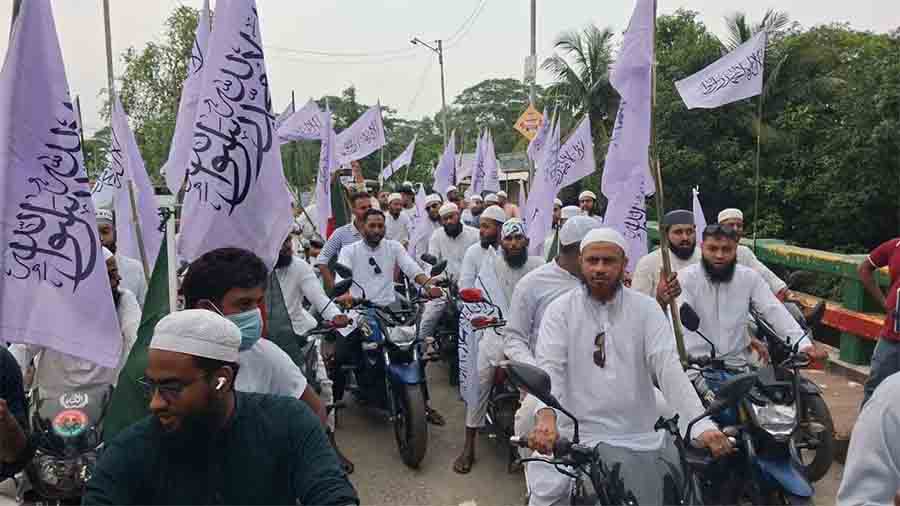
A sensation was created by hanging several blackened flags of the ISIS militants on both sides of the Abduz Zahur Bridge in Sunamganj. Eyewitnesses said that a group of outside extremists publicly hung these flags last Wednesday afternoon. Although the identities could not be confirmed, locals said that most of the youths were not residents of the area. Their behavior was also aggressive and mysterious. Their clothes and appearance were also imitating ISIS militants.
The picture is the same not only in Sunamganj, but also in the capital itself. Flags made in the style of extremists are flying on both sides of the road from Mohammadpur Shia Mosque intersection to Taj Mahal Road and Geneva Camp. The flag, hung 20 yards away, has Kalima written in Arabic script.
This special flag, modeled after the international militant organization Islamic State (IS), is flying not only in Mohammadpur, but also in several areas including Gabtoli, Mirpur, Jatrabari, Shanir Akhra. This flag has even been seen in various parts of the country, including Sylhet and Gopalganj.
Yesterday, during a field visit to several areas of the capital, it was seen that extremist flags were flying. However, law enforcement agencies have no information about who is planting them or for what purpose.
On a field visit, it was seen that these flags have been hung on both sides of Taj Mahal Road, Iqbal Road, and Khilji Road in Mohammadpur. Two flags have been hung crosswise in the middle of the road in front of the residential school. A police patrol team can be seen there. But the police members on duty could not provide any information regarding who put up the flags or when they were put up.

Image of Sunamganj
The flag is flying in front of Large Pharma on Taj Mahal Road. Even the security guard on duty in front of Large Pharma could not tell who and when hung the flag. If you go a little further, it is also flying in front of Mr. Baker’s outlet on the right. Even the shopkeeper does not know anything about the flag. Although no one knows anything, this special flag is flying in the whole of Mohammadpur.
Regarding this, Deputy Commissioner (DC) of Tejgaon Division of Dhaka Metropolitan Police (DMP) Ibne Mizan said, “The matter is being viewed seriously. Necessary action will be taken as per the law.”
Apart from Mohammadpur, flags made in the style of militants were seen hanging in Gabtoli and Mirpur areas on this day. The flag was also seen on the road leading from Technical Intersection to Mirpur No. 1. The flag was also seen flying in Jatrabari and Shanir Akhra areas.
Outside the capital, this flag can also be seen on several roads in Savar. It has also been seen flying on an electric pillar at the overpass in the Shibu Market area of the Narayanganj-Dhaka connecting road. More than 100 flags have been placed on both sides of the road.
A shopkeeper in the Shibu Market area, speaking on condition of anonymity, said that last Wednesday night, some madrasa students came and hung this flag on a light post in the middle of the road.
Street cleaners also gave similar information about the flag. Another local shopkeeper said that the showdown and flag-hanging was led by a teacher from the Shariah Graduation Institute on Nazimuddin Road in the capital. The founding director of that institute is Mufti Harun Izhar.
In 2013, a terrible explosion occurred while a pipe bomb was being made at a madrasa owned by Harun Izhar in Lalkhan Bazar, Chittagong. Detailed information regarding this has been included at the end of the report.
Tarek Al Mehdi, Additional Superintendent of Police (Crime and Operations) of Narayanganj District Police, said that the issue of hanging this extremist flag will be investigated and whether there is any other motive.
He said, “As the Football World Cup is underway, flags of different countries are being hung in different parts of the country. However, the issue of putting up flags with black writing on white cloth had not come to their attention before. The matter will be investigated and efforts will be made to find out who put them up and for what purpose.”
Outside Dhaka, this flag can be seen flying on various roads, flyovers and populated areas in Feni, Sylhet and Chittagong. This has created a lot of discussion and concern in various social media and media outlets.
In addition, there have been protest rallies and processions with the flag in Hathazari, Chittagong. Protests were later held in Hathazari after Friday prayers on June 19 in protest of the removal of the flag from the Jatrabari flyover. This flag was also there. After this incident, the same flag is being seen in various areas of Chittagong including Hathazari. In addition, protest processions with this flag have been held in several other districts including Pabna, Jessore.

Image of Mohammadpur
In this regard, Maulana Mir Idris, the central joint secretary general of Hefazat-e-Islam Bangladesh, said, ‘I see the black and white flags being flown, but we did not fly them. I support this because Islam does not allow asking someone to take down a flag with Kalima written on it. With the World Cup ahead, the entire country is covered in the flags of Brazil and Argentina. In that place, it is okay to fly the Kalima flag as an “Islamic country.”
Dr. Touhidul Haque, associate professor and crime analyst at the Institute of Social Welfare and Research, Dhaka University, believes that by hoisting this flag, a group is signaling its presence or starting activities in this country.
He said, “We have noticed such flags being displayed in some districts outside Dhaka before. Although their identities have not been revealed, we have noticed their showdowns. Just as the writing styles on the flags are unfamiliar, those participating in these showdowns are also unfamiliar to the locals.”
Stating that there is a considerable gap in what the local administration can do, he added, “We have social, cultural and religious harmony. In that place, some other group is announcing its presence or starting activities in this country. Along with this, they are also trying to understand what the reaction will be. The administration and local public representatives should identify them and take action. Otherwise, there will be anxiety and worry among the common people.”
Who is Mufti Harun Izhar, know his past

The time was October 7, 2013. The country was in turmoil with the mass movement, the trial of war criminals, and the riots at the Shapla Chattar in custody. At that time, a terrible explosion occurred at the Jamiatul Uloom Al-Islamia Madrasa in Lalkhan Bazar, Chittagong. At least 8-9 people were injured, and one person died while undergoing treatment. Initially, the Madrasa authorities tried to cover up the incident by making a ridiculous claim that a computer’s ‘UPS’ exploded, but later the intelligence agencies and experts from the Bomb Disposal Unit found traces of the production of improvised explosive devices, or IEDs, or hand-made bombs there. Several unexploded ‘pipe bombs’ and bomb-making equipment were recovered.
The Rapid Action Battalion (RAB) later arrested four militants of the banned militant outfit Harkatul Jihad in Dhaka for their involvement in the incident. Among them was a fugitive accused in the August 17, 2005 serial bomb attacks. Two of them were arrested from Uttara in Dhaka and the other two from Ashulia with weapons and explosives. At that time, 1,100 rounds of SMG bullets, 32 pistol bullets and one kilogram of explosives were recovered from the four arrested.
The police immediately described the bombs recovered after the explosion at the Lalkhan Bazar madrasa dormitory under the control of Hefazat-e-Islam as ‘hand-made grenades’. At that time, various parties made provocative statements claiming that the incident was a conspiracy by the Awami League government against the madrasa and Islam. However, bomb experts later identified them as ‘pipe bombs’.
In January 2011, 11 similar bombs were recovered from the Hathazari police station area of Chittagong. At that time, experts said that bombs using this technology were made in Pakistan and Afghanistan. The militant organization Lashkar-e-Taiba is accused of carrying out the most sabotage using this technology.
Intelligence information at that time also revealed that Mufti Izharul Islam, the director of Jamiatul Uloom Al Islamia Madrasa – Nayeb-e-Ameer of Hefazat-e-Islam and a member of the central committee of Nezam-e-Islam – and his son Mufti Harun Izhar had direct links with Lashkar. Mufti Harun himself gave this information to the police during interrogation by the intelligence police after his arrest in 2011. Earlier, on December 15, 2010, his father Mufti Izharul Islam – who is notorious as a top militant leader in the subcontinent – was arrested on charges of involvement with Harkat-ul-Jihad.

Harun Izhar (right), with BNP State Minister Tuku
The most well-known IED maker within the militant organization Lashkar-e-Taiba is Syed Abdul Karim alias Tunda, known as the right-hand man of Indian mafia don Dawood Ibrahim. Tunda, a supporter of Lashkar and radical militancy, was arrested in Nepal in August 2013. At that time, the country’s intelligence agencies also received information that Tunda had secretly come to Bangladesh under a false identity and had trained militants.
After talking to the intelligence officers and bomb experts on duty at the time, it was confirmed that the bombs recovered from the dormitory of the Lalkhan Bazar madrasa were of pipe bomb technology. One of the features of which is that these bombs cannot be detected by airport scanners and in many cases even by trained dogs.
Experts told this reporter that the terrorists used coffee to mix the bomb’s ingredients with color and odor to make it undetectable. US forces had suffered heavy losses from such bomb attacks in Afghanistan numerous times. These bombs have caused them a lot of suffering. Later, the Americans used ‘Water Blade Stingray’ technology to defuse such bombs in Afghanistan.
An official of a security agency in charge at the time, speaking on condition of anonymity, said that pipe bombs are not detected by scanners. Trained dogs also fail because they are confused by the smell. The main equipment for making these bombs is pipes and sockets (aluminum used for sanitary purposes) available in various hardware stores in the country. It is possible to make this powerful bomb with other readily available materials such as urea, nitric acid, potassium chloride, nitrobenzene, carbon tetrachloride and sugar. It would be terrible if the scanners and trained dogs failed to locate this bomb.
After the 2013 explosion, the Chittagong Metropolitan Police (CMP) wrote in their report: ‘After the explosion, 4 unexploded hand grenade-like bombs, 250 pieces of GI pipe, 100 marbles, a twisted mobile set, 200 grams of GI wire, twisted springs and two slide ranges were recovered from the madrasa dormitory.’
Although the police initially described the recovered bomb as an older version of a homemade grenade, experts were able to identify it as a pipe bomb used in Pakistan and Afghanistan after taking into account the fact that the homemade grenade was attached to a GI wire and a mobile phone.
Santosh Chakma, then sub-inspector of the CMP’s intelligence branch and a member of the Bomb Disposal Unit, admitted that the bomb recovered from Hathazari in 2011 was similar to the bomb recovered from the dormitory of the Lalkhan Bazar madrasa owned by Mufti Harun Izhar.
Bomb experts said that banned militant organizations in Bangladesh are making IEDs using technology from Afghanistan and Pakistan. These bombs are made by placing explosives inside thick iron pipes. To detonate, a special ring of pins like a grenade is placed outside the bomb. This type of bomb is also called a pressure release bomb. The special ring outside this bomb explodes with a loud sound within a few seconds of throwing it. Its destructive power is increased by the fact that it has a hard iron casing outside. And since the bomb has explosives and sharp objects inside, those splinters rush and tear people apart.
A police bomb expert, who did not wish to be named, said that in such bombs, a battery is used along with the initiator. Alternatively, a mobile phone is also used directly instead of a battery. A battery or a mobile phone is added to activate the explosive. Especially in Pakistan and Afghanistan, militants use such technology to make hand bombs.
Intelligence reports indicate that the notorious JMB militant in Bangladesh, Jahedul Islam alias Bomber Mizan, was the first to make bombs using this technology. After that, another JMB militant named Masum tried his hand at making bombs. Nurunnabi, who was killed in the bomb blast at the Hefazat-controlled Lalkhan Bazar madrasa, also received training from them.
Abdul Karim Tunda’s technology was used to make bombs using this IED technology. Lashkar-e-Taiba leader Abdul Karim gained notoriety in India in the 1990s for making bombs using this IED technology. When a part of his left hand flew off while making a bomb, he added the adjective Tunda to his name. According to Delhi Police, Tunda has been carrying out terrorist activities in India for more than two decades. Tunda, who is directly accused in 43 explosions, is accused of receiving training in explosives making from Pakistan’s intelligence agency ISI in the 1980s.
This Tunda has trained militants even after coming to Bangladesh. And the truth of this information is found in the information given by the detained Mufti Harun after his arrest. After his arrest on November 5, 2011, he admitted to the intelligence officers in Dhaka that he had direct links with Lashkar. After the 2013 blast, the intelligence officers put two and two together. Using the technology taught to them by the Hifazati Madrasa in Chittagong, bombs were being made.

World media is saying that Bangladesh has become a hub of international terrorism after August 5, 2024.
Izhar’s son Mufti Harun was arrested in October 2013 for his involvement in the grenade explosion at Lalkhan Bazar Madrasa. A case was filed against Hefazat-e-Islam leader Mufti Harun by Hefazat-e-Islam itself due to his association with the banned militant organization JMB. He was imprisoned for a long time. His father Mufti Izhar was also arrested later on the same charges. He also spent a long time in prison. When the detectives brought him before the journalists after his arrest, he raised two fingers and made a V-sign and said, “I am the founder of the grand alliance.”
Mufti Izharul Islam Chowdhury fled immediately after the grenade explosion at Lalkhan Bazar Madrasa. After being on the run for 2 years, he returned to Lalkhan Bazar Madrasa. Mufti Izhar and his son Harun Izhar, along with several others, were accused in three cases filed in connection with the grenade explosion. An arrest warrant was also issued against Mufti Izhar for not taking bail in three cases, including the Explosives, Acid Control Act and a murder case.
Intelligence agencies had said that a base of international militants had been established at the Jamiatul Uloom Al-Islamia Madrasa, located at the foot of the hill in Lalkhan Bazar, under the direction of Mufti Izaharul Islam. From there, the plan to attack the US Embassy and the Indian High Commission in Dhaka in late 2009 was hatched.
The attack was masterminded by the banned Islamic militant organization Lashkar-e-Taiba. Haroon Izhar, son of Izharul Islam, was associated with it. Police and intelligence officials said that another major terrorist attack was planned from there.
In late 2009, there were reports that militant attacks on two embassies in Dhaka could occur at any time. Based on this information and a telephone call, it was learned that the attack was planned at Mufti Izharul’s madrasa. Some of the international militants associated with it were staying at Mufti Izharul’s madrasa.
Upon receiving this information, the intelligence police conducted a raid on the madrasa and arrested Izhar’s son Harun Izhar and Indian citizens Shahidul, Salam, Sujan and Al Amin alias Maiful, members of the South Indian organization Lashkar-e-Taiba.
Sources said that during the 2009 raid, the intelligence police seized a laptop from Haroon Izhar’s room. The laptop contained information about the attacks on the US and Indian High Commissions. Before the police raid began, T. Nasir and Sarfaraz, two top leaders of Lashkar-e-Taiba, escaped from there.
On November 6 of that year, two Indian militants were arrested by Indian security forces while they were fleeing across the Kumira border into India. They were involved in several major terrorist attacks, including the bomb attack in Bengaluru’s Computer City. They were the most wanted in India. To avoid arrest, the two militants fled to Bangladesh via Dubai and took refuge in Mufti Izhar’s madrasa.
Earlier, RAB conducted a raid on a hilltop training camp of HuJI in the Raozan Rubber Garden Godarpar area and recovered jihadi books and a large quantity of explosives. Two cases were filed under the Explosives and Anti-Terrorism Acts in this incident. Eight people, including Mufti Izharul Islam Chowdhury, were accused in both cases.
Mufti Izharul Islam was arrested along with two associates by RAB-7 on December 15, 2010, on charges of having links with Harkatul Jihad. RAB arrested the then Amir of Harkatul Jihad (HuJI), Maulana Yahya alias Bardda (46), and his two associates, Md. Bahauddin (22) and Yar Mohammad (50).
During initial interrogation, Yahya said that an organizational office has been opened at Mufti Izharul Islam’s Lalkhan Bazar Madrasa to expand HuJI’s dominance in greater Chittagong. Some militants who were arrested in January 1999 on charges of attempting to kill the late poet Shamsur Rahman said that they had received training at Mufti Izharul Islam’s Lalkhan Bazar Madrasa.

https://stapravda.ru/20221228/reyting_samyh_populyarnyh_hostingov_v_rossii_196445.html, рейтинг хостингов России подтверждает, что выбор надежного провайдера важен для бизнеса.