
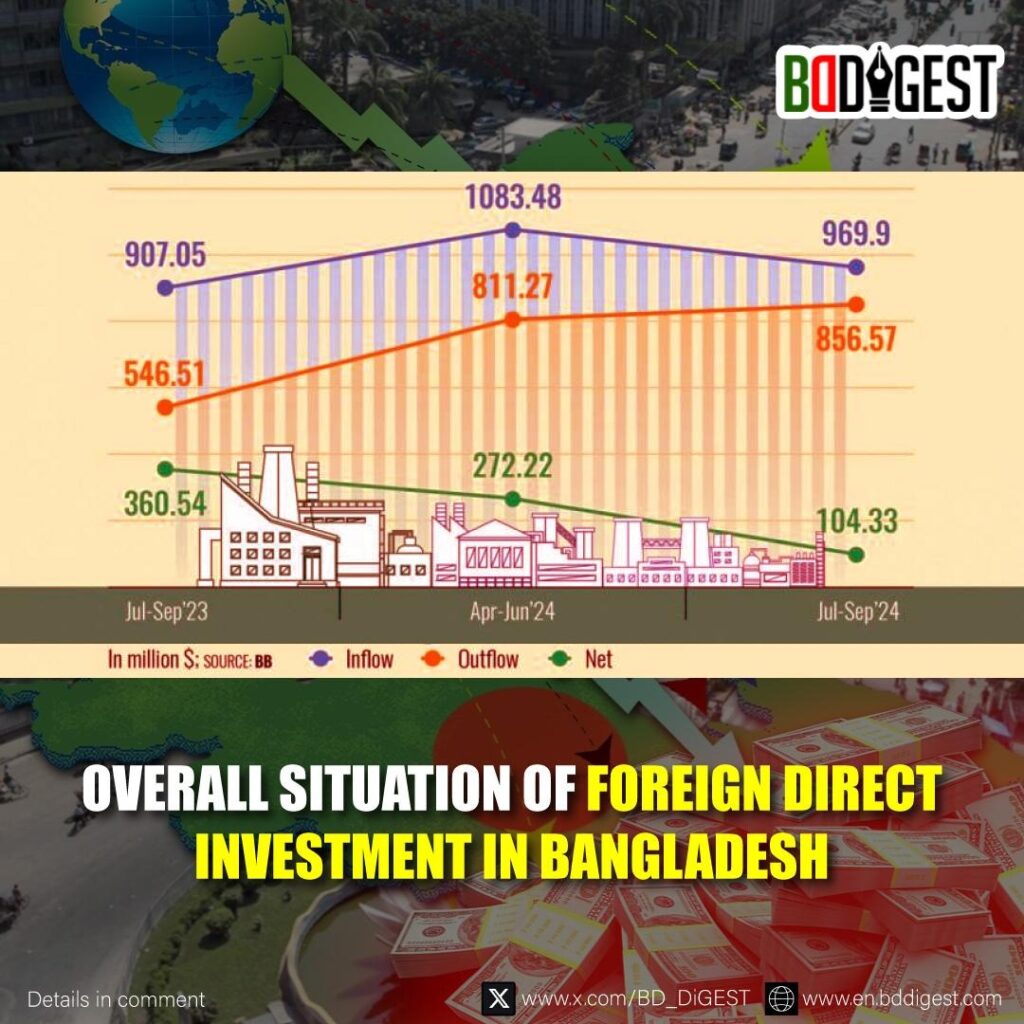
Dhaka: Foreign direct investment (FDI) in Bangladesh has dropped to $104.33 million in the July-September quarter of the 2024-25 fiscal year, the lowest in the past six years. This decline is attributed to foreign investors staying away from Bangladesh due to political instability, labor unrest, and the ongoing economic crisis.
According to data from Bangladesh Bank (BB), FDI has decreased by 71% compared to the same period last year. In the July-September quarter of 2023, foreign investment in Bangladesh stood at $360.5 million. There has been a decline in both net equity and reinvested earnings during this period.
In the first quarter of FY25, a total of $76.79 million came as net equity, marking a 46% decrease compared to the previous year. Similarly, reinvested earnings by companies operating in the country fell by 73%, amounting to $72.9 million.
This drop in FDI inflow has marked the lowest level in six years, primarily due to political instability and the economic crisis. The political turmoil in July and the collapse of the Awami League government in early August led to a breakdown in law and order across the country, which had a major negative impact on investment flows.

Zaved Akhtar, President of the Foreign Investors’ Chamber of Commerce & Industry (FICCI), commented on the issue, stating, “Investors prioritize predictability and stability in policy and the economy before making investments. Over the past two to three years, significant economic mismanagement in Bangladesh has eroded investor confidence and discouraged them from investing in the country.”
Further analyzing the situation, M Masrur Reaz, Chairman and CEO of Policy Exchange Bangladesh, said, “The decline in foreign investment is not surprising given the ongoing macroeconomic challenges, including inflation and an unstable currency exchange rate.” He added, “Political instability and the ongoing crisis have further shaken investor confidence and reduced investment flows.”
Rupali Chowdhury, former president of FICCI, expressed concern about the impact of political changes on new foreign investments. She said, “Such political changes create policy uncertainty, which discourages both domestic and foreign investors from making significant investments.”
Chowdhury also pointed out the lack of coordination among key government institutions such as Bangladesh Bank and the National Board of Revenue, as well as instability within ministries. This adds to the challenges faced by investors. She called for better inter-agency collaboration and clearer policy directives to create a more conducive environment for investment.
The decline in FDI inflows signals a concerning trend for Bangladesh’s economy and investment climate, particularly as the country is navigating through political and economic instability.

https://stapravda.ru/20221228/reyting_samyh_populyarnyh_hostingov_v_rossii_196445.html, рейтинг хостингов России подтверждает, что выбор надежного провайдера важен для бизнеса.