

❐ Feature Desk
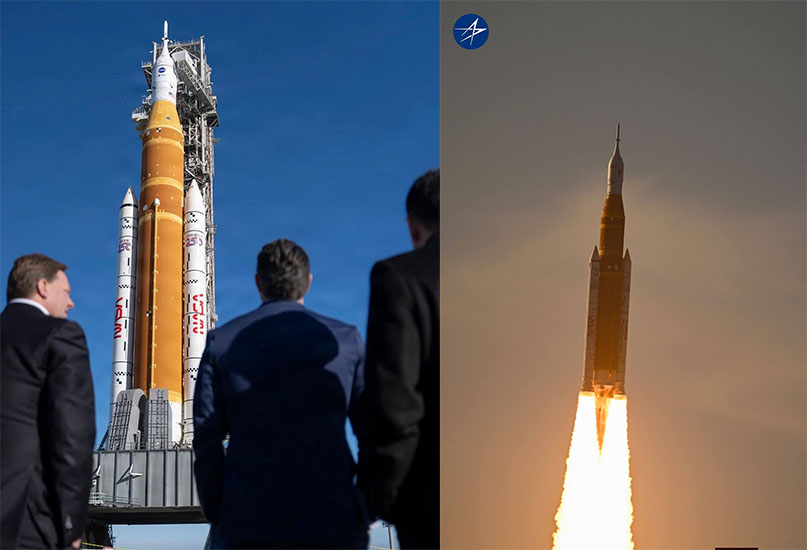
After more than half a century, the US space agency is going to send a manned spacecraft close to the moon again.
The ‘Artemis-2’ mission is being considered a new chapter in humanity’s space exploration, where not only technical experiments but also extensive scientific research on the human body and the space environment will be conducted.
During this approximately 10-day mission, four astronauts will orbit the moon in the Orion spacecraft and return to Earth.
According to the plan, the spacecraft will travel approximately 7,560 kilometers past the invisible part of the moon, which could be considered the farthest human journey in human history.
One of the most important aspects of this mission is the analysis of the human body’s response to space.
Radiation levels outside low Earth orbit are much higher, so special tests will be conducted to understand its effects on bone marrow, blood cell production and the immune system. Tiny artificial tissues made from human cells are being sent into space, which behave like real organs.
At the end of the mission, genetic changes in these tissues will be analyzed to see how thousands of genes respond to the space environment.
At the same time, research will also be conducted on the astronauts’ daily lives, stress, and performance. They will use wearable devices that will collect data on their sleep patterns, movement, heart rate, attention, and mental state.
The impact of living in a confined space for long periods of time on teamwork and mental stability will also be analyzed.
Astronauts will regularly collect saliva and blood samples to monitor changes in the immune system. By analyzing these samples, scientists will determine how much the body’s immune system weakens or changes due to the pressure and radiation in space.
Special attention will be paid to the behavior of viruses that are normally dormant but can become active in space.
Radiation measurement is a major goal of this mission. Astronauts will be equipped with personal radiation meters, which will instantly measure radiation levels. In addition, sensors installed at various locations on the spacecraft will provide detailed information about the spread and intensity of radiation.
This information will help ensure the safety of future missions in situations such as solar storms or sudden radiation increases.
Lunar observations are also a key part of the mission. The spacecraft will fly over a part of the moon that is not directly visible from Earth. Astronauts will observe ancient meteorite impacts, remnants of volcanic lava flows, and various geological formations.
New information about the Moon’s structure and history can be obtained, especially through observations of large impact craters.
Scientists also hope that astronauts may also see rare phenomena, such as fleeting flashes of light caused by meteorite impacts on the lunar surface or clouds of fine dust floating near the horizon, which have not yet been fully explained.
The information obtained from this mission will play an important role in future plans for human landings on the south pole of the Moon, long-term spaceflight, and sending humans to Mars.
According to experts, Artemis-2 is not just a space trip, but an important step on the path to humanity’s permanent presence in space.

https://stapravda.ru/20221228/reyting_samyh_populyarnyh_hostingov_v_rossii_196445.html, рейтинг хостингов России подтверждает, что выбор надежного провайдера важен для бизнеса.