
Staff Reporter
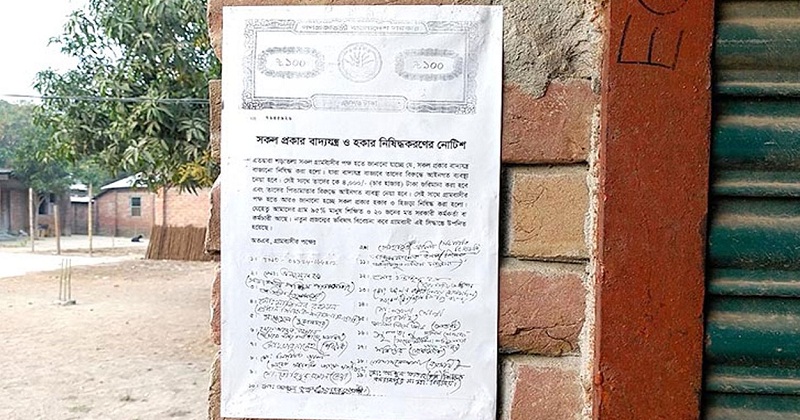
A notice has been seen on the walls of various houses in Shoratla village, located in the Harinakundu upazila of Jhenaidah district, for the past week. The notice states that all musical instruments and hawkers are prohibited in the village, and people from the third gender are not allowed to enter. Violating these rules will result in a fine.
On-site observations reveal that photocopies of non-judicial stamps worth 100 Taka have been pasted on the walls of various homes and business establishments in Shoratla village. The stamps prominently display a notice reading: “Prohibition of all types of musical instruments and hawkers.” The same notice also prohibits hawkers and third-gender people from entering the village.
The notice further states, “On behalf of the villagers, it is informed that all types of musical instruments are prohibited. Legal action will be taken against those who play musical instruments. They will be fined 4,000 Taka, and legal action will also be taken against their parents. Since 95% of the villagers are educated and there are around 20 government employees, the villagers have reached this decision considering the future of the new generation.”
At the end of the notice, 18 people have signed on behalf of the villagers. These include elected representatives, heads of various educational institutions, teachers, imams, and social workers.
Enamul Haque, the president of the West Para Jam-e-Mosque committee in Shoratla village, who signed the notice, said, “Previously, loud music was played in the village, causing problems for sick people, students, women, and children. Additionally, third-gender individuals would play loud music and dance and sing at various times. They, along with hawkers, would often extort extra money from people, which is why such a decision has been made.”
Local ward member Touhidur Rahman said, “The use of musical instruments negatively affects the studies of children. Therefore, this decision was made based on the opinion of all villagers for the benefit of the children.”
The Upazila Executive Officer (UNO) B.M. Tariq-uz-Zaman stated, “I have heard about this matter. It is illegal. No one can create such rules. I have already informed the law enforcement authorities to find out who is involved.”
Shahinur Alam Liton, General Secretary of the Bihongo Cultural Practice Center in Jhenaidah, said, “In the 90s, during the anti-autocratic movement, we engaged people through street plays and music. People from the cultural sector played a role in the 24’s student movement as well. I believe a certain group is trying to push our society backward by imposing religion on people. However, cultural practices are ongoing in many Muslim countries, including Saudi Arabia.”
He expressed anger, saying, “No area has the authority to ban musical instruments. This is illegal. We demand that the administration take action against it.”

https://stapravda.ru/20221228/reyting_samyh_populyarnyh_hostingov_v_rossii_196445.html, рейтинг хостингов России подтверждает, что выбор надежного провайдера важен для бизнеса.