
Opinion.
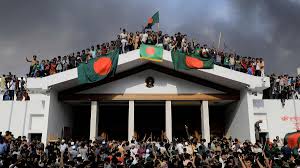
The July Uprising of 2024 in Bangladesh initially brought hope and the promise of a transformed nation. What started as a protest against the contentious job quota system grew into a widespread call for change against the long-standing political stalemate under the Awami League’s rule. Spearheaded predominantly by students, the movement aimed to create a society based on justice, equality, and accountability. However, months later, this unified vision is slowly losing its brightness, becoming fragmented and less focused.
The economic crisis in the country has been a significant factor in the waning momentum of the movement. The interim government, which was supposed to be a stepping stone for political reforms, has implemented policies that have only worsened the lives of ordinary citizens. Inflation is on the rise, making everyday expenses unbearable for many families. The introduction of broad VAT policies has led to further dissatisfaction among those who were already struggling to make ends meet. As a result, the public’s attention has shifted from systemic change to survival, leaving the movement with less support and energy. Moreover, the social cohesion of the nation is under threat, with the movement facing accusations of neglecting marginalized groups. Allegations of violence and suppression against Hindus and indigenous communities in the Hill Tracts have raised concerns regarding the movement’s stance on justice. The division within secular forces has grown due to claims of support for Islamic militancy in some movement segments. These issues have alienated potential allies and highlighted the inconsistency in the movement’s ideology.
The July Spirit also faces challenges in maintaining a united front due to its relationship with Chhatra Dal, the student wing of the Bangladesh Nationalist Party (BNP). Infighting and mistrust have replaced the hope of forming a joint opposition against the established political duopoly of the Awami League and the BNP. This has limited the movement’s inclusivity and appeal, moving it further from its original goal of being a platform for all. Reports of student leaders openly bragging about vandalizing government property, setting fires, and even claiming the lives of police officers as a “tactic to victory” have painted a disturbing image of the exploitation of student activism. Their confession to using counterfeit student IDs to infiltrate private universities and mobilize students under false premises adds a further alarming dimension to this situation. For the typical, non-political student, this revelation may be a significant breach of trust where they were unintentionally drawn into meticulously designed dirty politics.
The lack of law enforcement has been another hindrance to the movement. Since August 5th, there has been a surge in mob violence and intimidation, silencing dissenting voices and overshadowing the push for reform. The fear of retribution has even influenced public opinion polls, with many possibly withholding their true views. This has damaged the public’s faith in the democratic process and made the movement’s objectives appear more distant. Furthermore, internal rifts have emerged over the declaration of Proclamation of revolution, as the BNP of the main stakeholders boycotted the all party meeting with Chief Adviser Muhammad Yunus. There is already a new debate whether this was a revolution or an uprising. The movement’s distancing from the BNP and its supporters has weakened its potential alliances, contributing to its fragmentation. On the international stage, the re-election of Donald Trump in the U.S. is a new challenge, as the proximity between Muhammad Yunus and Democratic Party is an open secret. It is evident that Yunus wouldn’t be able to achieve what he could have if Kamala was elected as the first female President of the states.
The recent events in July have stirred up intricate dynamics within the political landscape of Bangladesh, with echoes of the country’s founding leader, Sheikh Mujibur Rahman. Mujib is revered by many, including a substantial number of students not aligned with any political parties, such as the Awami League (AL). These neutral individuals hold Mujib’s contributions in high regard, acknowledging his pivotal role in shaping the nation of Bangladesh though independence struggle. However, there is growing anxiety among these students regarding the escalating hostility and attempts to vilify Mujib’s legacy. They are of the view that such actions are not merely political criticisms but rather a detrimental effort to divide the nation by undervaluing a leader who embodies unity and independence.
Consequently, the Awami League seems to be benefiting from the opposition’s fragmentation. Recent events, such as Journalist Masud Kamal’s online survey showing persistent backing for the AL and the AL lawyer’s victory in the Sylhet District Bar association elections, indicate that its popularity is not entirely waning. The question remains whether this is due to genuine public support or the absence of a cohesive alternative. As the July Spirit diminishes, the Awami League may find itself stronger than ever, as they always had strong root level presence in the land of Bengal unlike Military backed Jatiya Party which was ousted in the 90’s.
[The Writer S M Faiyaz Hossain is a Political Commentator and a Masters Student at an Australian Public University. He can be reached at [email protected]]
Is the July spirit steadily transforming into a fading Bangladesh 2.0 dream ?
Visited 105 times, 1 visit(s) today

https://stapravda.ru/20221228/reyting_samyh_populyarnyh_hostingov_v_rossii_196445.html, рейтинг хостингов России подтверждает, что выбор надежного провайдера важен для бизнеса.