
❐ Special Correspondent
Although the Awami League government was replaced by the Yunus government in July-August in a militant attack in the name of quotas and various job demands, there has been no change in the job market. On the contrary, the situation has become more dire in the space of a year.
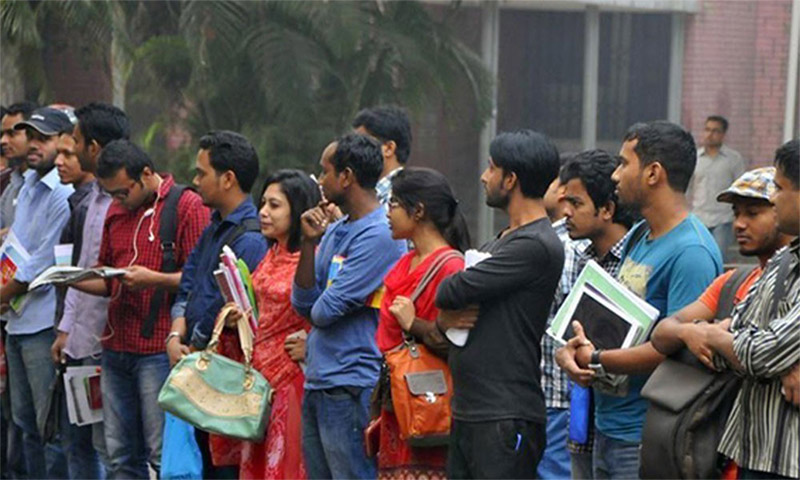
The latest labor force survey by the Bangladesh Bureau of Statistics (BBS) shows that the number of educated unemployed people in the country stood at 2.7 million by the end of 2024, which is 1.5 million more than the 2.5 million in 2023.
This number is beyond the number of unemployed workers in factories that have closed down one by one. Millions of workers in the industrial sector are currently unemployed.
Young people who have completed their graduation or post-graduation are struggling to find a job with a monthly salary of Tk 20,000. According to the Labor Force Survey (October-December 2024), the country’s labor force was 58.9 million at the end of last December. Of these, 47.4 million are males and 11.4 million are females.
Employment decline in the industrial sector
The number of jobs in the industrial sector has declined over the past decade. In 2013, there were 12 million workers in this sector, which is expected to drop to 12 million in 2024. The contraction in the industrial sector has also affected overall employment.
Hundreds of factories have closed across the country in the past year, resulting in an increase in the number of unemployed workers to between 100,000 and 150,000.
On the other hand, employment abroad has also declined. According to data from the Bureau of Manpower, Employment and Training (BMET), employment abroad is expected to decline by 22 percent to just one million in 2024.
Youth concerns
Ahmed Jobayer, a student at Dhaka University and a leader in the anti-discrimination movement, said, “We see that in university chats, almost all students are stuck on one question – what career path should they take after graduation? Some want to go abroad, some hope for a government job, and many say they will do any job they get. The main reason for this is the lack of career guidelines at the initial stage and the state’s unplanned education system.”
Imran Khan, a student at Jessore University of Science and Technology, believes that the government’s failure to regulate the market has made it difficult for employees to survive.
He said, “It is not possible to survive in the market with the salary of government jobs for grades 11-20. Because of this, the country’s talented people are becoming divided.”
Like the experts
Dhaka University Economics Department Professor Dr. Shahadat Hossain said, “Due to policy mismanagement, higher education institutions have not developed as needed. The education infrastructure is weak to develop the skills of students. Every year, about 2.5 million young people graduate, of which 1 million go abroad. There is not enough employment in the country for the rest.”
He added that money laundering, weakness of financial institutions, and reduced investment are not creating new jobs, which is frustrating the younger generation.
Professor Nurul Momen, director of the Career Counseling and Development Center at Rajshahi University, said, “Despite the large number of graduates coming out every year, employment opportunities are limited. Many are forced to work for low salaries, making it difficult to live comfortably. Employees are getting salaries based on the pay scale structure of about 10 years ago, while the cost of living has increased manifold.”
Overall picture
Statistics show that there is a major crisis in the job market in the country. Despite political changes through movements, there is no light of hope in the job market. The growing frustration of the youth and the lack of skill management are becoming new concerns for the economy in the long term.

https://stapravda.ru/20221228/reyting_samyh_populyarnyh_hostingov_v_rossii_196445.html, рейтинг хостингов России подтверждает, что выбор надежного провайдера важен для бизнеса.