
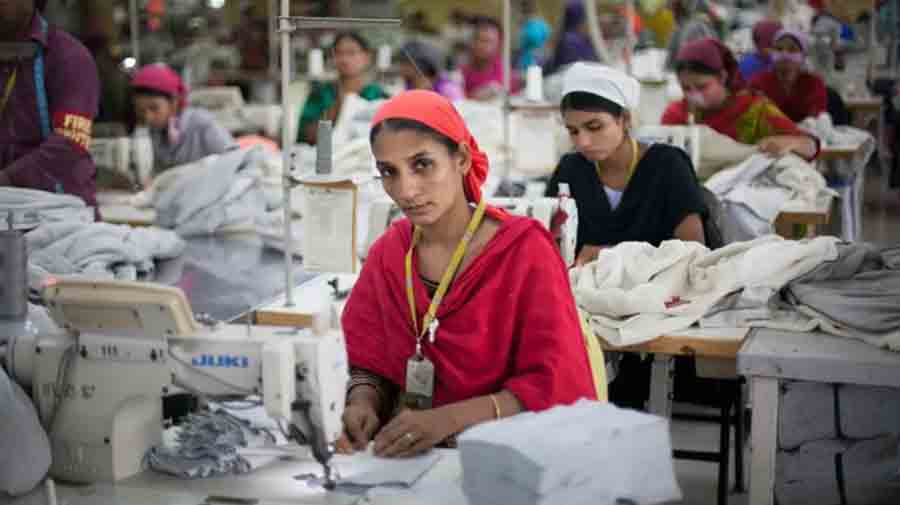
Special Correspondent
Bangladesh has seen a significant decline in ready-made garment exports to two major markets, the European Union (EU) and the United States, in the first half of 2026. Not only has demand declined, but Bangladesh has lost more market share than its competitors due to multiple structural and competitive factors.
European Union market
According to data from the European statistics agency Eurostat, Bangladesh’s ready-made garment exports to the EU in the first half of this year (January-June) decreased by 16.43 percent to 8.64 billion euros compared to the same period last year.
In the first five months of the year (January-May), export volume fell by 10.46 percent and average unit value fell by 9.41 percent. Among the world’s major garment suppliers, Bangladesh has seen the largest decline in the EU market—a decline that is higher than that of China, India, and Turkey.
US market
According to the Office of Textiles and Apparel (OTEXA) under the US Department of Commerce, Bangladesh’s garment exports to the US in the first five months of this year (January-May) decreased by 8.08 percent compared to the previous year to $3.25 billion.
During this time, the average unit price of the product decreased by about 2 percent. At the same time, competing countries Cambodia and Vietnam have increased their market share by capturing a portion of the purchase orders that have moved away from Bangladesh in the US market.
According to international market analysts, the reasons for Bangladesh’s loss of the export garment market are as follows:
1. Weakening global demand
Demand for apparel has fallen due to consumer spending a contraction in and economic uncertainty in the EU and the US. Inflation, rising interest rates and falling consumer confidence have led retailers to reduce orders in early 2026.
As a result, export earnings have decreased for all exporting countries, including Bangladesh. However, in the case of Bangladesh, the impact of this demand contraction has been greater than in others.
2. Decrease in the price per unit of product
The average unit price of Bangladeshi garments in the EU market fell by 9.41 percent between January and May. The average unit price in the US also fell by about 2 percent. Buyers are demanding products at lower prices and Bangladeshi exporters are trying to retain orders by reducing prices.
But this price decline is further reducing total export earnings. At the same time, many factories are losing profitability due to the pressure of low prices.
3. Intensification of regional competition
In the EU market: Bangladesh’s export decline rate is the highest (16.43%) compared to China, India and Turkey. These countries remain ahead of Bangladesh in terms of price, delivery time and product diversity.
In the US market: Cambodia and Vietnam have taken over a large portion of orders diverted from Bangladesh. These two countries have become attractive to buyers due to their low labor costs, fast delivery, and in some cases, customs benefits.
4. Weakness in price competition and ability to retain market share
Not only is demand declining, Bangladesh’s export decline rate is much higher than that of its competitors. This shows that Bangladesh is falling behind in price competition and is unable to maintain market share.
Analysts believe that rising production costs, rising labor wages, gas and electricity shortages, and logistical complications are also playing a role in this.
The 16.43% decline in exports to the EU and 8.08% to the US is not just a temporary demand contraction. It raises serious questions about the competitiveness of Bangladesh’s garment sector, its pricing strategy, and its position in the global supply chain.
If this trend continues in the coming months, export earnings and employment could come under further pressure.

https://stapravda.ru/20221228/reyting_samyh_populyarnyh_hostingov_v_rossii_196445.html, рейтинг хостингов России подтверждает, что выбор надежного провайдера важен для бизнеса.