
Staff Correspondent
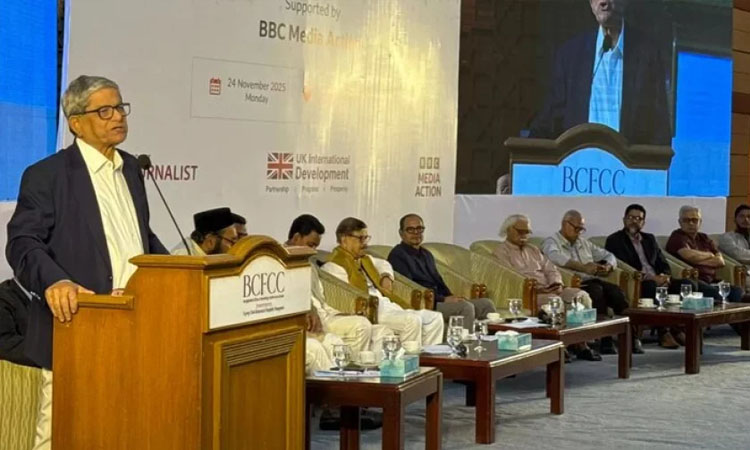
Dhaka: The Bangladesh Nationalist Party (BNP) is now trying to win the trust of journalists so that they can get their support in the upcoming national elections. BNP Secretary General Mirza Fakhrul Islam Alamgir said at a discussion meeting on Monday that divided journalists are in the service of politicians and they are stuck in political parties. He promised to ensure independent and impartial media if they come to power in the elections.
But on August 24, during the torture, arrests, and occupation of media houses in northern Bangladesh, BNP and Mirza Fakhrul remained silent and did not protest.
Mirza Fakhrul made the remarks at the Bangladesh-China Friendship Conference Center at an event titled ‘Discussion on Media Reform’ organized by the Broadcast Journalists Center (BJC). He said,
“Because of the division among journalists, they themselves end up in the pockets of politicians. In the BNP’s 31-point program, we have clearly stated that we will develop an independent media and form a commission for this.”
He also said that the interim government’s media reform commission report has not been discussed anywhere, but BNP will prioritize it if it comes to power.
But against the backdrop of this promise, the BNP’s past silence becomes clear. In the past year, many journalists have been attacked, detained in jail for days without trial, and media houses have been taken over by pro-BNP journalists. In these incidents, BNP leaders, including Mirza Fakhrul, did not protest or raise their voices in favor of journalists or “press freedom.” Instead, they silently accepted the situation.
Now, in the context of the upcoming elections, they are trying to gain the trust of journalists so that they can gain political advantage by getting their cooperation in the upcoming elections.
Fakhrul told journalists, “A party like the BNP does not want journalists to become party members or be in someone’s pocket. But you yourselves have divided and supported fascism in the last 15 years.” He stressed that journalists must remain free from political influence and practice independent journalism by adhering to professional principles.
He assured that the BJC’s proposed issues—such as a separate law for broadcast media, a National Broadcast Commission, a wage board, and recognition of channels as industries—will be given priority if the BNP comes to power.
In the historical context, Fakhrul mentioned that in 1975, all newspapers except four were closed under the Baksal system and the rest came under the control of the government. Later, BNP founder Ziaur Rahman organized independent newspapers and led to the emergence of many newspapers. During the BNP’s rule, many steps were taken to modernize the media, which laid the foundation for today’s TV channels, he mentioned.
But despite this assurance, BNP’s stance is being seen as an election tactic. While he criticized the BNP-Awami League’s shared division among journalist organizations, he did not point to his own biased past. It remains to be seen how the journalist community will accept BNP’s promise this time.

https://stapravda.ru/20221228/reyting_samyh_populyarnyh_hostingov_v_rossii_196445.html, рейтинг хостингов России подтверждает, что выбор надежного провайдера важен для бизнеса.