

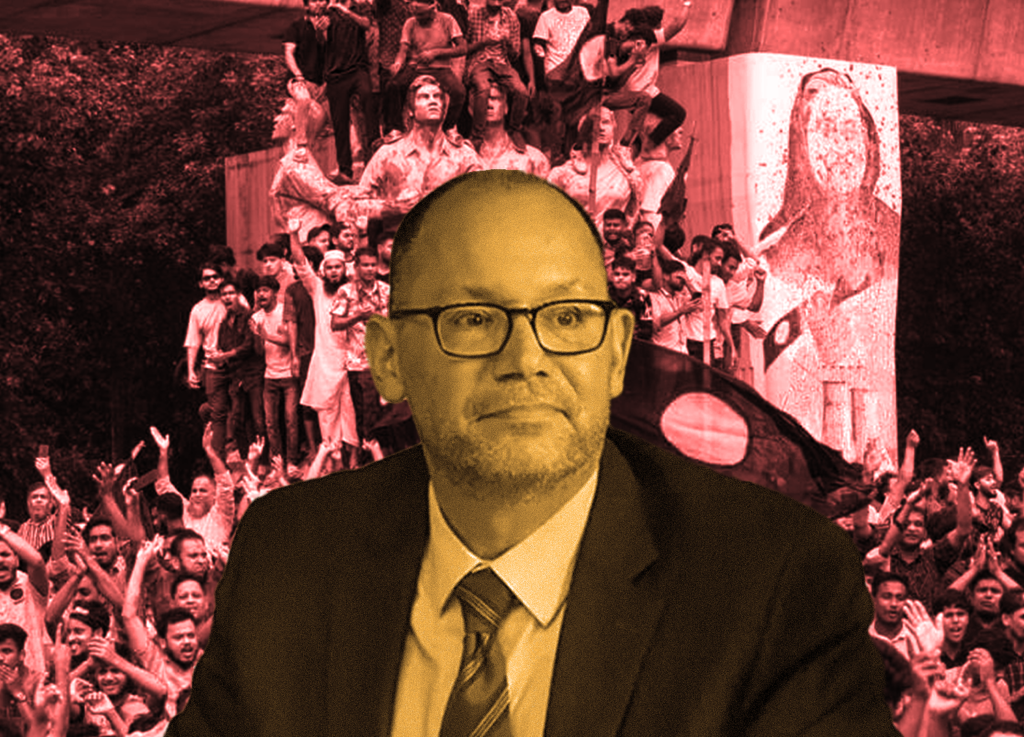
-Shariful Hasan, political analyst
Fires in the streets of France, attacks on town halls, looting of shops. President Macron has said in unequivocal terms that there is no place for violence, the guilty will be brought to justice, and the entire nation will stand by the law enforcement agencies. World leaders are seeing this incident as riots and chaos. No major human rights organization, the United Nations High Commission for Human Rights, or Volker Turk is taking a strong stand against the government on this issue. No one is calling it a “student-people’s revolution,” and no ambassador is expressing anger and warning the French government about the democratic rights of the movement and freedom of speech, nor is he standing with sympathy for the protesters.
Now let’s go back to July 2024.
Different behavior in Bangladesh
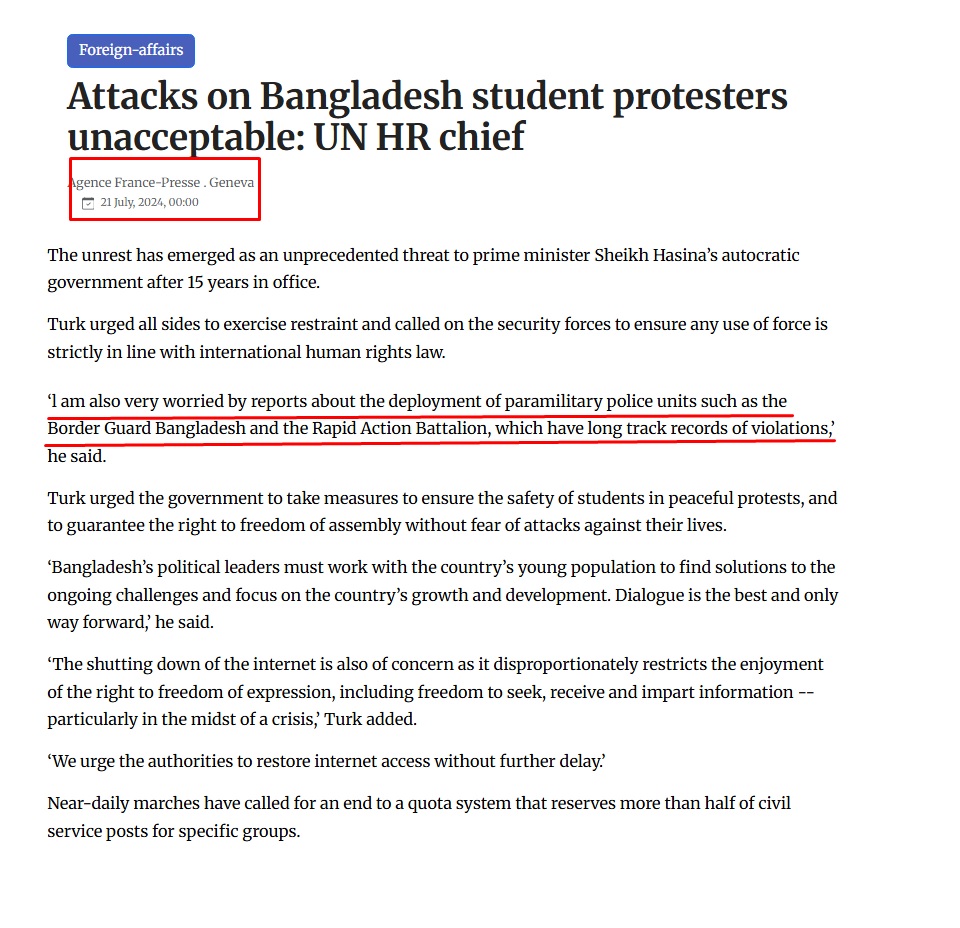
In mid-July, as the quota movement was turning violent, the ambassadors of the European Union and the United States began to issue public statements. The UN High Commissioner for Human Rights and Volker Türk expressed direct concern about the government’s role. Much of the international media presented the movement as a kind of moral struggle, and the term “revolution” quickly entered the international discourse.
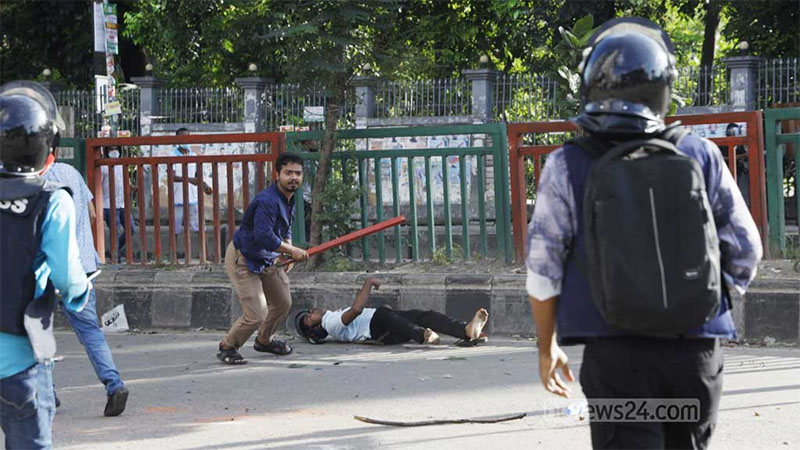
What was the situation in Bangladesh at that time? Police stations were set on fire, government buildings and the metro rail were damaged, policemen were killed, and the state television building caught fire.
In France, such incidents are being used today as “riots” in international circles and in the media. In Bangladesh, the same scene has been framed as “revolution” or “uprising” by international human rights organizations and embassy diplomats?
The character of the movement is the same, the difference is in the international attention
The period from July 16 to July 18 is crucial to understanding the events of July 2024 in Bangladesh. On July 16, six people died in Chittagong, Dhaka, and Rangpur, including Abu Sayeed. Following these deaths, thousands of students from public and private universities and colleges took to the streets, and on July 18, the movement turned violent: the BTV building was set on fire and the government shut down the internet across the country. According to the government’s letter of July 30, 235 police installations were damaged, and 44 policemen were killed, according to the Bangladesh Police.
The picture is similar in France: protests that began with school blockades have escalated into the burning of government buildings and attacks on police, and more than 2,400 people, many of them minors, have been arrested.

The nature of the movements in the two countries is almost the same, the difference is in international support. The international community and media attention after the news of the death in Bangladesh gave momentum to the movement, and the position of human rights organizations after the detention of leading coordinators pushed the government on the backfoot, which increased the courage of the protesters.
 The protesters in France are not getting this level of international support, and as a result, despite thousands of arrests, the movement is not gaining momentum. If protesters in France start carrying out deadly attacks like in Bangladesh, law enforcement there may not hesitate to use lethal weapons. And that will become acceptable, because the media has already framed the protesters as “looters” and “rioters.”
The impact of the statement makes a difference
The most striking part of this argument is the result of international statements. When a movement is publicly legitimized by foreign diplomats and international organizations, the morale and demands of the protesters increase, and pressure is put on the government. Naturally, this additional legitimacy has heated up the situation even more, pushing the movement from quota reform to the collapse of the government and reducing the chances of calm. The world is not sending such a message to the French government, but rather telling it to stop the violence. This difference in criteria is the main question.
Now let’s talk about using lethal weapons.
Until thousands of students, both private and public, took to the streets on July 18 to protest the deaths of five students on July 16, law enforcement agencies used rubber bullets, sound grenades, and tear gas as primary deterrents.
The killing of Abu Saeed on July 16 is also a huge mystery, as police were seen using rubber bullets on Abu Saeed as he charged towards them, and the forensic report found that Abu Saeed died of hemorrhage from a large wound to the back of the head, which was caused by stones thrown by protesters, according to various sources. Abu Saeed’s father also said in an interview that blood was still coming out of the large wound on the back of the head when he was bathed before the burial.
Other students who died on the 16th included Dhaka College Chhatra League member Sabuj Ali, who was killed in front of Dhaka College by protesters, and a hawker, who was killed while fleeing from police attacks.

With the support of the international media and the support of the media, these deaths took such a form that on July 18, students across the country attacked the state and law enforcement agencies. Much later, lethal weapons began to be used to save lives.
If such a deadly attack were to begin in France, what would French law enforcement do?
Rather, international leadership and human rights organizations are silent about the way the French police arrested thousands of students. But after the arrest of 5/6 leading student coordinators in the student movement in Bangladesh, all human rights organizations stood up to protect their human rights.
For this reason, the Bangladeshi government began to back down and the protesters became bolder.
The nature and character of the movements in France and Bangladesh are similar, what makes the difference is international support. The movement to overthrow the government, which emerged under the guise of the student movement in Bangladesh, gained momentum with international support, while in France, despite the arrest of thousands of students in the student movement, it is not able to gain momentum because the protesting students in France are not getting full support from world leaders, ambassadors, and human rights organizations including the United Nations.
Is movement with a flag in hand a sign of patriotism?
Protesters in France are seen holding national flags. This was the same scene in Bangladesh in July-August 2024: an attempt to give the flag-holding movement a patriotic look.

But holding the national flag does not make any act a sign of patriotism. If, under the shadow of the flag that is the symbol of the state and the people, the state’s assets are destroyed, shops are looted, government buildings are set on fire, the safety of the common people is endangered, or law enforcement agencies are attacked, then that is not patriotism, but rather an insult to that symbol. Loving the country means protecting the country’s assets and people. No matter how just the demand is, violence and looting can never be a legitimate way to achieve it. The tendency to give moral legitimacy to violence through the use of the flag is unacceptable in France or Bangladesh, in any country.
The job of international organizations and diplomats should be to speak with the same principles in all countries: condemnation of violence, whoever commits it; accountability if the state uses excessive force; and clarifying the difference between violence and peaceful demands. It is natural to question the integrity of a system that calls the same event a “revolution” in one country and a “riot” in another.

https://stapravda.ru/20221228/reyting_samyh_populyarnyh_hostingov_v_rossii_196445.html, рейтинг хостингов России подтверждает, что выбор надежного провайдера важен для бизнеса.