
❐ BD Digest Desk
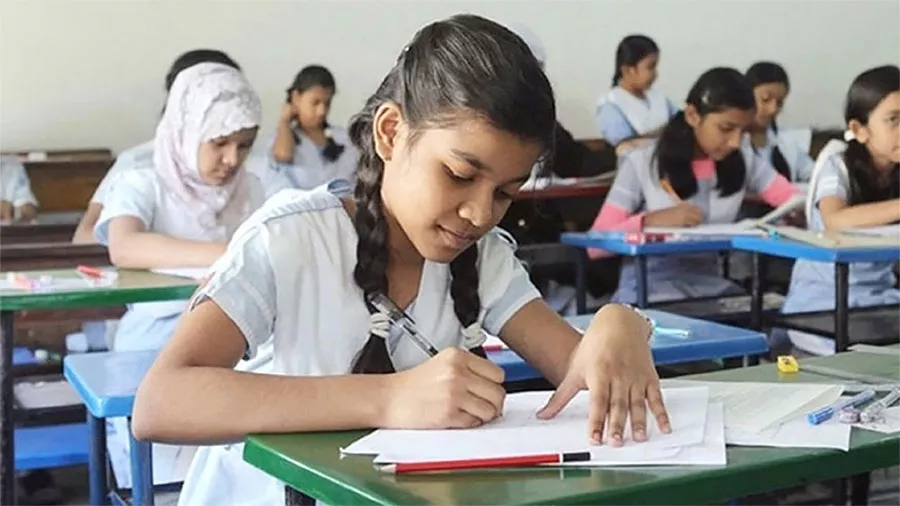
Students have been in sixth grade for four months after passing fifth grade. While they are adjusting to new books, new curriculum, and a new education system, another exam is looming before them—the fifth grade primary scholarship exam.
Due to legal complications, the interim government was unable to organize the exam in 2025. After the change of government, initiatives have been taken to organize the exam, albeit late.
If all goes well, the exam will be held in mid-April. About half a million students who are already studying at the secondary level can participate in it.
Education professionals say that it is not realistic for students to return to the fifth grade syllabus and take exams after studying in a new grade for four months. This not only disrupts the continuity of their studies but also increases mental stress.
After the annual exams of the fifth grade were over, most students did not keep their old books, notes and guides. Many sold them to buy new books. Now, suddenly, they are facing a dilemma as they prepare to sit for the exams by re-reading the fifth grade.
A student from a school in Mohanpur upazila of Rajshahi was encouraged by teachers to participate in the scholarship exam. His father, Afzal Hossain, is a hotel worker by profession.
He said, “The son had one roll. So the teachers were telling him to take the scholarship exam. I bought the guide with a lot of effort. After finishing the fifth grade, he sold it and bought the guide for the sixth grade. Now if the fifth grade exam is held again, what will he write? He has forgotten most of the five-grade reading.”
Teachers say that while urban students are able to afford books or guides to some extent, it has become almost impossible for many students in rural areas. As a result, they face discrimination from the very beginning.
The interim government took the initiative to introduce the Primary Scholarship Examination. For this, a policy was formulated, a distribution of seats was published, and sample question papers were also published. However, the policy stated that only 40 percent of the fifth-grade students of government primary schools would be able to participate in the examination.
Angered by this rule, teachers, students, and guardians of kindergartens and private schools filed a writ petition with the High Court.
On November 3 last year, the High Court overturned that policy and ordered that eligible students from private educational institutions be given the opportunity to participate in the exam in light of the 2008 policy.
Later, the government’s leave to appeal was also dismissed. Then, when the government took the initiative to conduct the exam under the name of ‘merit test’, excluding the word ‘scholarship’, another writ was filed in the court. As a result, it was not possible to organize the scholarship exam for 2025.
After the change of government, the new Education Minister Dr. ANM Ehsanul Haque announced a revision of the Milon policy. According to the new policy, 80 percent of students from government primary schools and 20 percent from kindergarten or private schools will be able to take part in the exam. There are plans to select about 82,500 students for the scholarship.
However, a new controversy has arisen over the timing. Because the scholarship exam is scheduled to be held in mid-April. Exactly a month after that, the sixth grade half-yearly exam will be held in June. As a result, students are having to prepare for exams of two different syllabus in just a few weeks.
According to teachers and educators, many students are experiencing mental stress while trying to cope with the pressure of studying two classes at the same time.
Sadia Khatun, a sixth-grade student at Motijheel Government Girls’ School, says, “The syllabus for the fifth-grade scholarship and the sixth-grade exam is completely different. It is very difficult to prepare for both at the same time. I am thinking of not taking the scholarship exam at all.”
Anjuman Ara Shiuli, a teacher at Viqarunnisa Noon School and College, said, “Since the two exams are so close in time, students will be able to prepare well for either one. There will be a gap for the other. This may affect the results.”
Some educationists consider the initiative to introduce scholarship exams at the primary level to be questionable.
Rasheda K. Chowdhury, executive director of the Mass Literacy Campaign, said that conducting separate tests for selected students creates unhealthy competition among children. This causes lagging students to fall further behind.
BRAC University Emeritus Professor Manjur Ahmed said the very idea of introducing a scholarship test at the primary level is questionable. According to him, “On the one hand, it is an unnecessary test, and on the other hand, it is being organized at an untimely time. This is creating unnecessary pressure on students.”
Despite criticism, the Department of Primary Education is preparing to organize the scholarship exam in mid-April.
Director General of the department, Abu Nur Md. Shamsuzzaman, said preparations are underway to organize the exam.
According to him, students can handle both exams if they put in a little extra effort.
However, many educators and parents believe that the decision to return to the syllabus of a class left behind four months ago and administer the exam is becoming another example of the education system’s shortsightedness.

https://stapravda.ru/20221228/reyting_samyh_populyarnyh_hostingov_v_rossii_196445.html, рейтинг хостингов России подтверждает, что выбор надежного провайдера важен для бизнеса.