

Staff Correspondent
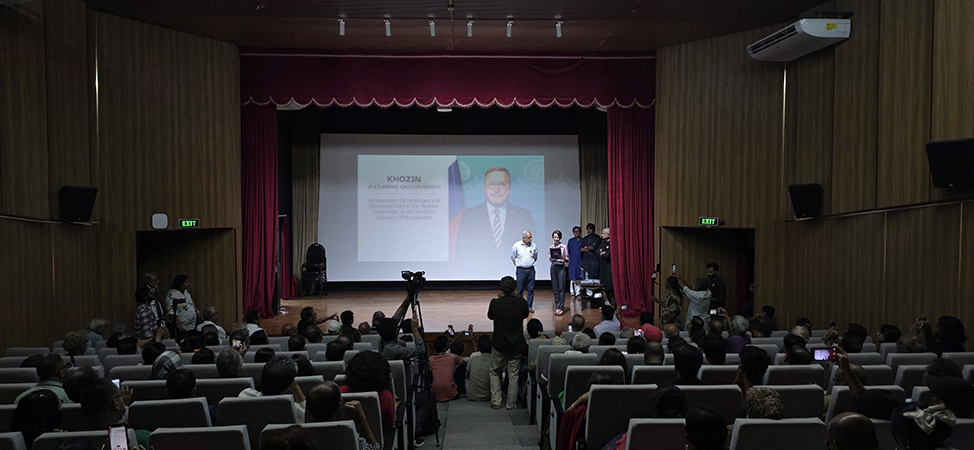
Dhaka, August 17: A special commemoration ceremony was held at the Russian Cultural Center in the capital today to commemorate ‘Operation Jackpot’, one of the most courageous and successful guerrilla operations in the history of the Liberation War, and to felicitate the naval commandos associated with the operation. Organized by ‘Smriti Ekattor’ and Russian House in Dhaka, in collaboration with ‘1971 Our Pride’, the event brought together veterans of Operation Jackpot, freedom fighters, guests and the general public to commemorate the historic naval operation of 1971.
The event specially commemorated Soviet sailor Yuri Redkin, who lost his life while clearing mines and salvaging sunken ships in Chittagong Port after the Bangladesh Liberation War.
Operation Jackpot: A historic chapter in the Liberation War
Operation Jackpot is known as the most successful and daring naval operation of the 1971 Liberation War. The Mukti Bahini Naval Commando Force was formed primarily around eight Bengali sailors who mutinied from the Pakistan Navy submarine PNS Mangroo, which was then stationed in the French port of Toulon. Later, many more naval personnel and young volunteers joined the force.
Planning and Training: The operation was planned in India in May 1971. The selected commandos underwent rigorous training for about two months at Ambagan in Plassey, Nadia. At the end of the training, each commando was given a limpet mine, a knife, a pair of swimming fins and some dry food; a stun gun for every three men and a transistor radio for the commanders.
Signal message: As a signal for the start of the campaign, it was planned to broadcast two specific songs on Calcutta Akashvani after the evening and morning news. The first song, “Ami Tomay Jat Shunyechim Gaan,” was broadcast on August 13, and the second and final signal song, “Amar Putul Ajaj Prothom Jabe Shashur Bari,” was broadcast on August 15—meaning that the campaign would be conducted that night.
Night of the operation: After midnight on August 15, 1971, i.e. in the early hours of August 16, this daring operation was conducted simultaneously in the ports of Chittagong, Mongla, Chandpur and Narayanganj. A team of 60 commandos led by Submariner Abdul Wahed Chowdhury (Bir Uttam) took part in the operation in Chittagong port, although in reality, a total of 37 commandos took part in the direct attack as one of the three teams could not reach Karachi. This naval operation was conducted under the leadership of Sector Commander Major Rafiqul Islam. At around 1:45 am, Chittagong port was rocked by a series of explosions. This sank several ships and barges anchored in the port, including the Pakistani MV Hormuz and MV Al-Abbas. MV Hormuz and MV Al-Abbas were carrying about 9,910 and 10,418 tons of weapons respectively.

On the other hand, 48 naval commandos led by Submariner Ahsanullah (Bir Pratik) launched an operation at Mongla port and sank 6 ships anchored in the port. Simultaneous attacks were also carried out on the river ports of Chandpur and Narayanganj that same night.
Results and Significance: According to multiple sources, in this single operation, about 176 commandos sank more than 44,500 tons of military equipment and damaged about 14,000 tons of equipment in one hour, and in subsequent operations in the following months, it is claimed that a total of more than 100,000 tons of equipment was sunk and more than 50,000 tons of equipment was damaged. As a result of this successful operation, the Pakistani government’s false propaganda that the situation in occupied Bangladesh had returned to normal. After this news was widely published in the world media, no foreign ship agreed to anchor in the ports of the then East Pakistan. As a result, the Liberation War received wide publicity in the international arena and the Pakistani army’s naval supply system of weapons was practically paralyzed.
In recognition of the success of this operation, many naval commandos were later awarded gallantry titles. Abdul Wahed Chowdhury, who led the operation, was later promoted to the rank of Commodore of the Bangladesh Navy and held various important positions, including Director of the Naval Intelligence Directorate.
Message from the Russian Cultural Center
The event was joined by the acting director of the Russian Cultural Center, Ms. Alexandra Khlevnai. In a post on the social media of the Russian Cultural Center after the event, Ms. Khlevnai addressed the audience, highlighting the extraordinary bravery of the Bangladeshi naval commandos and emphasizing the importance of preserving the memory of the Liberation War for future generations. She also recalled the long-standing friendship between the people of Bangladesh and Russia.

The post also said that a special message was read by the Ambassador of the Russian Federation to Bangladesh, Alexander Grigorievich Khozin, in which deep respect was paid to the Soviet sailors who participated in the dangerous mine clearance operation in Chittagong. The Russian Cultural Center said that the sacrifice of Yuri Redkin, who lost his life while participating in the Soviet mine clearance and rescue operation in Chittagong port on July 13, 1973, is an important chapter in the history of Soviet-Bangladesh friendship.
Five freedom fighters felicitated
Five freedom fighters and veterans present at the event were felicitated with commemorative crests for their contributions and services. The felicitators were—A.W. Chowdhury, Abidur Rahman, Syed Ahmed Majumder, Engineer Md. Mahbubur Rahman and Abdul Gafur and Momin Ullah Patwari.
The veterans who participated in the program shared their experiences and recalled the adventurous mission on the night of August 15-16, 1971. The program included the performance of the national anthems of Bangladesh and Russia, a documentary film was screened, a posthumous tribute was paid to the memory of Yuri Redkin, the symbolic songs of Operation Jackpot were performed, and a discussion was held with the veterans.


https://stapravda.ru/20221228/reyting_samyh_populyarnyh_hostingov_v_rossii_196445.html, рейтинг хостингов России подтверждает, что выбор надежного провайдера важен для бизнеса.