
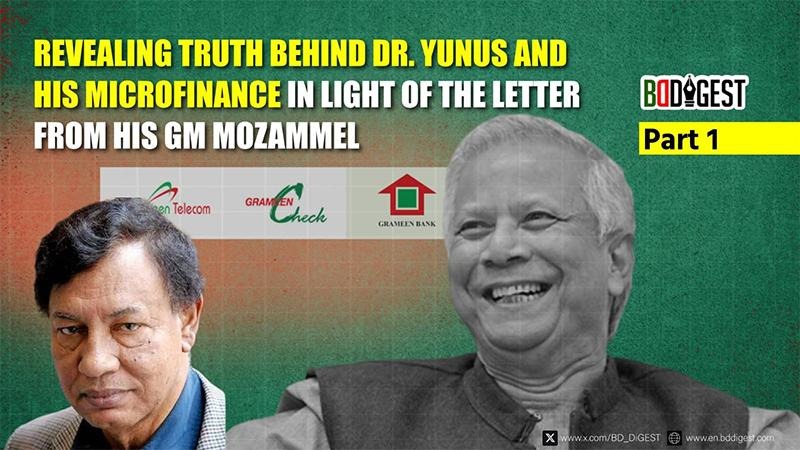
Editorial
-Nomad Dragonfly
Yunus and Grameen Bank won NobelPrize despite massive blunders for years. A glimpse of management style of Prof Dr Muhammad Yunus:
- -He was far above accountability due to his fame and prestige
- -A sign of personal interest, arbitrariness and nepotism
- -He frequently traveled abroad for personal gain and publicity
- -He acted capriciously even during the bank’s deep crisis
- -HedisabledBoard members by destroying chain of command
- -He was reluctant to hand over power and responsibilities
- -He followed inhumane policies in promotions and transfers
- -He ordered disbursement of loans abruptly in 1992 and 1993
In 1983, military ruler General HM Ershad, through an ordinance, established the Grameen Bank project of the then President of the Economics Department of Chittagong University, Professor Dr Muhammad Yunus, as a fully-fledged government-controlled bank. The institution gradually grew through domestic and foreign donations and by distributing microloans, and he also got some rules changed to reduce government share and influence in the bank.
Between 1991 and 2008, he created dozens of subsidiary enterprises using the label “Grameen” under his supervision and with his acquaintances, where various irregularities, nepotism and illegal transfer of funds occurred. In addition, various weaknesses were revealed in the management of the bank, including reluctance to maintain ethics and principles, and the promotion and transfer of employees. In 1998, Bangladesh Bank audited Grameen Bank for the first time and obtained many sensitive information, which Yunus hid from the Board members.
However, sensing potential danger, then General Manager Khandaker Mozammel Haque warned Yunus about various issues in personal letters on July 6, 1997, and January 1, 2000, and gave him guidance on how to overcome them. However, Yunus did not pay heed. He kept on earning various degrees, awards and honors abroad, and continued his PR campaigns.
Two more popular ventres of Yunus at that time were the Palli Phone scheme that mobile operator Grameenphone started providing to rural women borrowers in late 1990s and Grameen Check clothing under Grameen Samogree. In March 2000, when US President Bill Clinton came to Bangladesh in a state visit, he lauded microcredit schemes of Grameen Bank and BRAC, saying, the initiative was duplicated in over 60 countries and “ninety-four percent of the borrowers are women, and 98% of the loans are repaid.”
In 2006,Yunus won the Nobel Peace Prize jointly with the Grameen Bank for contribution to economic and social development through microcredit while becoming more vocal on domestic politicstogether with foreign diplomats and media regarding the elections slated for January 22, 2007.
After the army captured power on January 11, they offered Yunus the post of Chief Advisor, but he declined. However, a month later, Yunus expressed interest to enter politics and formed a party named Nagorik Shakti amid a ban on political activities as a state of emergency was in force. In May, Yunus announced that he was unable to move further due to lack of adequate support from the people with whom it would have been possible to form a party and put a strong and bright alternative before the people. “Instead of trying to create a new political arena with a weak party, let us wait for someone else to make the effort and succeed. The time has come to shift the nation’s economic and political gears. The nation’s spirit is ready to graduate to far higher levels. What is needed now is the creation of a new political party and leadership who can properly and skilfully do this,” he said in a letter to the nation.
On May 26, 2007, he faced reporters at the Dhaka airport who asked if he was taking the opportunity to form a team in an emergency or not. Dr Yunus said he did not want to form a party. “I said, let the election be done. But now in the new situation, I think that a party should be formed.”

The Crisis
In the letter dated January 1, 2000, Khandaker Mozammel first reminded Yunus about his 1997 letter (written in English) which said, “Your recent decision to formally allow debt consolidation at the borrower level will have an adverse impact on the financial stability of the bank. The repayment rate will look good for about 18 months but suddenly the repayment problems will come to the fore. If that happens, the bank will not be able to meet its mandatory financial obligations, such as staff salaries, pension benefits or the nearly $100 million installment of the government-guaranteed loan.”
In 2000, Khandaker Mozammel wrote, “I had hoped that you would discuss the issues mentioned in the memo with your senior colleagues and take steps to overcome the current crisis in Grameen Bank. It is a pity that you did not do so. The crises that I mentioned in the memo of July 1997 have intensified. Due to which the existence of Grameen Bank is currently facing danger.”
Mozammel said that at the end of December 1998, the bank’s income stood at Tk 227 crore and expenses at Tk 217 crore. A year later, the amounts stood at Tk 241 crore and Tk 242 crore.
The loan repayment rate in 1999 end was not higher than 65%. The amount of unpaid interest was Tk 170 crore, but Grameen Bank showed it as income he added that after December 31, the unpaid interest would cross Tk 210 crore.He explained that the provisions were shown lower (40% instead of 20% and in pension scheme 30% instead of 60%) to avoid loss.
“Our 20%-loan position is currently Tk1,000 crore. Out of this, the amount of overdue loans is about Tk270 crore and another Tk30-40 crore is likely to be added in the next 3 months.The bank’s debt is Tk1,100 crore. Out of this, the foreign debt is about Tk500 crore, which has to be repaid at the rate of 2% in the next 10 years in dollar. About Tk500 crore will have to be paid to various domestic companies in the next 1 to 5 years, with an interest rate of 8%,” said Mozammel.
Careless And Authoritarian
Mozammel lamented that despite all the crises in the bank, Yunus was away from the country for an average of 12 days a month, or about 130 days a year. In November 1999, he was at the bank for only 3 days. Yunus’s four-month foreign trips brought him personal gain and publicity, but the bank had not benefited, “rather, there is a huge loss.”
The then GM also said that Yunus’ “incompetence in transferring power and responsibility has pushed Grameen Bank towards destruction. Since in your absence, the acting managing director is supposed to take decisions on various issues, he practically does not have the power to make decisions. That is because you have already destroyed the balance of the chain of command of the bank management and made it ineffective.”
Mozammel said, “Your reputation and prestige have reached such a level that you are far above any kind of accountability.”
On the other hand, while the financial and administrative system of Grameen Bank had been in a state of extreme deterioration in 1995, it did not improve in 2000, “but in some cases, it spread and took on a complicated form.We are all aware that in 1993-94, loans were distributed without any regard for economic discipline and under your direct encouragement and instructions.”
In the letter, Mozammel mentioned that Yunus had not given any explanation for the unrealistic decision, adding that the loan amount distributed in 1992-93 was equal to all the loans disbursed from 1976 to 1992.
Next Part: The Fund Transfer Controversy

https://stapravda.ru/20221228/reyting_samyh_populyarnyh_hostingov_v_rossii_196445.html, рейтинг хостингов России подтверждает, что выбор надежного провайдера важен для бизнеса.