

BD Digest Desk
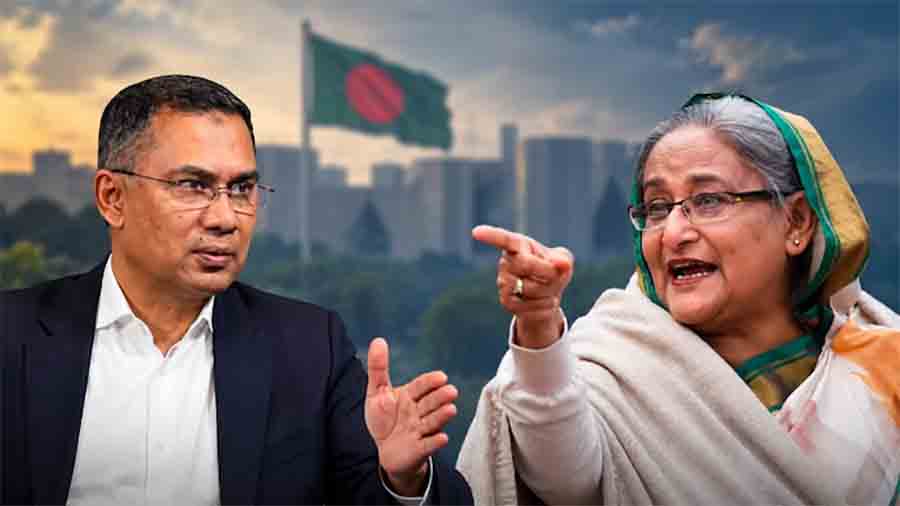
Awami League President Sheikh Hasina has criticized the current Prime Minister of Bangladesh Tarique Rahman’s decision not to attend the BRICS summit in New Delhi.
In his words, the decision is “immature” and contrary to Bangladesh’s national interests.
Sheikh Hasina has raised the question, if her presence in India is an obstacle to Tarique Rahman’s visit, then how was that visit possible when her father—former President of Bangladesh Ziaur Rahman—visited Delhi, even though he was living in exile there?
Bangladesh Home Minister Salahuddin Ahmed did not attend the first BIMSTEC Home Ministers’ Meeting held in New Delhi on Tuesday, October 13.
The absence of two senior Bangladeshi leaders from important meetings in the same city has raised fresh questions about Dhaka’s diplomatic policy amid tensions with India.
In an exclusive interview given to PTI published on October 14, Sheikh Hasina wanted to know, “So how can my presence in Delhi prevent Ziaur Rahman’s son Tarique Rahman from coming to India today? What is the real reason for this decision?”
Bangladesh did not attend the BRICS summit on September 12 and 13. Dhaka’s argument was that Tarique Rahman was invited not as the Prime Minister of Bangladesh, but as the President of BIMSTEC.
Meanwhile, Dhaka has requested that Sheikh Hasina be ‘extradited’ and sent back to Bangladesh. According to the BNP-led Bangladesh government, Sheikh Hasina’s stay in Delhi is a major obstacle to improving relations between the two countries.
After becoming Prime Minister, Tarique Rahman visited Malaysia and China. The difference between those visits and his decision to skip India is striking. China has been showing interest in important infrastructure projects in Bangladesh.
Sheikh Hasina, who has been in India since August 2024, has announced her return to Bangladesh by December 2026. She also said that if she returns to the country, she may face arrest, imprisonment, and even death.
A tribunal sentenced Sheikh Hasina to death in absentia in November 2025 in a case filed for allegedly ordering the ‘use of force’ to control the July-August 2024 protests.
In an interview with PTI, 78-year-old Sheikh Hasina questioned Tarique Rahman’s reasoning behind skipping important meetings in New Delhi, drawing on events from nearly five decades ago.
In the interview, Sheikh Hasina recalled that Tarique Rahman’s father and former President of Bangladesh Ziaur Rahman had visited New Delhi in 1979. Sheikh Hasina was living in India at the time after Sheikh Mujibur Rahman and some of his family members were killed in August 1975.
Sheikh Hasina told PTI, “When he visited Delhi in 1979, I was in Delhi. When he went to London in 1980, I was also in London. My presence in those two cities did not stop him from going there.”
Through this comparison, Sheikh Hasina wants to convey that despite political differences, there is no sufficient reason for Tarique Rahman to avoid visiting India because of her presence—especially when his father visited those cities despite Sheikh Hasina’s presence.
Sheikh Hasina said, “It is very unfortunate that Bangladesh did not participate. In my opinion, it was an immature decision and did not serve the national interest of Bangladesh.”
His argument is that Bangladesh has lost the opportunity for economic cooperation by not participating in the conference of major emerging economies.
Sheikh Hasina also criticized the use of diplomatic communication to convey messages in the country’s internal politics. According to her, Bangladesh’s foreign policy should be guided by national interests rather than political calculations.
The controversy erupted ahead of the BRICS summit hosted by India in New Delhi on September 12 and 13.
Prime Minister Narendra Modi invited Tarique Rahman, as the chair of BIMSTEC, to a special discussion session at the summit. BIMSTEC is a regional alliance of seven countries; Bangladesh holds the rotating chair.
In the invitation sent to Tarique Rahman on July 14, Modi wrote that his participation would “enrich the discussions.” However, Dhaka drew a distinction between an invitation as the leader of Bangladesh and an invitation as the president of a regional organization.
While speaking to reporters on September 10, Bangladesh’s State Minister for Foreign Affairs Humayun Kabir questioned the invitation.
He said, “How will we go? Has anyone from the Bangladesh government been invited? Our Prime Minister has not been invited. Who said our Prime Minister has been invited? The BIMSTEC President has been invited.”
He also hinted that Tarique Rahman’s first visit to India should be a bilateral one, adding that the visit would happen “if the timing is right.”
India’s claim was that Tarique Rahman was invited to attend the BRICS special session as well as for a separate bilateral visit. Bangladesh, however, did not send any official delegation to the BRICS summit. The dispute over the invitation is also linked to Sheikh Hasina’s position in India.
Tarique Rahman did not attend the BRICS summit—almost a month later, a senior Bangladeshi leader was absent from another multilateral meeting hosted by India.
Bangladesh Home Minister Salahuddin Ahmed did not attend the first BIMSTEC Home Ministers’ Meeting in New Delhi on October 13. Instead, Dhaka sent a delegation led by Senior Secretary of the Home Ministry, Manjur Morshed Chowdhury.
Bangladesh’s Prothom Alo reported on October 12 that the decision was communicated to the BIMSTEC Secretariat through a diplomatic letter on October 4. The name of the Home Minister was not on the list of Bangladesh’s four-member delegation.
Several senior Bangladeshi government officials, speaking on condition of anonymity, told Prothom Alo that the decision was taken in the context of tensions between the two countries.
The meeting was significant because it was the first BIMSTEC Home Ministers’ meeting held nearly three decades after the regional organization was established in 1997.
The meeting discussed counter-terrorism, cross-border crime, intelligence cooperation, human trafficking, and other challenges to regional security.
India-Bangladesh relations deteriorated after the Hasina government collapsed in the face of protests in August 2024 and her stay in Delhi. Since then, Dhaka has been demanding Sheikh Hasina’s ‘extradition’.
Sheikh Hasina has rejected the criminal proceedings against her as politically motivated.
The dispute intensified after Sheikh Hasina addressed a virtual press conference from New Delhi on August 5. Bangladesh’s Foreign Ministry later said that the incident had “spoiled” the atmosphere surrounding Tarique Rahman’s proposed visit to India.
New Delhi said it did not organize the press conference and did not support Sheikh Hasina’s statements about the Bangladesh government.
In an interview with German broadcaster Deutsche Welle on September 24, Humayun Kabir said that relations between the two countries should be built on the basis of dignity and equality. He also called for creating a more favorable environment ahead of Tarique Rahman’s visit.
However, in a recent interview with PTI, Sheikh Hasina said that it is not possible for Bangladesh to hold its relations with India hostage due to the politics surrounding her exile.
The absence of senior Bangladeshi leaders from the meeting in New Delhi for two consecutive times has sparked a storm of discussion centered around Sheikh Hasina. Bangladeshi leaders also seem reluctant to go to India for major multilateral meetings.
At such a time, Sheikh Hasina’s statement raises a new question – will pushing India away protect Bangladesh’s interests, or could it harm the country?

https://stapravda.ru/20221228/reyting_samyh_populyarnyh_hostingov_v_rossii_196445.html, рейтинг хостингов России подтверждает, что выбор надежного провайдера важен для бизнеса.