
❐ BD Digest Desk
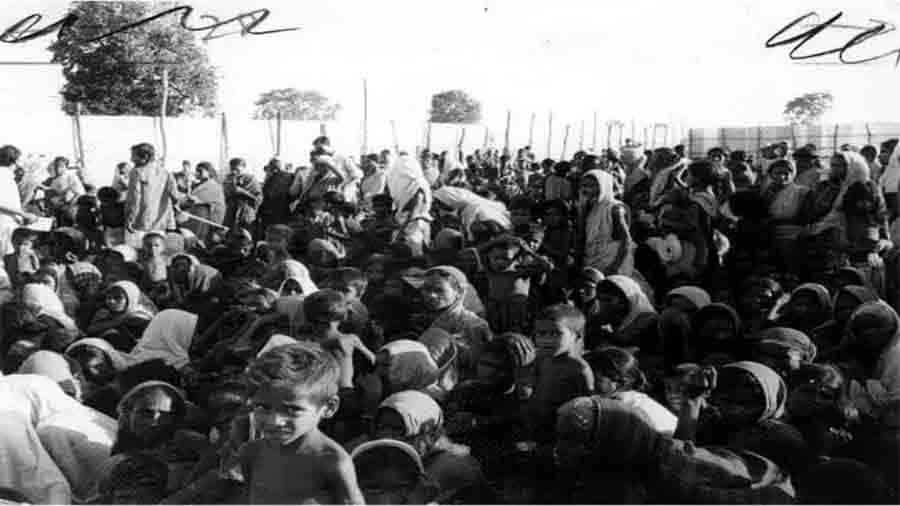
The 1974 famine was one of the most severe humanitarian crises in Bangladesh’s post-independence history. It was not simply the result of a natural disaster, but also a complex combination of post-war vulnerability, long-term poverty, administrative constraints, the global economic crisis, and Cold War geopolitics.
Amartya Sen’s Poverty and Famines: An Essay on Entitlement and Deprivation (Oxford University Press, 1981) and Naomi Hossain’s analysis (especially the chapter “Accounting for 1974, ‘Natural Calamities’”) make this phenomenon even clearer.
Background and long-term vulnerability
After the liberation war, infrastructure was destroyed, administration was weak, and millions of people were malnourished and displaced. Many families suffered from malnutrition for five years or more due to the cyclone of 1970, war, and inflation. The 1975-76 nutrition survey showed that 59 percent of the rural population was below the minimum calorie requirement (2,122) and all members of households with less than three acres of land were suffering from a lack of calories, vitamins, and minerals. In this context, famine is seen as the culmination of long-term poverty rather than a sudden event.
Floods: The horrors of the Yamuna and Teesta
Amartya Sen wrote, “First the floods, then the famine”—this is a brief history of the 1974 famine. The Yamuna (Brahmaputra) burst its banks six times between June and August. Although the water level was lower than in the 1955 floods, the Yamuna remained above the danger level for a long time in 1974, and the Teesta crossed the danger level for 29 days (it never reached that level in 1955). The river erosion in an area of 2,000 people per square mile left about 24,000 people suddenly homeless and landless between June and October.
According to field research by Muhiuddin Alamgir, by the end of July, flood-affected areas were witnessing deaths of people and livestock, damage to agricultural land and crops, destruction of houses, and loss of employment. This, coupled with the shortage of drinking water and rising prices, led to the spread of epidemics such as famine and cholera. In early August, additional deaths began to be reported from various areas, including Rangpur.
Sheikh Mujibur Rahman called it “natural calamities” in an interview with John Pilzer and admitted in parliament that about 27,000 people died of starvation and disease.
Amartya Sen’s Entitlement Theory: Not Food Shortage, but Failure of Rights
Chapter 9 of Sen’s book (Famine in Bangladesh) shows that in 1974, overall rice and wheat production and per capita food availability were higher than in previous years (index 106 based on 1967). Production also increased in the most affected districts (Mymensingh, Rangpur, Sylhet). Therefore, it was not a Food Availability Decline (FAD) famine.
The real reason was the failure of exchange entitlement. The main asset of rural workers was their labor. The floods hit during the peak employment period of June-August, drastically reducing job opportunities. As a result, their wage rate in exchange for rice fell sharply—by 35 to 70 percent in some districts (about 70 percent in Mymensingh, 58 percent in Rangpur and Sylhet). Working families, already close to the minimum subsistence level, suddenly lost the ability to buy food. Most of the people who took shelter in the langarkhanas were landless workers or very small farmers.
Government response and international context
The government used the floods to seek foreign aid, but donors suspected that it was a “cry wolf” tactic for budget support. Secret US embassy cables indicated that the government was looking at humanitarian relief as a way to provide budget support. In late September, the prime minister admitted the famine and opened 4,300 langarkhanas, aiming to feed three million people a day. But the system was weak.
John Pilzer’s documentary An Unfashionable Tragedy shows that “Bangladesh fatigue” had developed in the international community—people no longer wanted to pay attention to the same tragic images over and over again.
The United States’ PL-480 food aid to Cuba was delayed due to jute exports, which was further complicated by the Cold War context.
Death toll and long-term effects
The official estimate is 26-27 thousand, but independent studies (including Alamgir) estimate the total death toll at 1 million-1.5 million (including starvation and disease). The crisis was followed by political changes and a new emphasis on food security and livelihoods in national development policy—known as the “subsistence crisis settlement.”
Main source
Amartya Sen, Poverty and Famines (Oxford University Press, 1981), especially Chapter 9.
Naomi Hossain’s analysis: Accounting for 1974, ‘Natural Calamities’
Field research by Muhiuddin Alamgir
This famine teaches that even if there is food, death becomes inevitable if people do not have rights and purchasing power. The combination of natural disasters, economic structures, and international politics can create humanitarian catastrophes—which are still relevant to the principles of food security and disaster management today.

https://stapravda.ru/20221228/reyting_samyh_populyarnyh_hostingov_v_rossii_196445.html, рейтинг хостингов России подтверждает, что выбор надежного провайдера важен для бизнеса.