
Opinion
If you disagree with the conclusion that the West (US+Europe) was active in the regime change in Bangladesh, you can feel free to skip this discussion because the main text is based on this conclusion. Even if everything else is excluded, the US trade agreement proves that a loyal government was essential for them here. Besides, the global situation also indicates that.
After regime change in Bangladesh, after the long resistance in Syria, the formation of a loyal government, desperate efforts in Iran, the next target will move further east to Myanmar. Bangladesh will be the next launch pad for Myanmar. Among all the countries mentioned, Bangladesh is less important, but regime change in Bangladesh is the easiest, the easy task has been done first.
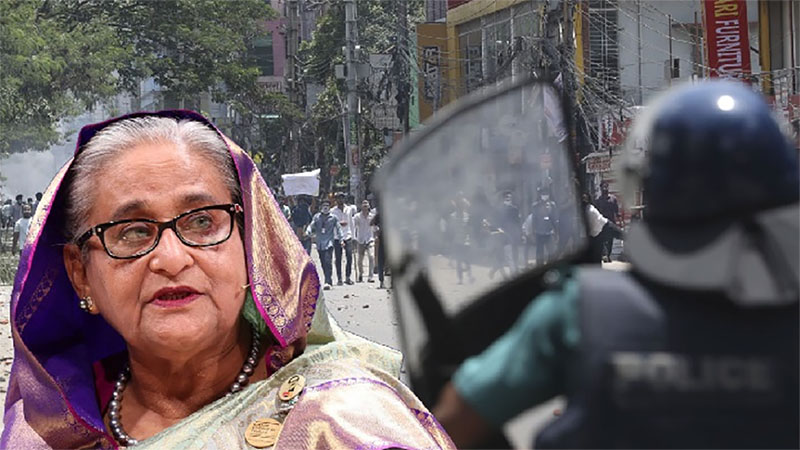
The main purpose of this article is to discuss the foreign policy failures of the then ruling party Awami League’s attempts to confront regime change. Needless to say, this is a completely personal observation, if you disagree, debate is welcome. But rude arguments with a big neck are not allowed. As I get older, I don’t like these things.
The Bangladesh state was created by opposing US imperialism by the book. The communists of Bangladesh did not lead this opposition. At that time, one group of the two powerful communist parties opposed the creation of Bangladesh, while the other group was in the second row. The Awami League took the lead, which was not a communist party in any sense. Opposition to imperialism was not the main goal of its politics. But the fight for territorial rights on the basis of nationalism basically brought it face to face with opposition to imperialism, and the Awami League did not retreat from that fight with its nationalist ego.
The middle-class, lower-class bourgeoisie carried out this important task. This happens in history. Some people achieve great things beyond their own abilities. Bangabandhu Sheikh Mujibur Rahman’s proverbial organizational skills and patriotism, despite the ideological polarization of the world at that time – the US opposition – made the amazing event of the creation of Bangladesh possible.
At the beginning of the 21st century, when trade wars have started again in the world, the post-Soviet unipolar world order has been challenged by the rise of China and the consolidation of Russia, and US aggression has resumed, and many governments opposed to US interests are falling one after another in the lab test of the “Color Revolution” in the name of the Arab Spring, the Awami League is back in power in Bangladesh.
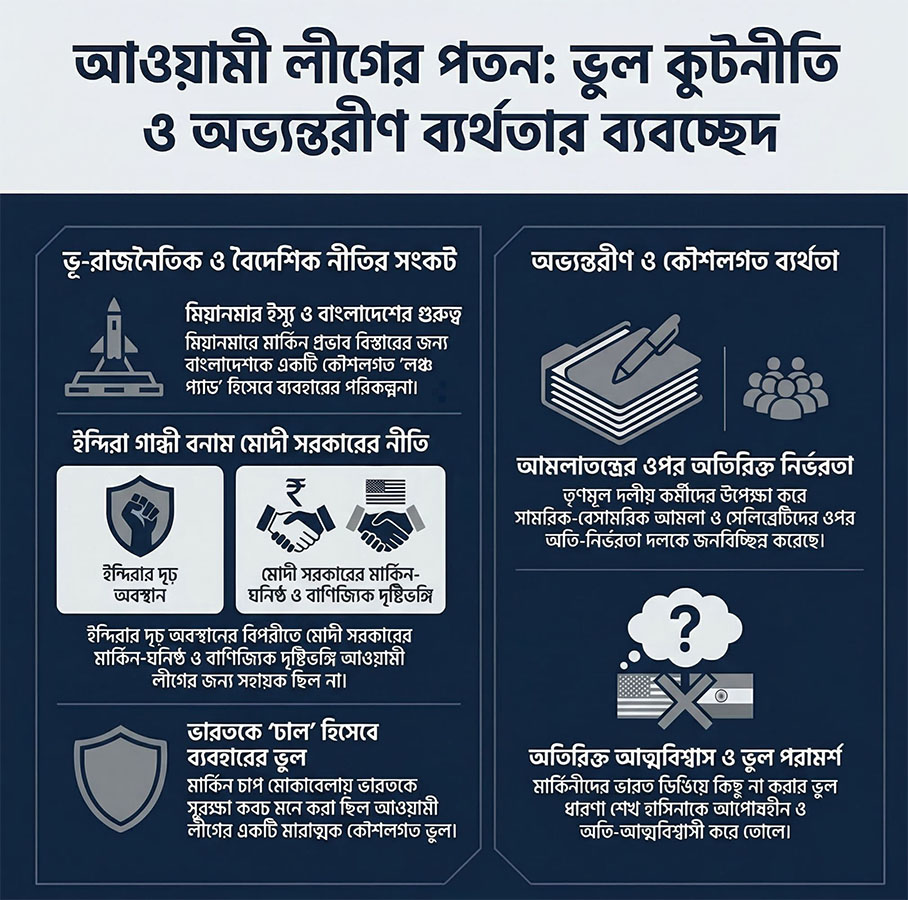
This is probably unfortunate for both the Awami League and Bangladesh. Even more unfortunate for the Awami League – the results of the Indian elections in 2014. Historically, the Congress in the center of India and the CPM in West Bengal – have always been the best choice for the Awami League. During the liberation war, India, despite being a poor country itself, fought internationally for Bangladesh under the leadership of Indira Gandhi is unforgettable. Henry Kissinger – He personally hated both Indira Gandhi and Sheikh Mujib and did not hesitate to express it.
The Awami League was able to assuage some of Bangladesh’s long-standing and justified grievances over the Ganges water in 1996, when India had a leftist prime minister, IK Gujral, at the centre and the CPI(M) in West Bengal. We will remember that later, the Awami League was unable to secure the rights to Teesta water, when the BJP was at the centre and the Trinamool was in West Bengal.
Let’s get back to the main topic.
The BJP came to power in India in the 2014 elections. The BJP is a shadow organization of the Hindutva RSS, formed in 1925. They go by various names like Hindu Mahasabha, Bajrang Dal. Just as the Islamists have an agenda of Islamic nationalism, so do they have an agenda of Hindu nationalism. On the other hand, the Awami League has secular Bengali nationalism. Theoretically, it is the complete opposite. Almost all religious nationalists are agents of imperialism. During the British era, both the RSS and Jamaat were on the side of the British. Later, both of them protected the interests of American imperialism. So are the Zionists.
There is strong criticism of Awami League President Sheikh Hasina against the BJP in 1992. On the other hand, there is also news of BNP expressing joy over the fall of the Congress and the BJP’s rise to power.
But the Awami League had to establish a working relationship with the BJP, there was no alternative. Bangladesh was able to obtain several things from India that were in its interests, such as the exchange of enclaves and the increase in maritime borders.
On the other hand, by eliminating the rebels of India’s Seven Sisters, Bangladesh permanently resolved India’s long-standing security threat in the region, and also provided transit facilities through Bangladesh. But the BJP government did not provide proper support to the Awami League on sensitive issues like the Teesta water agreement and stopping border killings. This opportunity was seized by the opposition forces of the Awami League in Bangladesh. Along with religious narrow-mindedness, anti-India sentiment has become the main card in Bangladeshi politics, which has become difficult for the Awami League to deal with.
It becomes more difficult for the Awami League when the United States wants to exert more influence in Bangladesh. The establishment of nuclear power plants with Russian assistance, the huge push for infrastructure development with Chinese assistance, and the achievement of self-sufficiency in the agricultural sector – all these make the Americans worried.
Sheikh Hasina is not a communist like her father. But as nationalists, they are the type of politicians who will not compromise after a certain point and will become stubborn.
Where others treat the US ambassador like a god, you have to wait for an appointment to meet Sheikh Hasina, Sheikh Hasina openly criticizes the foreign policy of the Americans. Indira Gandhi was a politician of this genre. But Indira Gandhi is not the current reality, Sheikh Hasina’s reality is Narendra Modi – who is the opposite of this genre. Not so much a politician, but more of a sales person.
His ridiculous attempt to prove how close a friend he is to the US President. Modi’s India has created the impression that they are the US representatives in South Asia, where the Americans will not carry out any regime change operation without their approval.
The Awami League was finally caught here. The Americans were able to unite all the forces that opposed Sheikh Hasina within the country. Left, right, activists, extremists. They also became active within the Awami League. As a result, Sheikh Hasina’s main force – her organization and workforce – became neglected and became lifeless. The government and the party were completely taken over by the military-civilian bureaucracy and cheap celebrities.
On the other hand, Sheikh Hasina’s anti-Americanism is becoming very clear and undisguised. Narendra Modi’s closeness to the BJP is also evident. Perhaps his advisors gave him the idea that even if the Americans get angry, they will not do anything to bypass India. This trust makes him overconfident. He considers India as a shield in the US policy towards Bangladesh.
What happened in the end proves that the Americans did not care about India in the “Bangladesh Regime Change” operation, they did their own thing. Or even if India was aware, it did not have the strength to disagree. This is natural according to Narendra Modi’s character. He is not Indira Gandhi, who could have given a strong answer to Henry Kissinger, who could have raised questions of policy and self-respect instead of trade.
However, India was probably able to obtain the option of saving Sheikh Hasina’s life from the Americans.
Let’s end with the last assumption.
If China and Russia come out of their shell and stand by Iran, World War III will officially begin. Otherwise, Iran will eventually fall. After Iran, US aggression will move further east. Pakistan, Afghanistan, India, Bangladesh, Myanmar.
Pakistan is in their hands. Afghanistan can be a little disturbing. India is also in their hands. Bangladesh is in their hands. The next big move is Myanmar.
South Asia, an important theater of the declared or undeclared world war. Many years later, when the final chapter of this history is written, there will definitely be a mention of Sheikh Hasina and the Awami League of Bangladesh. There will be others too. The place will definitely be determined according to the role that everyone played, is playing.

https://stapravda.ru/20221228/reyting_samyh_populyarnyh_hostingov_v_rossii_196445.html, рейтинг хостингов России подтверждает, что выбор надежного провайдера важен для бизнеса.