
– Preset71
During the Six-Point Movement, Sheikh Mujibur Rahman was arrested late at night on May 8, 1966, under the Defense of Pakistan Rules. On January 17, 1968, he was released at midnight only to be rearrested by Pakistan’s military intelligence. This time, the accusation was the “Agartala Conspiracy.” A new case was filed titled “State vs. Sheikh Mujibur Rahman and Others.”
At that time, many top leaders of the Awami League were in prison. Amena Begum and Mizan Chowdhury managed to continue party activities. The uncompromising Chhatra League persisted with strikes and protests over the Six-Point Program. Meanwhile, a few senior Awami League leaders opposing the Six-Point Program joined a newly formed coalition called PDM (Pakistan Democratic Movement). Among them, Abdul Salam Khan and Ataur Rahman Khan took the initiative to provide legal support to Sheikh Mujibur Rahman by preparing a team of local lawyers.
After learning about the Agartala Conspiracy Case, expatriates in the UK became concerned. On April 6, the “Pakistan Students Federation” organized a protest and rally at Speaker’s Corner in London’s Hyde Park. Though it was called by students, the event was supported by organizations like the “Pakistan Welfare Association” and the “Pakistan Caterers Association.” As a result, nearly seven to eight thousand Bengalis from various UK cities joined the meeting. After the meeting, participants marched to the Pakistan High Commission in Lowndes Square to submit a memorandum. At this time, a few individuals led by Zakaria Khan Chowdhury and Sultan Mahmud Sharif entered the High Commission and vandalized Ayub Khan’s portrait and set it on fire. The agitated Bengalis expressed their faith in Sheikh Mujibur Rahman and vowed to secure his release at any cost. The BBC broadcasted the news at 10 PM that night, and the event was featured on the front page of *The Times* the following day. Until that point, this was the largest gathering of Bengalis in the UK.
During Sheikh Mujib’s visit to London in 1963, many students had met him. By 1968, many of these students had returned to the country. Among them were Barrister Moudud Ahmed and filmmaker Alamgir Kabir. On May 27, they wrote a letter to Minhazuddin, one of the organizers of the East Pakistan House in London, urging him to consult a prominent British lawyer for legal assistance on behalf of Sheikh Mujibur Rahman.
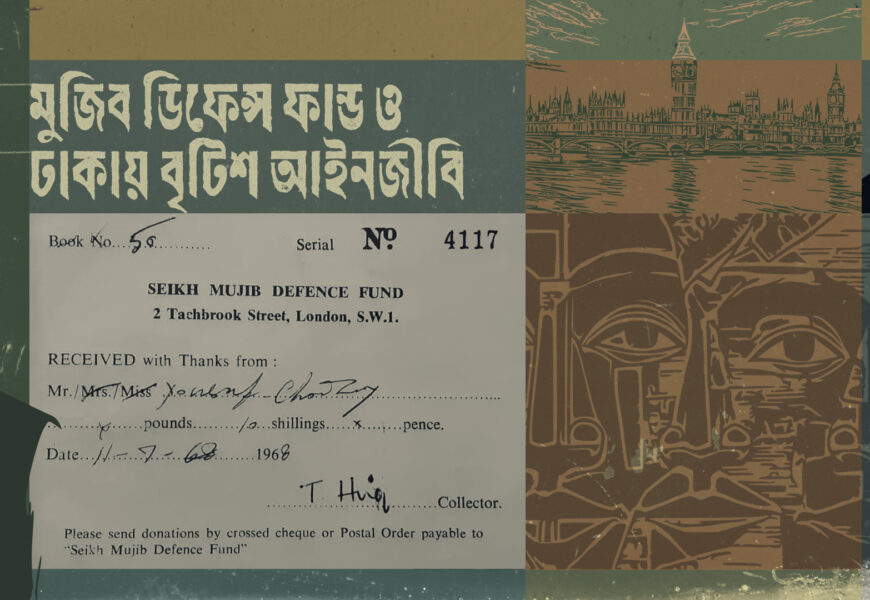
Minhazuddin and Zakaria Khan Chowdhury collaborated with Amnesty International to engage a renowned legal firm, “Bernard Sheridan,” and contacted Thomas Williams QC, a barrister and Labour Party MP. Subsequently, they reached out to Bengali community leaders in the UK. After several meetings, it was decided that the British lawyer’s travel expenses would be covered by the Bengali community. To this end, a 12-member committee named the “Sheikh Mujib Defense Fund Committee” was formed, chaired by Abdul Mannan Chanu Miah, with Minhazuddin as secretary and Hafiz Majiruddin as treasurer. An account titled “Sheikh Mujib Defense Fund” was opened at the National Provincial Bank with an initial deposit of £810. An office was established at a restaurant owner’s address in the Kensington High Street area, and Sultan Mahmud Sharif took charge of its operations.
On June 19, the Agartala Conspiracy Case trial began at a special tribunal in Dhaka Cantonment. After three days of proceedings, the court was adjourned, and the next hearing was scheduled for July 29. On July 25, Thomas Williams QC arrived in Dhaka and was welcomed by the team of lawyers. Barristers Moudud Ahmed and Amirul Islam were appointed as assistants. On July 29, Thomas Williams appeared in court as the chief defense counsel in the case “State vs. Sheikh Mujibur Rahman and Others.”
The expatriates did not stop their efforts after sending the lawyer. On July 14, another protest rally was held at Hyde Park, followed by a demonstration in front of the Pakistan High Commission. The most striking aspect of this rally was a Bengali woman leading the procession with her child in a stroller, followed by rows of men and women. British media, including the BBC, covered the event extensively.
Meanwhile, the expatriates learned that Ayub Khan would visit London on July 21 and stay at Claridge’s Hotel. On July 23, about 50 young Bengalis surrounded the hotel, chanting slogans demanding Ayub’s resignation and Sheikh Mujibur Rahman’s release. As the media gathered, Ayub secretly left the hotel and moved to the Selsdon Hotel in Croydon. Upon learning this news, over 100 Bengalis marched with torches to the Selsdon Hotel on July 27 and staged an all-night protest. This form of protest, unfamiliar to the British, intrigued the public and media, putting Ayub Khan in an embarrassing situation.
On July 31, the Pakistan Students Federation organized another torchlight procession. On August 6, *The Times* published a detailed report on the trial proceedings, including Thomas Williams’ arguments. Inspired by this, expatriate Bengalis became even more active in their campaign to secure Sheikh Mujibur Rahman’s release.
Sources
1. Newspapers on Bangabandhu: Agartala Conspiracy Case, PIB, 2019.
2. Politics of Bangladesh in Britain, Faruk Ahmed, Sahitya Prakash, February 2012.

https://stapravda.ru/20221228/reyting_samyh_populyarnyh_hostingov_v_rossii_196445.html, рейтинг хостингов России подтверждает, что выбор надежного провайдера важен для бизнеса.