

Opinion
The controversial death toll figures from the July coup that ousted Sheikh Hasina need to be investigated.
The UN must provide the basis and evidence for the death toll they have published.
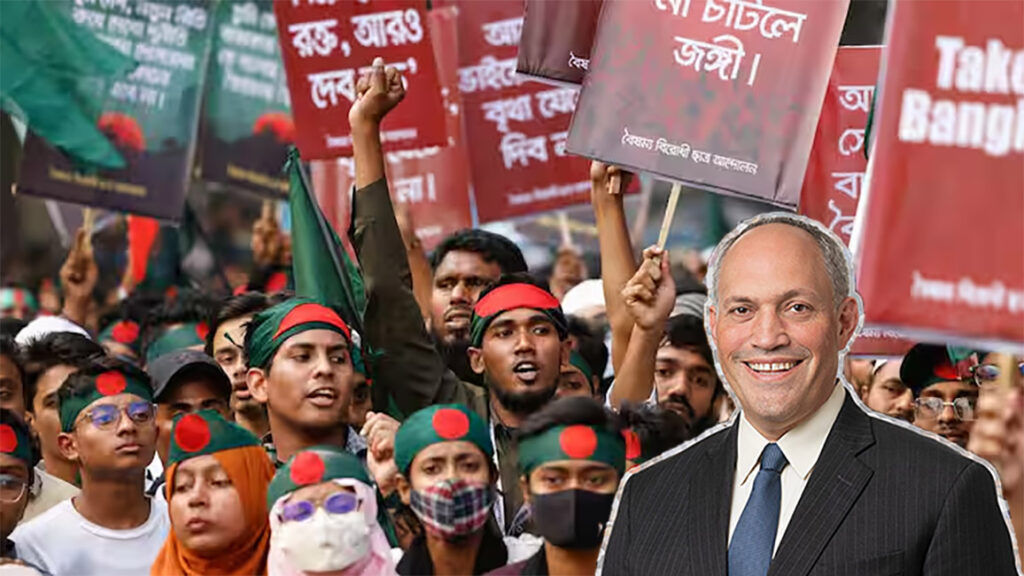
Protests spread across Bangladesh in July and August 2024. They resulted in the ouster of Sheikh Hasina, Bangladesh’s long-time prime minister and daughter of the country’s founder. Sheikh Hasina and her Awami League embraced secularism and sought to maintain communal and social tolerance in Bangladesh.
Historically, Bangladeshis have viewed Islamist extremism negatively due to the role of Jamaat-e-Islami during the country’s birth. Jamaat-e-Islami’s role in the genocide that occurred during the country’s birth contributed to this attitude.
Both the United States and the United Nations have downplayed concerns about radical Islamism, while accepting without critical scrutiny Islamist accusations against critics of links to Islamist terrorism.
In his memoir Power & Principle, Zbigniew Brzezinski, President Jimmy Carter’s national security adviser, recalled the debates that took place before Ayatollah Ruhollah Khomeini’s victory over the Shah in the 1979 Islamic Revolution.
“The State Department and the US ambassador to Tehran, William Sullivan, even opposed providing the Iranian government with crowd control equipment, because they believed it could hinder the necessary negotiation process,” Brzezinski wrote.
He also recalled, “As the crisis deepened, it became increasingly clear to me that lower-level State Department officials—particularly Henry Precht, the head of the Iran desk—were acting out of a principled dislike of the Shah and seeking his complete removal from power.”
Hosni Mubarak was a dictator in Egypt. During his rule, the military presided over a system in which their influence over the economy distorted competition, often by squeezing out private-sector competitors through unfair contracts or procuring subsidized supplies.
During the Arab Spring 15 years ago, the Obama administration welcomed the fall of Mubarak and cleaned up the image of the Muslim Brotherhood, accepting without scrutiny the organization’s promises of democracy and reform, even though its actions suggested otherwise.
In 2022, George Clooney claimed that his wife Amal helped the Muslim Brotherhood draft their new constitution. The constitution removed provisions on women’s equality and subordinated women’s status to Islamic law . Gender was also removed as a criterion for discrimination in the discrimination clause.
Although Amal presents herself as an international human rights activist, if her husband is to be believed, she has worked against human rights and women’s empowerment in Egypt and has helped to spread Islamist views. This does not mean that she is an Islamist herself; she is not. Rather, like many progressives, she has been overly naive about the ultimate goals of Islamist movements.
Egyptians quickly learned the value of their naivety. Once the Muslim Brotherhood’s proposed constitution and policies revealed its true intentions, the public began to oppose the organization on a large scale. The ouster of Mohamed Morsi on July 3, 2013, is more likely to be called a revolution than a coup—because millions of Egyptians who had embraced the Muslim Brotherhood just a year earlier later felt a deep revulsion toward the organization.
It is in this context of naivety and willful disregard for reality regarding Jamaat-e-Islami that the US and the UN should carefully consider their statements.
To justify the ouster of Sheikh Hasina, the United Nations said 1,400 protesters were killed in the chaos that preceded the fall of her government and the banning of her party. The Awami League admitted that about 800 people were killed in the protests.
After Sheikh Hasina was ousted, Nobel Peace Prize winner Muhammad Yunus became the ‘Chief Administrator’ of Bangladesh’s interim government. He had a falling out with Sheikh Hasina over her own corruption. He had every reason to exaggerate the death toll to make his opponent politically unacceptable. Nevertheless, he cited the figure of 800 deaths in the UN General Assembly until the UN unnecessarily inflated the figure.
Along with US Secretary of State Marco Rubio and US Ambassador to the UN Mike Waltz, Indian Foreign Minister S Jaishankar and India’s Permanent Representative to the UN Harish Parvataneni should demand that the UN release the names of those killed.
The Awami League can identify victims, including anti-government students, policemen, and communal minorities killed by students and their Islamist supporters. But the Jamaat-e-Islami cannot, because most of the victims they claim never existed.
It is understandable that uncertainty may prevail in the final stages of a crisis. But UN experts, who receive high tax-free salaries, should act more responsibly than fabricating numbers to disparage people with political positions they dislike.
But the reality is that the UN fueled the anti-Sheikh Hasina violence. UN Secretary-General Antonio Guterres—a veteran Portuguese socialist—embrace Yunus. Yet Yunus’s reputation at international conferences in Clinton Foundation-affiliated circles is in stark contrast to the perception of ordinary Bangladeshis. Ordinary Bangladeshis know him best for his role in trapping the poor in debt through Grameen Bank—a microfinance scam, in the author’s words, that of paying back loans after receiving a salary.
If Guterres cannot now provide the basis for the UN’s claim, it would seem that UN and Western officials have manipulated the data to support his efforts to discredit Sheikh Hasina, promote Yunus, and ban the Awami League, which is the most popular political party in Bangladesh despite legitimate criticism of the abuses of Sheikh Hasina’s regime.
Islamists have led Iran to disaster. Thousands of Iranians have lost their lives this year alone protesting against the oppressive regime. Thousands were also killed during the ‘Women, Life, Freedom’ movement. The Egyptians reached the dangerous edge of Islamism and returned from there. Bangladesh is still teetering on that dangerous edge.
It is understandable why Prime Minister Tarique Rahman is not demanding that the UN release the names of those claimed to have been killed. Because the UN’s exaggerated numbers have created the basis for disqualifying the Awami League from the elections and empowering the Jamaat-e-Islami. If the UN is forced to admit that its experts fabricated the death toll, Rahman will immediately lose his legitimacy. He essentially won an election in which only one party was allowed to contest.
If the UN cannot reveal the truth, then it is time to overturn the results of the anti-Sheikh Hasina coup and hold new elections. In such elections, those citizens of Bangladesh who believe in secularism, democracy, economic growth, and social tolerance can freely compete.
-Michael Rubin’s opinion published in First Post.

https://stapravda.ru/20221228/reyting_samyh_populyarnyh_hostingov_v_rossii_196445.html, рейтинг хостингов России подтверждает, что выбор надежного провайдера важен для бизнеса.