
Editorial
The labor-related terms of the Agreement on Reciprocal Trade signed on February 9, 2026, between the United States and the interim government of Bangladesh could profoundly impact the low-cost labor-intensive production model in Bangladesh’s garment and other export-oriented industries.
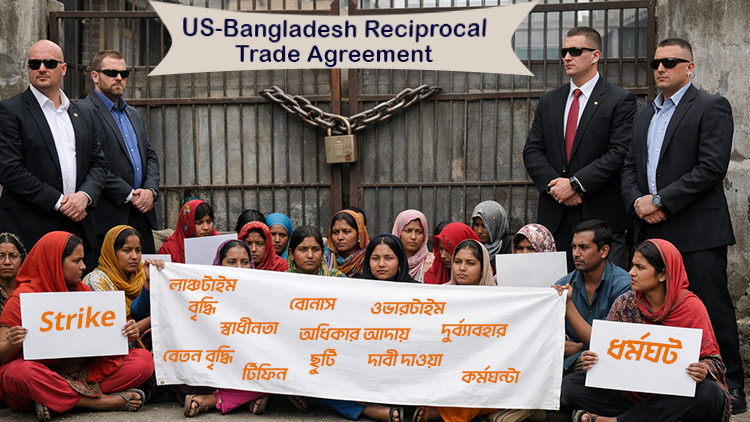
The US Trade Representative stated that these binding commitments, detailed in Article 2.9 (Labor) of the Agreement and Article 1.19 of Annex III, are taken with the aim of strengthening workers’ freedom of association, collective bargaining, and the right to strike, in line with international labor standards (ILO Fundamental Principles and Rights at Work).
However, in the context of Bangladesh—where most workers are poorly educated, lack commitment to long-term employment, and in many cases are easily influenced by external influences or emotionalism—these changes could put significant pressure on productivity, cost control, and overall stability.
General terms of the US trade agreement
- Bangladesh will uphold internationally recognized labor rights, including fully protecting workers’ freedom of association and the right to collective bargaining.
- These rights must be ensured by amending the labor law.
- Labor laws must be effectively enforced and adequate penalties must be imposed for violations.
- Labor laws cannot be weakened or reduced, especially to facilitate trade or investment.
- These rights will apply to special economic zones, including export processing zones (EPZs).
Specific demands for amending the Bangladesh Labor Act (BLA)
According to the terms of the “US Trade Agreement”, Bangladesh will have to issue a practical obligation to amend and implement the existing “Bangladesh Labor Act (BLA)” so that the rights of labor unions are protected. In addition, the following other provisions are mentioned in the “US Trade Agreement” to be added to the Bangladesh Labor Act:
- The minimum requirement of 20% worker support for labor union registration should be reduced to a level that does not hinder the formation of labor unions.
- The Director General of the Department of Labor must obtain the approval of the Labor Court to cancel the registration of any labor union.
- The requirement for personal information from union members should be limited to factory ID card numbers, national identity cards, or birth certificates.
- For registration of a workers’ union, it will be considered sufficient to hold just one general meeting and submit the minutes of the meeting.
- Penalties for anti-labor union discrimination and unfair labor practices (ULPs) should be increased to discourage employers from discriminating against labor unions.
- Blacklisting of workers by factory owners should be banned, and ULPs should be given the right to file cases directly in the labor courts.
- Unreasonable restrictions on workers’ right to strike should be removed. For example, the clause prohibiting strikes for a specific period of time after the establishment of the enterprise should be repealed and severe penalties (including imprisonment) for illegal strikes by workers should be removed.
Simplifying the labor union registration process :
The US trade agreement demands that the Bangladesh Labor Act (BLA) be amended to reduce the minimum requirement of 20% worker support for union registration so that union formation is not hindered. Workers can form unions without 20% of workers or workers. Registration requires only a general meeting and minutes; personal information requirements are limited (e.g. factory ID card, NID or birth registration).
Negative impact : Less educated workers are more likely to be motivated by short-term gains (extra pay, bonuses) or external incentives rather than long-term loyalty. As a result, multiple rival unions may form in the same factory, which will create internal conflicts, groupings, and instability, which will disrupt factory production.
The production process—which is line-based and time-dependent—will be repeatedly disrupted by disagreements between various labor unions, increasing costs and increasing the risk of customer order cancellations.
Increase fines for anti – union labor practices and ban blacklisting
The US trade agreement requires Bangladesh to increase penalties on factories in its labor laws to discourage employers from engaging in anti-union discrimination and unfair labor practices, and blacklisting or banning workers; to prohibit blacklisting as an unfair labor practice (ULP) and to give workers/unions the right to file cases directly in labor courts.
Negative impact : Employers’ ability to control workers will decrease. In a low-cost labor-based model, where productivity depends on strict discipline and rapid coordination, the changes imposed by the US trade agreement could increase unreasonable demands from workers. Workers could disrupt production by making unreasonable complaints or excuses, resulting in increased costs (fines, legal battles) and creating an atmosphere of distrust and fear in the workplace.
Removal of unreasonable restrictions on the right to strike
The “US trade agreement” calls for the removal of harsh penalties such as labor strike bans or imprisonment for illegal strikes by workers for a certain period after the factory reopens.
Negative Impact : In the garment sector, where there are strict daily production targets, minor grievances (or external provocations) can easily spread in garment factories and can easily become a pretext for strikes. This easier right for workers to strike can repeatedly disrupt the production process.
This could reduce productivity by 30-50%, delay deliveries, and potentially undermine Bangladesh’s credibility in the global market. Bangladesh’s low-cost labor advantage in the international market—which relies on fast production at low cost—would be severely disrupted.
Expansion of labor rights in Export Processing Zones (EPZ)
The reciprocal trade agreement with the United States has included a condition that within 2 years of the US trade agreement coming into effect, EPZs must be brought under the amended “Bangladesh Labor Law” or the EPZ Labor Law must be comprehensively reformed to ensure the formation of independent labor unions in Export Processing Zones and the right of workers to strike.
The EPZ Labor Law should be amended in line with Bangladesh Labor Law and international standards to avoid unreasonable restrictions on the right to strike (e.g., banning strikes after the establishment is operational or imposing harsh penalties such as imprisonment).
Negative Impact : EPZs have been relatively peaceful and highly productive because labor unions were banned in export processing zones. Now, if independent labor unions are formed as per the terms of the US trade agreement, foreign investors may withdraw for fear of creating labor unrest. In the Bangladeshi context, since less educated workers are easily influenced, major strikes over minor issues will stop production, which will erode the competitive advantage of EPZs.
Other conditions :
Criminal cases filed against garment workers and labor leaders (especially those related to the 2023 wage movement) should be properly disposed of or withdrawn. Increase the budget for labor law enforcement, appoint more labor inspectors, give powers for surprise inspections, etc.
Negative effects : While these increase worker confidence, there is a risk of abuse. External forces, such as political groups, competitors, local residents, can use workers to shut down factories, which will increase production costs and lead to the closure or relocation of many factories. This agreement is more detailed and binding than the previous GSP suspension (since 2013) or the TICFA negotiations.
This will have direct implications for labor law reform in Bangladesh, especially in the garment sector. While the labor provisions of the US trade agreement provide short-term relief through tariff concessions (19% rate), they could destabilize Bangladesh’s low-cost labor-based production model in the long term. This will lead to reduced productivity, increased costs, and increased employment risks—creating challenges for the livelihoods of millions of workers and the economy.

https://stapravda.ru/20221228/reyting_samyh_populyarnyh_hostingov_v_rossii_196445.html, рейтинг хостингов России подтверждает, что выбор надежного провайдера важен для бизнеса.