
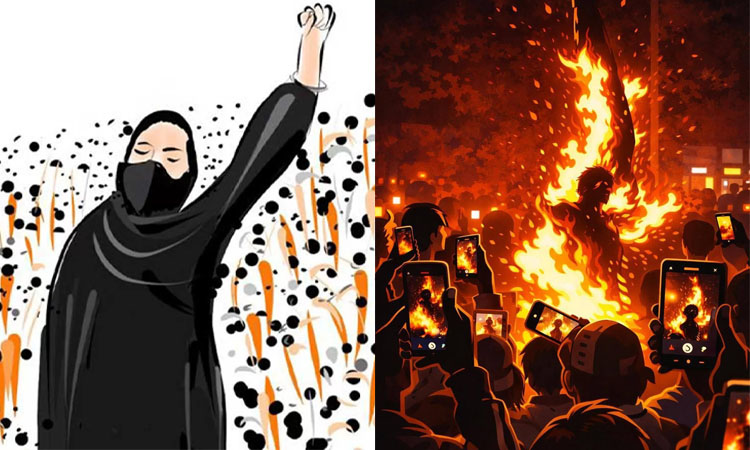
While stand by Muskan in India’s hijab controversy, why doesn’t civilized and educated society in Bangladesh dare to protest for Dipu Chandra Das, who was burned to death?
In 2022, the hijab controversy became a national discussion in the Indian state of Karnataka. A group of Hindu students taunted a Muslim student named Muskan Khan for wearing a hijab to college and shouted ‘Jai Shri Ram’. Muskan, unfazed, protested by shouting ‘Allahu Akbar’. After the incident went viral, Muskan received huge support in India, regardless of religion or caste. Her teachers, human rights activists, the media, and Bollywood stars such as Pooja Bhatt, Kamal Haasan, Amitabh Bachchan, etc. spoke out in her favor. Many Hindu citizens also saw it as a religious fanaticism and supported it from a human rights perspective. In Bangladesh, there was also a surge of support for Muskan’s right to wear the hijab and veil.
This incident highlights a bright side of India’s democratic society, where a section of the majority society also comes forward to protect the rights of minorities. However, the exact opposite picture is seen in Bangladesh.
On December 18, 2025, a Hindu textile worker named Dipu Chandra Das was lynched to death by a mob in Bhaluka upazila of Mymensingh on false charges of blasphemy. After beating him to death, his body was tied to a tree and set on fire. The police investigation found no evidence of blasphemy; it was later learned that it stemmed from a workplace dispute. A few days later, a Hindu rickshaw puller named Govinda Biswas was lynched and injured by a mob in Jhenaidah on suspicion of being a ‘spy of India’ after seeing a red thread on his hand. In addition, after the fall of Sheikh Hasina, persecution of the minority Hindu community in Bangladesh increased in 2024-2025.
In the name of security, a platoon of the army was deployed in Hazari Goli, Chittagong, and atrocities were carried out on traditional religious followers overnight. According to the Bangladesh Hindu Buddhist Christian Unity Council, there were 2,184 attacks from August to December 2024, including temple vandalism, house looting, and arson. In the first six months of 2025, there were another 258 incidents, including rape, temple attacks, etc.
Despite protests from Hindu communities and human rights activists around the world, the silence of the media, intellectuals and civil society in Bangladesh is striking. Those who were once vocal about Muskan’s rights on social media, TV and newspapers, are silent on the brutal murder of Dipu Chandra Das. The leaders of the student movement who threatened to separate the Seven Sisters, who came to power by deceiving the people with the rhetoric of reforms, rights, equality and harmony, have also not spoken out on this issue.
What is the difference between the educated societies of the two countries ?
In India, support for Muskan’s case has come because democratic institutions, media and civil society there relatively prioritize freedom and human rights. Although Hindus are the majority, many have rejected religious fanaticism and stood up for the rights of minorities. Is the same situation prevailing in Bangladesh?
After the fall of Sheikh Hasina, the influence of Islamic extremist groups has increased. Several media houses including Bangladeshi media tycoon Prothom Alo and The Daily Star have been attacked and taken over by these extremists. The silence of civil society may be due to:
- Fear of Islamists: Many remain silent for fear of attacks by extremists.
- Political influence: Hindus are often seen as supporters of the Awami League, so attacks on them are seen by some as political revenge. The chief advisor himself has said, “Hindus are not being persecuted because of their religion, but because of their Awami League affiliation,” which suggests that he has in fact supported this mob violence.
- Social pressure: Fear of being labeled ‘pro-India’ or ‘non-Muslim’ if one speaks out for the minority in a Muslim-majority society.
- Institutional Weaknesses: Law and order have broken down due to the weakness of the interim government, resulting in a lack of security during protests.
This double standard exposes the hypocrisy of a society that talks about equality and harmony. The educated society of Bangladesh must now ask: Are human rights only for a specific religion, or for everyone? Silence in incidents like Dipu Chandra Das can lead to even greater disasters in the future. The time has come for courageous protest, so that Bangladesh can once again become a country of communal harmony.
– Mrinmoy Sen

https://stapravda.ru/20221228/reyting_samyh_populyarnyh_hostingov_v_rossii_196445.html, рейтинг хостингов России подтверждает, что выбор надежного провайдера важен для бизнеса.