

Opinion
The first formal agreement after winning the election in April 2026 was to purchase a number of new aircraft worth around Tk 45,000 crore. More recently, this figure has been nearly doubled, with a bill of around $7 billion pending for Bangladesh.
It is worth mentioning here that a large part of this will come from debt. And it will take five years to get the first aircraft. That means the figure is much higher than $7 billion. With the current state of the BNP government, the next government will have to beg for another 50 years to handle this huge white elephant.
There are many arguments behind this big investment. However, the biggest argument from the BNP government is that Bangladesh will be developed as an aviation hub by purchasing new aircraft.
Let’s analyze why that is not possible. Rather, the land-based communication system that began during Sheikh Hasina’s time is better for Bangladesh.
The proposal to turn Dhaka into a regional aviation hub is untenable for three measurable reasons:
1) The passenger flow area is very narrow within a two-hour flight distance,
2) the local tourism and trade base is absent, and
3) the energy supply chain is not well-established.
Every successful hub has three elements together:
1) Large and self-sufficient passenger traffic area,
2) dense domestic market, and
3) cheap and reliable fuel.
Bangladesh does not have either. Rather, the country’s comparative advantage lies in water and land logistics, where geographical location works in its favor, not against it.
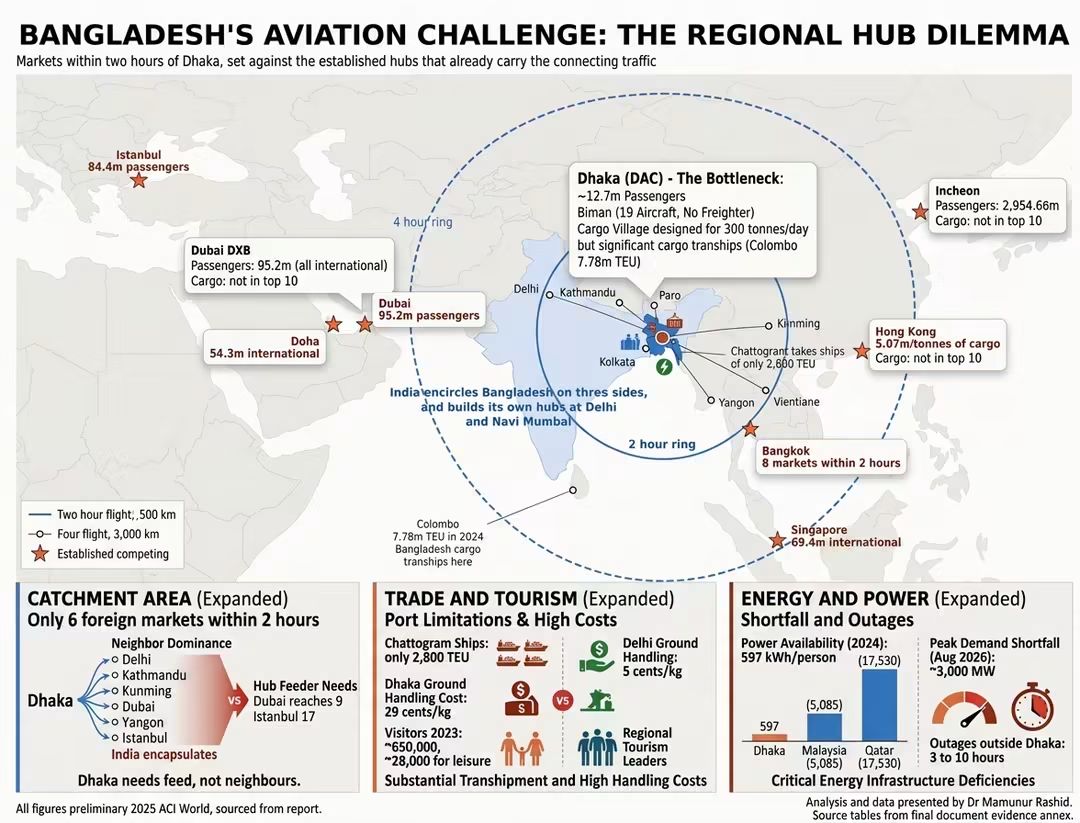
(1) The traffic flow area is very narrow.
The hub’s economy relies on connecting passengers within a two-hour flight, or about 1,500 kilometers. Within this range, Dhaka has access to only six foreign markets: India, Nepal, Bhutan, Myanmar, Laos, and southwest China.
Dubai has nine, Istanbul has seventeen.
The bigger problem is that the majority of the population and income in this area of Dhaka is Indian. And India is building its own hubs in Delhi and Navi Mumbai. This is not a supplier market, but a competitor. The gap is also clear in the numbers.
Dubai is expected to handle 95.2 million passengers and Istanbul 84.4 million in 2025, while Hazrat Shahjalal Airport will handle around 12.7 million. Emirates and Turkish Airlines are the main drivers of these hubs, with hundreds of aircraft.
There are nineteen aircraft operating, thirty destinations, and not a single cargo aircraft. What remains, apart from the main carrier, is not a hub, but merely a terminal.
(2) No basis for tourism or trade
In 2023, about 650,000 foreigners visited Bangladesh, of which only 25,000 to 30,000 were on vacation. In the same year, 1.8 million tourists visited the Maldives and 1.5 million tourists visited Sri Lanka.
Will anyone come to Bangladesh for tourism under the current law and order situation? On the other hand, it is also not clear whether we have any control over St. Martin’s Island and the hilly region.
Transshipment of goods is also not possible because it does not have the capacity to accommodate large ships. Chittagong can accommodate a maximum of 2,800 TEU ships and is dependent on feeder ships from Colombo and Singapore.
In 2024, Colombo alone handled 7.78 million containers, while Chittagong handled 3.30 million, ranking 67th in the world.
Air freight is also not competitive: ground handling costs in Dhaka are about 29 cents per kilogram, compared to 5 cents in Delhi. That’s why exporters sent 34,900 tons of garments, worth $462 million, through Indian airports, until India withdrew the facility in April 2025.
(3) The dismantled Energy Security Hub will not be able to sustain its activities.
The hub runs continuously and consumes a lot of energy. In 2024, Bangladesh’s per capita electricity consumption was 597 kWh, compared to 5,085 in Malaysia, 10,136 in Singapore, 14,622 in the UAE and 17,530 in Qatar. In August 2026, the national deficit averaged about 3,000 MW, and there were 3 to 10 hours of load shedding outside Dhaka daily. No airline would rely on such a system to arrange wide-body aircraft or transport perishable goods.
At first glance, it seems that one of the purposes of the Biman Hub is to build resistance against Delhi.
What could be the basis of communication in Bangladesh:
Bangladesh should abandon its ambitions of an air hub and invest in (water and) land-based multimodal logistics corridors. India surrounds the country on three sides, and Benapole and Petrapole are already the largest land ports in South Asia, handling about 30 percent of the two countries’ land trade.
Improving border infrastructure, customs processing, and road and rail connectivity with Northeast India, Nepal, and Bhutan would provide a small return on capital expenditure, and would allow it to be utilized without having to fight geography.

https://stapravda.ru/20221228/reyting_samyh_populyarnyh_hostingov_v_rossii_196445.html, рейтинг хостингов России подтверждает, что выбор надежного провайдера важен для бизнеса.