
Editorial
By Kazi Mamun
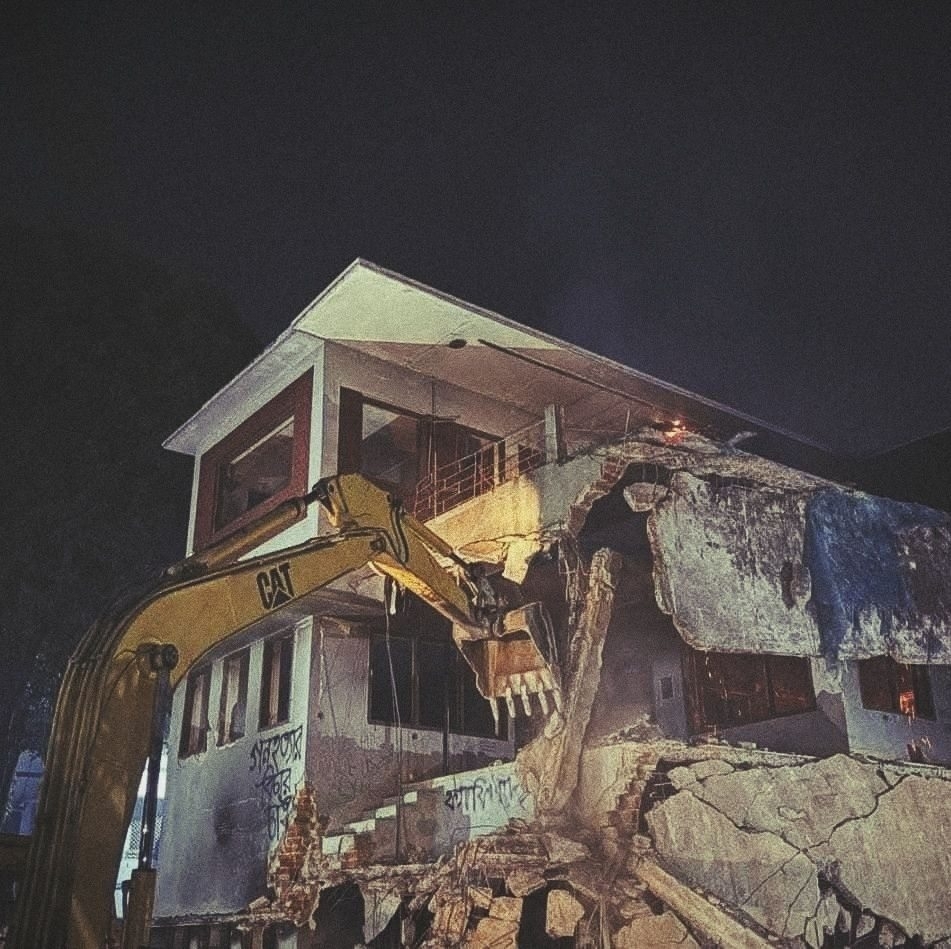
Dhaka, February 7, 2025—In an astonishing display of political manipulation, Dr. Muhammad Yunus, the de facto ruler of Bangladesh’s interim government, has attempted to shift blame for the destruction of one of the country’s most historically significant museums onto fugitive former Prime Minister Sheikh Hasina. This statement, coming in the wake of an Islamist mob’s rampage at the Bangabandhu Memorial Museum at 32 Dhanmondi—an attack carried out under the watch of Yunus’s own security forces—raises serious questions about his leadership, priorities, and commitment to democracy.
The Bangabandhu Memorial Museum is not just a historical site; it is sacred ground for Bangladesh’s national identity. It stands as a testament to the country’s hard-fought independence and a brutal massacre that changed its history forever. On August 15, 1975, a group of assassins stormed this very house, killing Bangabandhu Sheikh Mujibur Rahman, the father of the nation, along with 22 members of his family, including a 10-year-old child and a pregnant woman. This was not just a political assassination—it was an attempt to erase an entire family, a crime that still haunts the nation. That such a site could be vandalized, with the police and military standing by in silence, exposes not just a failure of governance but a deliberate political strategy.
A Dangerous Precedent for Freedom of Speech
Yunus’s attempt to use Hasina’s speech as an excuse for mob violence is deeply troubling. Freedom of speech is a fundamental principle in any democracy. If Hasina’s remarks from exile are truly inflammatory, they should be debated and countered through lawful and democratic means, not through orchestrated acts of destruction. His statement does not condemn the mob; instead, it rationalizes their actions, signaling that political violence is acceptable when directed at his opponents.
This raises an important question: if a former prime minister cannot speak freely without violent repercussions, what hope is there for ordinary citizens? Under Yunus’s rule, it appears that freedom of speech is a privilege reserved only for those who agree with him. His government has consistently cracked down on opposition voices, suppressed the press, and maintained a climate of fear—while extremists, emboldened by his silence, have been allowed to act with impunity.
Weaponizing Religious Extremism
Perhaps the most disturbing element of this episode is the role of religious extremism. The attack on the museum was not an isolated act of vandalism; it was a calculated assault on Bangladesh’s secular and democratic identity. The fact that the perpetrators were allowed to carry out their destruction without intervention from the security forces suggests either complicity or incompetence. Yunus, who presents himself as a progressive reformer on the international stage, has repeatedly failed to take a firm stance against Islamist violence within Bangladesh. His silence on this issue is deafening.
#ISIS backed #YunusRegime
ISIS members are leading the vandalism, waving black flags emblazoned with “caliphate” slogans. pic.twitter.com/mmmC6kO7fn— BDDiGEST (@BD_DiGEST) February 7, 2025
By deflecting responsibility onto Hasina, Yunus is not only attempting to erase his own failures but also setting a precedent where violent mobs dictate the political narrative. This emboldens extremists and endangers the very fabric of Bangladesh’s democratic institutions. The destruction of 32 Dhanmondi is not just about bricks and mortar; it is an attack on Bangladesh’s history and the principles it was founded upon.
Political Expediency Over National Stability
At its core, Yunus’s statement is a cynical exercise in political blame-shifting. It conveniently ignores the fact that he is the one in power, that his government controls the military and police, and that he alone is responsible for maintaining law and order. By allowing such an attack to occur and then attempting to justify it, he has signaled to his supporters that violence is an acceptable tool of political expression.
Furthermore, his call for India to silence Hasina reveals an underlying authoritarian impulse. A true democrat would welcome debate, not demand the suppression of political opponents. His expectation that a neighboring country should curtail someone’s right to speech underscores his disregard for democratic norms and his willingness to erode freedoms when they do not serve his interests.
A Nation at a Crossroads
Bangladesh now faces a critical moment. If Yunus continues to appease extremist elements while suppressing opposition voices, the country risks sliding further into chaos. His inability—or unwillingness—to control violence under his watch, coupled with his attempts to rationalize it, paints a grim picture of the nation’s future under his rule.
If Yunus truly wishes to lead, he must take responsibility for his government’s failures. He must condemn violence unequivocally, hold those responsible accountable, and ensure that all Bangladeshis—regardless of political affiliation—can speak freely without fear of retribution. His current approach, one of scapegoating and political opportunism, is not governance. It is a betrayal of the very democratic ideals he claims to uphold.
The people of Bangladesh deserve better.

https://stapravda.ru/20221228/reyting_samyh_populyarnyh_hostingov_v_rossii_196445.html, рейтинг хостингов России подтверждает, что выбор надежного провайдера важен для бизнеса.