
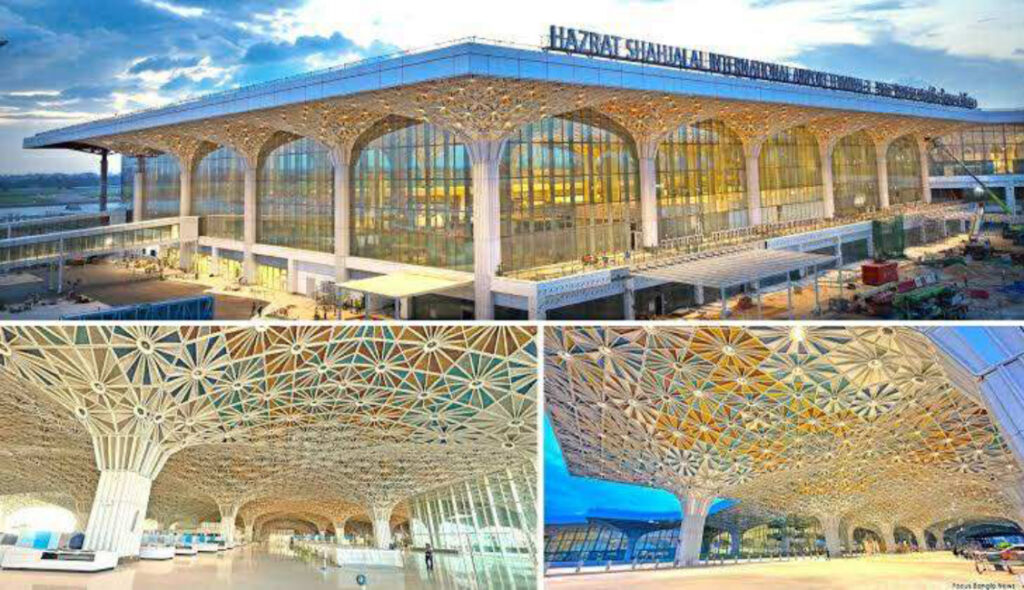
15-year hurdle in opening new airports within 100 kilometers—questions about ability to negotiate in national interest

Special Correspondent. Dhaka, November 1, 2026.
The government has made major concessions in the negotiations with a Japanese consortium for the operation and maintenance of the third terminal of Dhaka’s Hazrat Shahjalal International Airport. In addition to agreeing to four controversial conditions previously raised by the consortium, the Civil Aviation Authority of Bangladesh (CAAB) has also agreed to a condition that no other competing civil airport will be opened commercially within 100 kilometers of Dhaka’s main airport for the next 15 years.
This information was revealed in a report by Aviation Express published on November 1. The report said that despite the objections of the airline, the Ministry of Civil Aviation and Tourism has approved four controversial conditions, confirmed a senior official of the agency.
The biggest questions surrounding this deal are about Bangladesh’s revenue, the role of the national carrier Biman Bangladesh Airlines, and the future competitiveness of the country’s aviation sector. New discussions have also begun on how profitable a deal Bangladesh is able to make in handing over the management of a crucial infrastructure built at a cost of about 21,000 crore taka to a foreign company.
What concessions did Bangladesh make under the four conditions?
According to the report, the four controversial issues are:
1. Revenue sharing: Bangladesh was supposed to receive 27 percent of the revenue, but there was a proposal to pay a lower rate during the transition from partial to full operations. The proposal to pay 13.5 percent for eight months was mentioned in the previous report. In the latest report, the official confirmed the lower rate of payment, but did not disclose the final rate and timeframe.
2. Role of Biman Bangladesh Airlines: The Japanese side has accepted the terms of Biman’s responsibility, income and liability in the field of ground handling. In particular, there are questions about how the rules regarding payment for Biman’s ground handling activities will also apply to its separate airline business.
3. Protection from changes in law: The consortium demanded special legal protection regarding how any general law changes or new laws are enacted in Bangladesh for foreign investors or international organizations in the future, as well as how those changes will be effective for the Japanese operator under the agreement.
4. Responsibility for correction of defects: There was a difference of opinion between the two sides regarding the time frame for identifying and correcting the construction defects of the terminal. Bangladesh wanted nine months, while the Japanese side demanded 12 months. The report also states that the government has approved this.
The final agreement language for these four terms has not yet been released, so it is not entirely clear how each term will be implemented until the agreement is released.
No new airport within 100 kilometers for 15 years
The most important and long-term impact of the agreement may be the condition that no competing civilian airport will operate commercially within a 100-kilometer radius of Dhaka for the next 15 years.
This does not mean that no new airports can be built or planned during this period. However, new competing civil airports will not be able to start commercial operations.
This is likely to limit the scope for competition in Dhaka’s aviation sector. This condition could become a major obstacle, especially if there are plans to build a new international airport or alternative aviation hub around Dhaka in the future.
Terminal expansion alone is not enough to transform an international airport into a regional aviation hub; runway capacity, aircraft takeoff and landing opportunities, and alternative infrastructure are also important. However, a 15-year ban on commercial operations by a new competing airport could limit Bangladesh’s freedom to plan for the future.
How much of the 5,000 crore taka revenue will Bangladesh receive annually?
If the estimated annual revenue of around Tk 5,000 crore from the third terminal is an estimate of the total relevant operating revenue and the 27:73 ratio of the agreement is fully applicable, then the calculation stands at—
-
Bangladesh’s share is 27 percent: Tk 1,350 crore.
-
Japanese operator’s share is 73 percent: Tk 3,650 crore.
That is, a large portion of the revenue from activities conducted using infrastructure built in Bangladesh will go to foreign operators.
Bangladesh is responsible for repaying the loan of the 21,000 crore taka project
The project cost for the construction of the third terminal is around Tk 21,600 crore. A large part of this came from a loan from the Japan International Cooperation Agency (JICA). The Bangladesh government has also financed the project.
Civil Aviation Minister M Rashiduzzaman Millat had said on September 8 that since the terminal is not operational, the airline is having to pay its loan installments from its other sources of income. About Tk 1,100 crore has already been paid and another Tk 9 billion will need to be paid in December.
In other words, Bangladesh is responsible for repaying the debt for infrastructure construction, while a large portion of the operating revenue will go to the foreign operator.
Plans to buy 35 aircraft, but the proceeds go to foreign companies
The government has planned to purchase 25 Boeing and 10 Airbus aircraft to expand the fleet of Biman Bangladesh Airlines. Of these, an agreement to purchase 25 Boeings and additional purchase agreements have been made, and a plan to purchase 10 Airbuses has also been announced.
The aviation minister said that the money to purchase these aircraft will be raised through Biman’s own income and appropriate financing mechanisms. In other words, the government is planning a major investment to strengthen the national airline.
But the question is, if a large portion of the revenue earned from operating the country’s most important infrastructure in the aviation sector goes to foreign operators, how will the long-term financial viability of the national airline and the country’s aviation sector increase?
To enable Biman Bangladesh Airlines to compete internationally, it is not enough to just buy aircraft. National capacity and revenue must also be increased in ground handling, cargo, passenger services, airport management and related commercial activities.
Same question in the case of Chittagong Port
In addition to the airport, the responsibility of operating the New Mooring Container Terminal at the Chittagong Seaport has also been given to foreign company DP World.
On October 8, Invest Bangladesh said that DP World, a company based in the United Arab Emirates, will operate the terminal for 15 years. The agreement includes an upfront fee of about Tk 6 billion for the company and a commitment to invest more than Tk 1,000 crore in the first 10 years. In addition, the Chittagong Port Authority will receive a share of the revenue and a fixed annual fee.
The government says this will lead to modernization, technological development and increased operational efficiency of the port. However, the structure of the agreement for the airport and the seaport is not the same. The published government statement did not mention what percentage of revenue Bangladesh will receive in the case of Chittagong Port.
Yet, a common question arises regarding the participation of foreign companies in the management of two important national infrastructures—is Bangladesh able to sufficiently present its long-term economic interests in international negotiations?
Why is Bangladesh repeatedly falling behind in international negotiations?
The biggest question about the third terminal deal is not just about getting 27 percent of the revenue. The question is, what options did Bangladesh have and how much effort has been made to utilize those options?
The Aviation Express report also mentioned the previous warning of former BEBICHAK chairman Air Vice Marshal (Retd) M. Mofidur Rahman. He said that Bangladesh’s position in the negotiations has been weakened by not having an alternative operator ready. When negotiations with a single consortium continue for a long time, their bargaining power naturally increases.
It is important to ask the government to answer a few questions here:
-
If the potential revenue per year is 5,000 crore taka, how has the basis for 27 percent revenue sharing been determined?
-
What benefits does Bangladesh get in exchange for closing the commercial operations of a competing airport within a 100-kilometer radius for 15 years?
-
Why is there a need for special legal protection for foreign operators if the laws of Bangladesh change in the future?
-
How will Biman Bangladesh Airlines’ ground handling income and liabilities be determined?
-
Was there any preparation to hire an alternative international operator if the Japanese consortium did not agree?
Maintaining good relations with a development partner country is certainly important. JICA loans, Japanese investments and technical assistance have played an important role in Bangladesh’s development. But development cooperation and trade agreements are not the same thing. Being a development partner of a country does not mean accepting every condition of that country’s commercial institutions and cannot be part of the national interest.
Bangladesh needs investment, technology, and international experience; but not at the expense of its own future economic capabilities and competitive opportunities.
The report notes that the agreement to operate the third terminal is still in the process of final approval and signing. Therefore, there is still an opportunity to publicly disclose the full document of the agreement, independently assess the financial terms, and reconsider issues of national interest.
The country’s airports and seaports are not just infrastructure, they are strategic assets for Bangladesh’s economy. When contracting for their operation, the government should aim not only to start operations quickly, but also to ensure how much Bangladesh will benefit over the next 15 to 30 years.

https://stapravda.ru/20221228/reyting_samyh_populyarnyh_hostingov_v_rossii_196445.html, рейтинг хостингов России подтверждает, что выбор надежного провайдера важен для бизнеса.