
By BBC Bangla
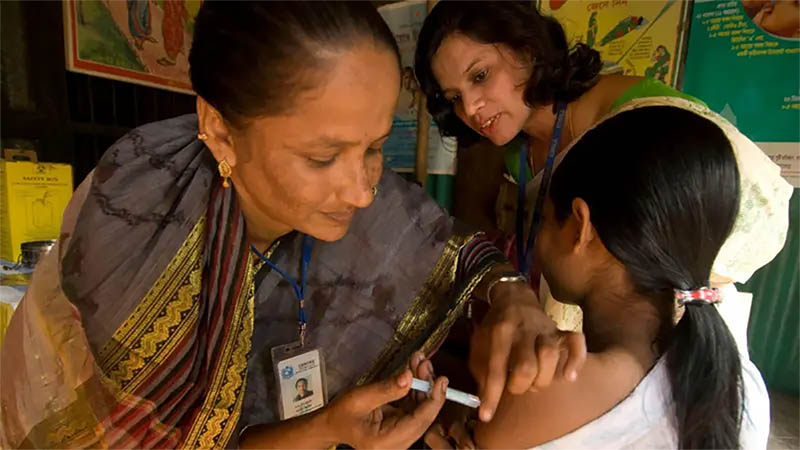
For over a month, several districts in Bangladesh have been facing a shortage of EPI (Expanded Programme on Immunization) vaccines for children. For the first time since last year, Bangladesh has had to purchase these EPI vaccines, which were previously provided free of charge. Discussions with civil surgeons from several districts reveal that different districts have been experiencing shortages of different vaccines for about a month. While the directorate has sent vaccines to some districts, resolving the shortage in those areas, others are still unable to administer vaccines to children due to non-delivery.
However, AFM Shahabuddin, the manager of the Expanded Programme on Immunization, claims there is no shortage or deficit of vaccines. He asserts that the delay in vaccine delivery is due to the time it takes to distribute all vaccines to various districts after they arrive in Bangladesh. He argues that this delay cannot be termed a shortage.
Districts Facing EPI Vaccine Shortages
Local journalists from several districts report that some vaccines under the EPI program are in short supply in certain sub-districts. Although health officials verbally acknowledge the issue, they are reluctant to admit the shortage on camera. The districts experiencing significant EPI vaccine shortages at upazila health complexes include Munshiganj, Manikganj, Chandpur, and Cumilla. However, Munshiganj’s Civil Surgeon, Dr. ATM Obaidullah, stated that while there was a brief shortage of one or two vaccines a month ago, there is currently no shortage. He claims that all routine vaccines under the EPI program are now available in stock in the district. In contrast, Chandpur’s Civil Surgeon, Dr. Noor Alam Din, admitted to a shortage of the pentavalent vaccine, which has persisted for about a month. He noted that the directorate would be better positioned to say when the shortage will be resolved. Expressing hope, he said, “Generally, resupply happens after three to four months, so it should be resolved.”
He further confirmed that the pentavalent vaccine, essential for children up to 18 months, is currently completely unavailable in Chandpur. Despite the shortage, Dr. Noor Alam Din claimed that children would not miss out on vaccinations, stating, “They may not get it this month as scheduled, but they will receive it in two to three months.” He added that this is not the first time a shortage has occurred; for over a year, vaccine shortages have been recurring. “For the past one and a half years, it’s been like this. Vaccines arrive, then come again after three months. It’s become routine.
We hope they will arrive next month,” he said. Meanwhile, Gazipur’s Civil Surgeon, Mamunur Rahman, stated that while there was a shortage, it has been resolved in his district. “The vaccines have arrived in Gazipur. We are supplying them to other upazilas. Some may have received them today, others might get them tomorrow. They are coming recently,” he said.
Manikganj’s Civil Surgeon, Dr. Md. Khurshid Alam, reported that four EPI vaccines—OPV, Penta, PCV, and IPV—are currently “stocked out” in the district and have been unavailable for about a month. He claimed that while the district-level stock is depleted, upazila-level operations are ongoing. He noted that a strong letter has been sent to the directorate demanding vaccines. “The good news is that we have written very strongly. We expect to receive these vaccines at the district store soon,” he said. When asked how upazilas have vaccines if the district lacks them, he explained, “We had supplied them earlier, and they are managing with that stock. But if upazilas request new stock now, we cannot provide it at this moment. We hope to get the required vaccines within two weeks.”
Approximately 4 Million Children Vaccinated Annually
Dr. AFM Shahabuddin, the program manager, claimed there is no shortage of the seven vaccines administered under the EPI program. He explained that the seven vaccines do not always arrive in the country simultaneously, and they are sent to districts only after all are received. Due to fuel costs and restrictions on sending vaccine vehicles multiple times, distribution is done in one go, which may cause slight delays. He insisted this cannot be called a vaccine shortage. The government vaccinates children under the EPI program based on a specific annual target. Dr. Shahabuddin said, “On average, we vaccinate about 4 million children annually in Bangladesh. If the growth rate increases, the number goes up slightly the next year. Last year, we vaccinated 3.9 million children, and this year, it was 4 million. Next year, it might increase further. However, each vaccine has different dose schedules, so the average varies slightly.”

Where Do the Vaccines Come From?
Dr. Abu Hossain Md. Moinul Ahsan, Director of the Hospital Division at the Directorate of Health, stated that there is no shortage of vaccines under the EPI program. He suggested that communication gaps may lead to perceptions of shortages, and vaccines are sent as soon as districts communicate their needs. He noted that while Bangladesh previously received these vaccines for free, they now have to be purchased but are still provided free to the public. “Earlier, we got vaccines free of cost from the Melinda Gates Foundation. Now, we buy them with government funds. We provide them free to the public, but we have to purchase them ourselves. Before, we got them free and gave them free,” he said.
Regarding the procurement process, he explained that Bangladesh now purchases EPI vaccines through a tender process. “Previously, they came directly without purchase. Now, we have to follow procedures—tendering, procurement rules. Suppliers deliver, which causes delays that didn’t happen before. But if any district reports a shortage, we send the vaccines as soon as they inform us.”
Since 2024, Bangladesh has been procuring these vaccines through UNICEF. “We pay UNICEF, and they handle the procurement. They purchase certified, quality-controlled vaccines for us. Vaccines are bought from whichever country they are readily available, following international processes and quality control,” he added.
Which Diseases Are Covered by These Vaccines and Why?
Each vaccine targets a specific disease. For example, the measles vaccine protects children solely from measles. Vaccination prevents diseases effectively. According to the EPI guide, before the program began, approximately 250,000 children in Bangladesh died annually from six diseases. On April 7, 1979, Bangladesh launched the EPI program to vaccinate all children under one year against six infectious diseases. Routine vaccination has significantly reduced mortality rates from diseases like tuberculosis, diphtheria, whooping cough, measles, and tetanus.
Since 2009, the Sheikh Hasina government expanded the program to cover eight infectious diseases. Over time, the scope of vaccination has further increased for specific diseases. Vaccines are administered in different doses for children, adolescents, and women of childbearing age, from birth to 49 years. The EPI guide highlights that the program aims to reduce child and maternal mortality rates and childhood disability.
The BCG vaccine is given to prevent tuberculosis, OPV for polio-myelitis, and the pentavalent vaccine for diphtheria, whooping cough, tetanus, hepatitis B, and Haemophilus influenzae-related diseases. Additionally, the PCV vaccine prevents pneumococcal pneumonia, the MR vaccine protects against measles and rubella, a separate measles vaccine targets measles, and the TT or Tetanus Toxoid vaccine prevents tetanus. Notably, the Sheikh Hasina government has been widely praised internationally for significantly reducing child and maternal mortality rates. Due to its expertise in managing the EPI program efficiently in a densely populated country, Bangladeshi officials regularly train counterparts in other countries.

https://stapravda.ru/20221228/reyting_samyh_populyarnyh_hostingov_v_rossii_196445.html, рейтинг хостингов России подтверждает, что выбор надежного провайдера важен для бизнеса.