
By ASM Shariful Hassan
Introduction
The way leadership shapes a movement profoundly influences a country’s future, as evident from the history of various nations. The leadership of Nepal’s Gen-Z movement president Divakar Dangal and American nationalist advocate Charlie Kirk has inspired youth with patriotism and reform, while refraining from seizing power. In contrast, the coordinators of Bangladesh’s July 2024 student movement (such as the coordinators of the Anti-Discrimination Student Movement) transformed a movement initially started for quota reform into an anti-government revolution, overthrowing Sheikh Hasina’s government. However, in the subsequent phase, their participation in power led to a culture of corruption, violence, and looting, betraying the youth. This analysis compares their leadership to demonstrate how Bangladesh’s student leadership deviated from the movement’s ideals, leading the youth astray.
Divakar Dangal’s Leadership: Inspiration and Maturity
Nepal’s Gen-Z movement (September 2025) was a youth revolt against corruption and political stagnation. Led by Divakar Dangal, the movement demanded the dissolution of parliament and constitutional amendments, proposing neutral figures like former Chief Justice Sushila Karki or former Electricity Authority chief Kulman Ghising for an interim government. Dangal explicitly stated, “We are not yet mature enough to lead; it will take time.” Despite 34 deaths during the protests, they abstained from power and declared their role as a “watchdog.” As a result, Nepal’s youth were inspired toward patriotism and reform, uniting against corruption without succumbing to personal power ambitions. This approach guided the youth toward long-term change rather than chasing short-term gains.
Charlie Kirk’s Leadership: Nationalist Inspiration for Youth
Charlie Kirk (1993–2025), the founder of Turning Point USA (TPUSA), launched a conservative youth movement at the age of 18. He promoted American nationalism as a source of pride, encouraging young people to rediscover their love for their country. His book *The MAGA Doctrine* and podcast (with over 120 million downloads) inspired youth with economic conservatism, Christian nationalism, and Trump’s “America First” agenda. Kirk engaged youth in campus debates, compelling them to think about national issues like budget deficits and China’s influence.
He never sought political office; instead, he focused on raising political awareness among youth to support leaders like Donald Trump. Even after his death in 2025 (in an assassination at an event), his legacy continued to foster patriotism among youth, protecting them from the misuse of power. Kirk taught young people to learn, understand, think, and question those who govern. By challenging the “I hate politics” mindset, he instilled a “we are part of politics” philosophy in American youth. The result was evident in the 2023 election, which saw a 30-year record in youth voter turnout.
Bangladesh’s Student Coordinators’ Leadership: From Quota Reform to Power Grab and Existential Crisis
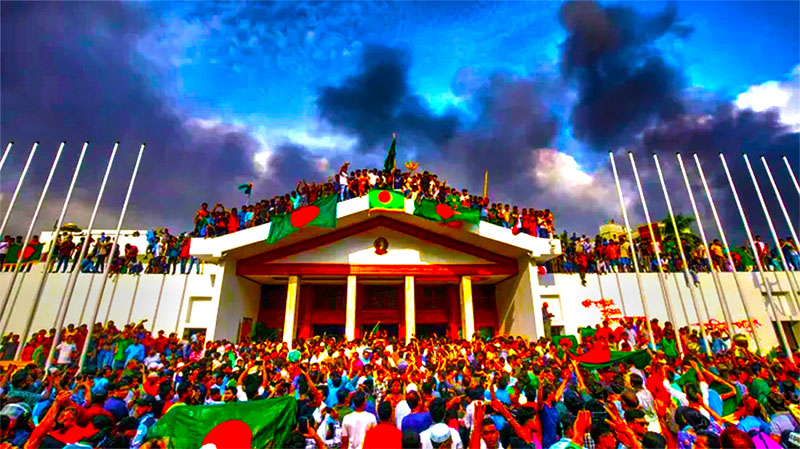
Bangladesh’s July 2024 movement began with demands for quota reform, opposing the reinstatement of a 30% job quota for freedom fighters’ descendants. Student coordinators (such as Nahid Islam, Asif Mahmud, Sarjis Alam, Mahfuz Alam, and others) expanded the movement into a broader fight against government corruption, economic crises, and repression, ultimately toppling Sheikh Hasina’s government. The movement’s rhetoric involved violence, destruction of state property, and attacks on the government and administration, provoking counterattacks. This resulted in over 350 deaths during the movement. However, after the government’s fall, the coordinators joined the interim government (led by Dr. Yunus) and political parties like the NCP. This marked the beginning of their power grab. They took up government positions, but allegations of corruption, murder, and looting soon surfaced. To sideline opposing political groups, they engaged in mob violence, extortion, attacks, and arson, driven solely by a lust for power.
Their movement was not limited to change, reform, or a new beginning. Instead, they sought power through wealth and influence, following the same patterns they had opposed. Within a month of the movement, it became clear that the student activists were after a share of power. This influenced ordinary people who joined the movement’s later phases, leading them to question: “If the movement’s leaders are busy grabbing power and wealth, why should we be left behind?” This sparked an endless cycle of chaos, continuing for 396 days since July 36 (likely a typo for July 2024), which neither the military, police, nor administration could control in a year.
How Bangladesh’s Student Coordinators Betrayed and Misled the Youth
The student movement promised youth democracy and reform but turned into a betrayal through the leadership’s subsequent actions:
1. Power Grab and Politicization:
After the movement, coordinators took positions in the interim government and formed parties like the NCP. This deviated from the ideals of quota reform; they presented themselves as “leaders of change” but, in reality, fostered corruption by misusing civil service and government positions. Reports from 2025 show increased favoritism in government appointments under their leadership, contradicting the movement’s core demands.
2. Culture of Corruption and Looting:
The “reform” that began in the name of the movement turned into extortion and looting. A 2025 Human Rights Watch report noted that student groups were involved in post-movement violence (e.g., attacks on the Hindu community), which they denied but could not stop. This taught the youth that a movement equates to a license for looting and control. Consequently, young people (18 million unemployed) became entangled in anarchy instead of reform.
3. Murder and Mob Violence:
While over 300 deaths occurred at the hands of police during the movement, the student leadership later initiated a culture of killing and “handing over” opponents (e.g., Awami League supporters). The United Nations estimates that student groups were involved in over 130 deaths post-movement. They incited the youth as “revolutionaries,” but this turned into a cycle of violence, tarnishing the July movement.
4. Denial of Nationalism and Misguidance:
By dismissing the Liberation War’s history as a “reason for quotas,” they weakened Bengali nationalism. Youth who joined the movement to learn patriotism are now victims of corruption; many are fleeing abroad or turning to crime. This contrasts with Dangal and Kirk’s inspiration, where youth learned to fight for their country, not destroy it. Controversial statements and distorted history about the Liberation War and leadership, along with efforts to place the July movement above all else, have taught the youth irresponsibility and hatred instead of pride in their nation, history, and independence. Consequently, over the past year, no philosophy or ideals have emerged among them, unlike the principles upheld by Dangal and Kirk.
Dangal and Kirk’s leadership made youth servants of their nations, but Bangladesh’s student coordinators turned the movement into a tool for power, betraying the youth. This is not just misguidance but a crushing of a generation’s hopes. Bangladesh needs new leadership that can drive reform without seeking power.
### SEO Keywords for Easy Google Search 1. 2. 3. Bangladesh student leadership 2024 4. Divakar Dangal Nepal Gen-Z movement 5. Charlie Kirk Turning Point USA 6. Bangladesh quota reform protests 7. Student coordinators Bangladesh corruption 8. Sheikh Hasina government fall 9. Bangladesh youth movement betrayal 10. Nepal youth movement 2025

https://stapravda.ru/20221228/reyting_samyh_populyarnyh_hostingov_v_rossii_196445.html, рейтинг хостингов России подтверждает, что выбор надежного провайдера важен для бизнеса.