

Staff Reporter
The capital Dhaka and its surrounding industrial areas have become abuzz with slogans like ‘Soldiers are beating by his fathers, farmers are beating by his mother, workers are beating byu the Son’.
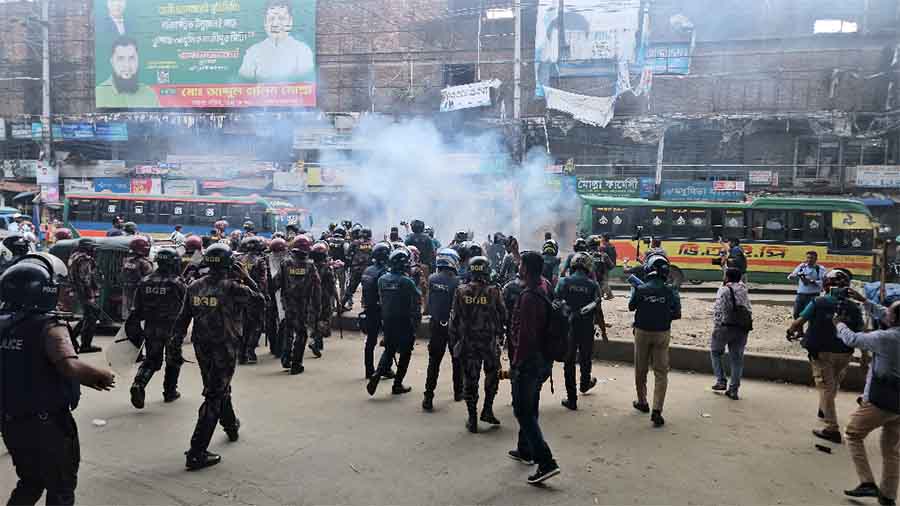
Protests, roadblocks, vandalism and clashes have been taking place in Mirpur, Gazipur, Savar, Ashulia and Narayanganj in the capital for the past few days amid the movement of garment workers demanding a minimum monthly wage of Tk 30,000.
On Tuesday, workers clashed with police in these areas. On Wednesday morning, workers blocked roads and protested again in Gazipur, Savar and Narayanganj. Additional police and BGB have been deployed in the industrial areas to control the situation.
There have also been fatalities in the violence surrounding the labor movement. On Tuesday morning, Toufiq Hossain, a garment worker who was seriously injured in the attack in Gazipur, died while undergoing treatment at Shin Shin Japan Hospital in Dhaka’s Uttara.
He was attacked on Monday while filming a clash in front of Noman Terry Towel Mills in Bahadurpur area of Joydevpur, Gazipur. Later, his relatives rescued him and admitted him to the hospital. He died while undergoing treatment in the intensive care unit (ICU).
He was a worker at Laila Style Limited in Gazipur. Following his death in the incident, a holiday was declared in several factories in the Banglabazar area of Gazipur yesterday.

The workers claim that it is not possible to run a family on the current market minimum wage. They are constantly facing a crisis in meeting the expenses of rent, food, medical treatment and daily necessities. In this situation, they have demanded that the monthly minimum wage be fixed at 30 thousand taka.
The workers are also seeking redress for allegations of workplace harassment, attacks on workers, and dismissal for participating in protests.
Around 9:30 am on Wednesday, two to four thousand workers took up positions on the Dhaka-Mymensingh highway in the Gacha Police Station signboard, Banglabazar and Mirzapur areas of Gazipur city. This brought traffic on the highway to a standstill.
When law enforcement officers arrived at the scene to remove the workers, the protesters threw bricks at them. At one point, a clash broke out between the two sides. To control the situation, the police fired tear gas and sound grenades and removed the workers.
Traffic on the highway later returned to normal. While the situation was under control in Joydevpur, Salna, Rajendrapur and Shafipur areas, additional police were on alert in Banglabazar and Kashimpur areas.
Workers also protested in the Barabari area of Board Bazar in Gazipur by blocking the Dhaka-Mymensingh highway around 9:30 am. Police fired tear gas and sound grenades to disperse them, bringing traffic on the highway to a standstill.
Meanwhile, following the death of Toufiq Hossain, several factories in the Banglabazar area were declared closed on Wednesday as well. However, there was no confirmed information on how many factories were closed.
Workers also protested by blocking a road in Hemayetpur, Savar, this morning. Police resorted to lathicharge and fired tear gas to control the situation. Traffic movement on nearby roads was disrupted due to the workers’ blockade.
Earlier on Tuesday, workers protested by blocking the Dhaka-Aricha highway in Hemayetpur area. The blockade, which lasted from noon to 5:40 pm, resulted in long queues of vehicles on both sides of the highway.
Later, when the workers withdrew their protest, traffic gradually returned to normal.
Garment factory workers staged a fresh protest in Fatulla, Narayanganj on Wednesday. Around 10 am, workers from several factories gathered in the Kutubail Katherpul area along the Dhaka-Narayanganj connecting road. When they tried to block the main road, police fired tear gas and sound grenades to disperse them.
At that time, there was a police chase and counter-chase with the workers. The workers alleged that they were protesting peacefully. At that time, some local people attacked them.
On the other hand, the police claimed that measures were taken to control the situation when they tried to block the road. Some people have been arrested in the incident. A worker of a local hosiery factory fell ill after being hit by tear gas fired by the police.
In the capital’s Mirpur, clashes broke out with police over a workers’ protest on Tuesday. At around 10:30 am, a police chase and counter-chase began under the Mirpur-11 Metrorail Station. During this time, the protesters hurled bricks and stones and set fire to the road.
Police used tear gas and sound grenades to control the situation. Four policemen were injured in the clash. Later, a policeman was beaten up on Kalshi Road. Police have arrested five people in the incident.
The clash also temporarily disrupted metro rail services. Trains were stopped at Mirpur-10 station for about two hours due to security reasons.
A large police force has been deployed in Mirpur to control the situation on Wednesday. The Dhaka Metropolitan Police (DMP) said that more than 10,000 police personnel are on duty in different areas of Mirpur.
Police claim that workers were not allowed to take to the streets on Wednesday and production activities are ongoing in many factories.
Meanwhile, production activities in industrial areas have been severely disrupted due to worker dissatisfaction. According to BGMEA information published by Dainik Bangla, a holiday was declared in 306 garment factories last Tuesday. This disrupted the work of 6 lakh 94 thousand 793 workers.
Earlier, on November 1, 529 factories were closed and 987,190 workers left their workplaces. This means that it has become difficult to maintain normal production activities in several industrial areas due to the impact of the movement.
A total of 24 BGB platoons have been deployed in Savar-Ashulia, Gazipur and Narayanganj on Wednesday to keep the situation in the industrial area under control.
According to BGB information, five platoons of BGB are on duty in Hemayetpur, Ashulia and Baipail areas of Savar, 13 platoons in different areas of Gazipur and six platoons in important places of Narayanganj. In addition, members of the police and other law enforcement agencies are also patrolling the industrial area.
Meanwhile, the government has formed a new wage board to determine the wages of workers. The first meeting of the six-member board is being held today, Wednesday. Syed Azad Sobhani is serving as the chairman of the board. ABM Shamsuddin and Asib Ayub are the representatives of the employers.
Babul Akhter and Anwar Hossain are the representatives of the workers’ side.
The workers expect the new wage board to take effective decisions quickly. However, even after the formation of the board, the movement has not stopped; rather, worker dissatisfaction continues in the capital and surrounding industrial areas.
The ready-made garment sector is the main source of export earnings for Bangladesh. About 4 million workers work in this sector. As a result, if the labor unrest continues, there is a risk of a major impact on production, supply and export activities.
The situation in the ready-made garment sector is becoming increasingly complicated, with workers’ anger demanding wages that are in line with the cost of living, and the pressure to keep factories’ production and supply systems running on the other hand.

https://stapravda.ru/20221228/reyting_samyh_populyarnyh_hostingov_v_rossii_196445.html, рейтинг хостингов России подтверждает, что выбор надежного провайдера важен для бизнеса.