
 Staff Correspondent
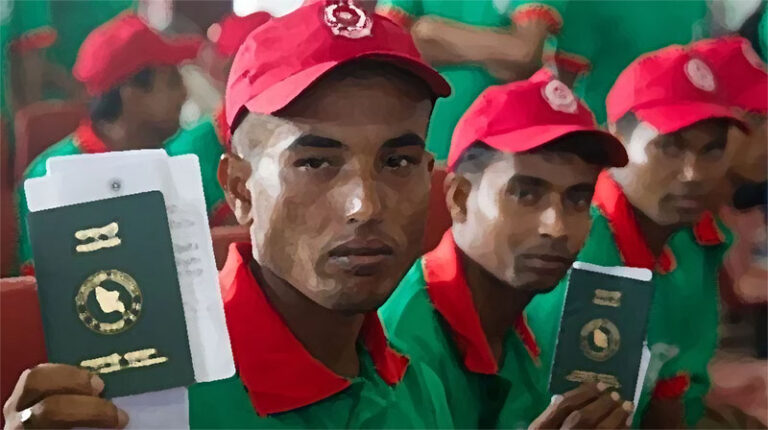
The government has increased the welfare fee charged from employees while going abroad after 11 years. From October 1, an employee going abroad will have to pay 5,500 taka as welfare fee. Until now, this fee was 3,500 taka. That is, an additional 2,000 taka will be charged from each employee. The government’s argument is that the scope of services for expatriate employees has increased and the fee has been increased to ensure their safety and welfare activities.
However, with the decision to increase the welfare fee, the issue of the use of this fund has also come to the fore. The money taken from the overseas workers is used to bring the body of the deceased worker back home, provide financial assistance to the family, provide medical treatment, provide educational stipends and provide legal assistance. Again, money from this fund has also been spent on activities such as capital formation of the Expatriate Welfare Bank and building educational institutions abroad. As a result, there are questions about how much money is spent directly on the welfare of the worker from whom this money is being compulsorily taken and how much is being spent on other activities.
Fees increased after 11 years
A circular from the Ministry of Expatriates’ Welfare and Overseas Employment has announced that the welfare fee will be set at Tk 5,500. In 2015, this fee was set at Tk 3,500 for overseas workers. The new rate will be effective from October 1.
The ministry said that the scope and volume of service activities for expatriate workers is continuously increasing. The fees have been re-determined to ensure overall welfare activities, including worker protection, and to align with the market value of the dollar.
In addition to the welfare fee, employees have to pay another Tk 1,000 for insurance. Earlier, a fee was charged for the smart card along with the exit permit, but now it is being provided free of cost.
The service for which this money is paid
According to government information, various types of assistance are provided to expatriate workers and their families from the Wage Earners Welfare Fund. If a worker dies abroad, assistance is provided for bringing his body back to the country and burying it. Currently, 35 thousand taka is provided for burial and transportation after the body reaches the airport. A one-time payment of 3 lakh taka is given to the family of the deceased worker. There is also a provision for medical assistance for sick workers, educational scholarships for children and legal assistance for workers in danger.
Apart from this, various services are provided through the rehabilitation of returnee workers, assistance in solving various problems of workers abroad, and airports and Bangladesh missions abroad. According to the Wage Earners Welfare Board, Tk 200 crore has been given to the Expatriate Welfare Bank for the rehabilitation of returnee workers.
This means that the welfare fund money is not spent at all on the welfare of the workers. Rather, the question is, how much of the total fund money is being spent directly on the worker and his family and how much is being used for other activities.
Bank capital with workers’ money
The biggest example of the use of welfare fund money is the Expatriate Welfare Bank. According to government data, the bank had a total paid-up capital of Tk 100 crore when it was established in 2010. Of this, Tk 95 crore was provided from the Wage Earners Welfare Fund. The government provided Tk 5 crore.
One of the objectives of establishing the Expatriate Welfare Bank was to provide low-interest, unsecured loans to workers willing to go abroad and to help returnees in self-employment. That is, the use of this money is also in the interests of the expatriate workers. However, the money from the welfare fund has not been used as a direct grant, but as the paid-up capital of a bank.
The Wage Earners’ Welfare Board’s own information also states that 95 percent of the bank’s paid-up capital was provided by the Welfare Board.
Schools abroad at a cost of 100 crore taka
Another big example of the use of welfare funds is the construction of educational institutions abroad. A report in Prothom Alo said that an expenditure of Tk 100 crore 267 thousand 558 was approved to build five educational institutions for the children of expatriate workers in Saudi Arabia, the United Arab Emirates, Bahrain and Greece. This money is supposed to be provided from the Wage Earners Welfare Board fund.
The board’s welfare fund is mainly funded by contributions from migrant workers. At that time, migration researcher C. R. Abrar raised the question of how much direct benefit this expenditure would have for the workers who contributed money to the welfare fund, as most of them were low-skilled workers.
On the other hand, the then president of the Wage Earners’ Welfare Board and secretary of the Expatriate Welfare Ministry said that expatriates do not just mean workers; these works are done for the overall welfare of all expatriates. It is not that workers have to directly benefit from all the work.
This statement further clarifies the main question. A large portion of those who pay welfare fees are migrant workers. How transparent is it that the money taken from them will be used to decide what kind of projects will be considered ‘welfare’ and how that decision is made?
The source of the fund’s money is also workers.
The Wage Earners Welfare Fund was formed in 1990. Later, the Wage Earners Welfare Board became a statutory body through the 2018 Act. According to government data, the fund’s money comes mainly from various fees collected from expatriate workers. Some fees collected by Bangladesh missions abroad and a 10 percent surcharge on consular fees are also deposited in the fund.
As a result, there is little scope to view this fund as ordinary government revenue. It is natural to expect that the worker who pays while going abroad and his family should be the main beneficiaries of this fund.
But if the fund is used for bank capital, schools abroad, or large projects, it is also necessary to disclose the rationale for providing money to these sectors, the expected benefits, and the actual beneficiaries.
Where will the extra two thousand taka go?
The new decision will put an additional burden of Tk 2,000 on a worker going abroad for welfare fees. With millions of workers going abroad every year, this additional money is expected to add a significant amount to the fund.
The government says the fee has been increased due to the expansion of the scope of services. However, detailed accounts of which new services will be added with the fee increase, how much money will be spent on which sectors, and what benefits the employees will receive have not been revealed.
The annual report for the fiscal year 2024-25 has been published on the website of the Wage Earners Welfare Board. The report was published on April 1, 2026.
In addition to this report, it is possible to understand the fund’s income, expenditure, and how much money is going to which sector by analyzing the accounts of previous years. In particular, if these are disclosed separately – direct welfare assistance, administrative expenses, investments, bank payments, and expenses on various projects – a clear idea of fund management can be obtained.
Question of clarity
The welfare fee charged from expatriate workers is primarily for the purpose of ensuring their safety and welfare. In that sense, there is a rationale for spending money on supporting the family of the deceased worker, bringing the body home, medical treatment, legal assistance, or rehabilitation of the workers who have returned from abroad.
But when the same fund is used for bank capital or large projects abroad, questions arise about the priority of spending. The necessity of these projects, the rationality of the expenditure, the number of beneficiaries, and the results after the project implementation—all need to be disclosed.
Especially after 11 years, when the welfare fee has been increased from Tk 3,500 to Tk 5,500, the employee also has the right to know how much of the Tk 5,500 taken from him is being spent on his own welfare or that of his family.
The government has cited increasing the scope of services as the justification for increasing fees. Now, disclosing how much money is being spent on those additional services, how many employees are receiving benefits, and how much money is left in the fund at the end of the year—these data will be the biggest test of transparency in fund management.

https://stapravda.ru/20221228/reyting_samyh_populyarnyh_hostingov_v_rossii_196445.html, рейтинг хостингов России подтверждает, что выбор надежного провайдера важен для бизнеса.