
Special Correspondent | April 21, 2025
Radical religious groups are threatening to take to the streets against state initiatives for women’s rights and development. Just as religion-based political parties and organizations protested against the women’s development policy formulated by the Awami League government twelve years ago, similar reactions are emerging against the report of the Women’s Reform Commission formed by the interim government.
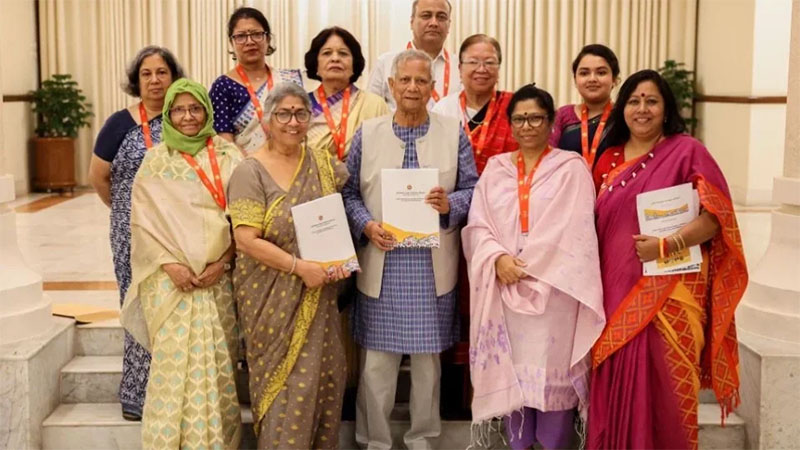
On April 19, the Women’s Reform Commission submitted its report to Chief Advisor Dr. Yunus, who promptly directed relevant ministries and departments for quick implementation. Immediately after, extremist groups including the war criminal party Jamaat-e-Islami, Islami Andolan Bangladesh, and Hefazat-e-Islam began protesting. They allege that these recommendations are anti-Islamic and against the “fundamental principles” of society.
The Qawmi madrasa-based organization Hefazat-e-Islam has labeled this commission “anti-Islam and anti-society” and demanded its dissolution. The extremist group has given the government until May 3 to meet their demands, threatening to launch protests otherwise.
It should be noted that Hefazat emerged by opposing the women’s development policy. In 2013, they held a massive rally at Shapla Chattar in Motijheel as a counter-reaction to Shahbag’s Ganajagaran Mancha, which the government later brought under control. Now, the same extremist group has announced its return to the streets, centering on the Women’s Reform Commission’s report.
What’s in the Reform Commission’s Recommendations?
The Women’s Reform Commission, formed to eliminate discrimination against women and ensure equal rights, recently submitted its final report to Chief Advisor Dr. Yunus. Headed by Shirin Parvin Haque, the 10-member commission’s report was titled: “Identifying Steps to Eliminate Discrimination Against Women at All Levels in All Spheres and Achieve Gender Equality.”
Among the recommendations for establishing women’s rights, the report notably proposes removing discriminatory clauses from the constitution and abolishing the provision of state religion.
The commission recommends implementing a uniform family law to ensure equal rights for women of all religions in marriage, divorce, inheritance, and maintenance. Additionally, it proposes including forced sexual relations within marriage as rape under the law, reforming the language and clauses of rape laws, and ensuring protection for people of all genders.
Addressing violence and harassment against women, the commission calls for refraining from misogynistic language and imagery in social campaigns, emphasizing the need for awareness programs to foster respectful and sensitive attitudes.
Other recommendations include: not criminalizing sex work while ensuring their labor rights, abolishing the death penalty, withdrawing reservations from CEDAW, and ratifying ILO Conventions 189 and 190.
The commission also recommends extending maternity leave to six months across all sectors (like government institutions), introducing fully paid paternity leave, establishing childcare centers in workplaces, and ensuring women-friendly work environments.
To ensure active participation of women in representative politics, the commission proposes increasing parliamentary seats to 600, with 300 reserved for women through direct elections.
Formed on November 18, 2023, the commission included: Mahin Sultan (Senior Fellow, BRAC Institute of Governance and Development), Supreme Court lawyer Fauzia Karim Firoz, Bangladesh Garments and Industrial Workers Federation President Kalpana Akter, women’s health specialist Halida Hanum Akhtar, Bangladesh Women Workers Center Executive Director Sumaiya Islam, former National Human Rights Commission member Nirupa Dewan, Naripokkho Director Kamrun Nahar, Asian Development Bank Senior Social Development Advisor Ferdousi Sultana, and student representative Nishita Zaman Niha.
The report contains 433 recommendations, and relevant ministries and departments have already been instructed to implement them quickly.
Why Are Extremists Objecting?
The day after the Women’s Reform Commission submitted its report, the extremist group Hefazat-e-Islam held an emergency executive committee meeting to reject it. Following the meeting, Hefazat’s Joint Secretary General Mamunul Haq presented five demands at a press conference, claiming that the commission’s proposals offensively described religious injunctions—particularly Islamic inheritance and family laws—as causes of discrimination against women.
The extremist Hefazat condemned the chief advisor’s official Facebook page for promoting the commission’s proposals and demanded their withdrawal.
Mamunul Haq, known for inciting militancy and violence, stated: “We vehemently reject and demand the cancellation of these proposals. We demand the dissolution of this commission for making such controversial, anti-Islamic, offensive to devout Muslims, directly opposed to Islam, conflicting with Quran-Sunnah, and disgraceful proposals. We also demand the withdrawal of the announcement endorsing these proposals on the chief advisor’s Facebook page.”
Announcing a rally at Dhaka’s Suhrawardy Udyan on May 3, Mamunul said: “Our Secretary General has announced this grand rally. We want to send a clear message about its main purpose and demands.”
Hefazat’s demands also include withdrawing cases against its leaders related to violence during protests against Indian Prime Minister Narendra Modi’s Bangladesh visit.
Essentially, Hefazat’s objections center on the commission’s recommendations for equal rights for women in Muslim inheritance and family laws.
The clandestine organization Jamaat-e-Islami also issued a statement calling some recommendations “heinous,” claiming they would push society into extreme instability. Party Ameer Shafiqur Rahman expressed astonishment in the statement: “Some recommendations blatantly violate Quran-Hadith. This will destroy the core values of all religions. The people of Bangladesh will unanimously reject it.”
However, Jamaat did not specify which recommendations they opposed.
Another extremist group, Islami Andolan Bangladesh, led by the Pir of Charmonai, described the report as a “reflection of Western feminist thought.”
The party’s women’s wing leaders stated: “The language and perspective of these reform proposals are incompatible with our society, culture, and women’s religious beliefs. This exposes the commission’s anti-religion mentality.”
They alleged that commission chair Shirin Haque and other members adhere to “one-sided feminist” ideology and do not represent the country’s women comprehensively.
Additionally, the Combined Ulama Mashayekh Parishad rejected the report, stating: “These proposals are a severe attack on religion and culture by so-called Western feminists. If implemented, the interim government will face the same fate as fascists.”
Why Such Persistent Opposition on Women’s Issues?
Although Bangladesh’s constitution declares gender equality, in practice, it often remains only on paper. Various laws—and even some constitutional provisions—contradict the ideal of non-discrimination. Despite repeated state initiatives for women’s rights and development, they consistently face fierce opposition from religious extremists.
After the UN’s “Convention on the Elimination of All Forms of Discrimination Against Women” (CEDAW) was adopted in 1979, Bangladesh signed it but maintained reservations on key inheritance clauses due to religious opposition. The recent Women’s Reform Commission’s recommendation to lift these reservations has reignited old debates.
A look at the history of women’s development policies shows that after the 1995 Beijing World Conference on Women, the Awami League government took the first initiative in 1997 to formulate a women’s development policy. However, various Islamist extremist groups strongly opposed it. Later, in 2004, the BNP-Jamaat government revised the policy. The military-backed caretaker government made further changes in 2008.
When Awami League returned to power in 2009 and revisited the women’s development policy, extremist groups restarted their protests. At the time, even BNP activists joined the opposition. When the policy was finalized in 2011, Prime Minister Sheikh Hasina had to reassure that “the Awami League government will not enact laws contrary to Quran-Sunnah.”
Former Women’s Council President Fawzia Moslem commented at the time: “Fundamentalists have opposed women’s development policies from the beginning. Hefazat’s recent opposition is clear—their 13-point demand includes efforts to halt women’s progress.”
However, interim government advisor Farida Akter, a long-time associate of Farhad Mazhar and executive director of his NGO UBINIG, wrote in her column: “Hefazat claims in its 13 points that the women’s policy is anti-Islamic. But their opposition suggests they are against all forms of women’s development, which they have clarified in various discussions. They should discuss this with their women’s wing and other women’s organizations. When the women’s movement demands policies for all women, we need to hear from Hefazat’s women, not just its male leaders.”
In reality, women’s development initiatives have always faced obstacles from religious extremist groups. This raises the question: Is this opposition to women’s rights purely religious? Or does it reflect deeper cultural and political tendencies to control women?

https://stapravda.ru/20221228/reyting_samyh_populyarnyh_hostingov_v_rossii_196445.html, рейтинг хостингов России подтверждает, что выбор надежного провайдера важен для бизнеса.